When your future depends on the details, every decision matters.
With us, your in good hands.

A strong work permit file can open the door to Canada. A weak file can lead to refusal, delays, lost job opportunities, and expensive re-application. Our goal is simple: help you build the right strategy, submit the right evidence, and move forward with confidence.
Canada offers many different work permit pathways. Some applicants qualify through an employer-specific job offer. Others fit under an open work permit category. Certain cases need a Labour Market Impact Assessment, while others can move under an LMIA-exempt stream such as intra-company transfer, certain free-trade categories, spousal open work permits, or other International Mobility Program options. The right pathway depends on your immigration history, the job, the employer, the exemption code if one applies, and the evidence you can produce.
Because officers review credibility, purpose, compliance, and documentation together, the application has to tell one clear story. We help you put that story together.
A Canadian work permit is the document that authorizes a foreign national to work in Canada under specific conditions. Many people search for this process using different terms such as work permit Canada, Canada work visa, temporary work permit Canada, foreign worker permit, employment authorization Canada, or Canadian work visa. Search language varies, but the legal issue remains the same: you need a properly prepared application that fits the correct program and satisfies IRCC or the border officer reviewing it.
Two broad categories exist. An employer-specific work permit limits you to the employer, location, and role described in the approval. An open work permit allows work for most employers in Canada without tying you to one specific job. The category matters because the eligibility rules, required fees, and supporting evidence can look very different from one file to another. That difference often drives approval or refusal.
• LMIA-based work permits for positions supported by Employment and Social Development Canada.
• LMIA-exempt employer-specific work permits under the International Mobility Program.
• Open work permits for eligible spouses, certain graduates, and other qualifying groups.
• Intra-company transferee applications for executives, managers, and specialized knowledge workers.
• Free-trade and treaty-based categories where available.
• Extensions, restoration applications, and bridging solutions in the right circumstances.
Current fee information matters because fee changes can affect eligibility and filing strategy. Based on the current IRCC fee list, the standard work permit processing fee is $155 per person. The open work permit holder fee is $100 when an open permit category applies. Biometrics are generally $85 per person if required. For many employer-specific LMIA-exempt applications, the employer must also submit an offer of employment through the Employer Portal and pay the $230 employer compliance fee. If someone has lost status and needs restoration as a worker, the restoration fee is $246.25 in addition to the new permit fee.
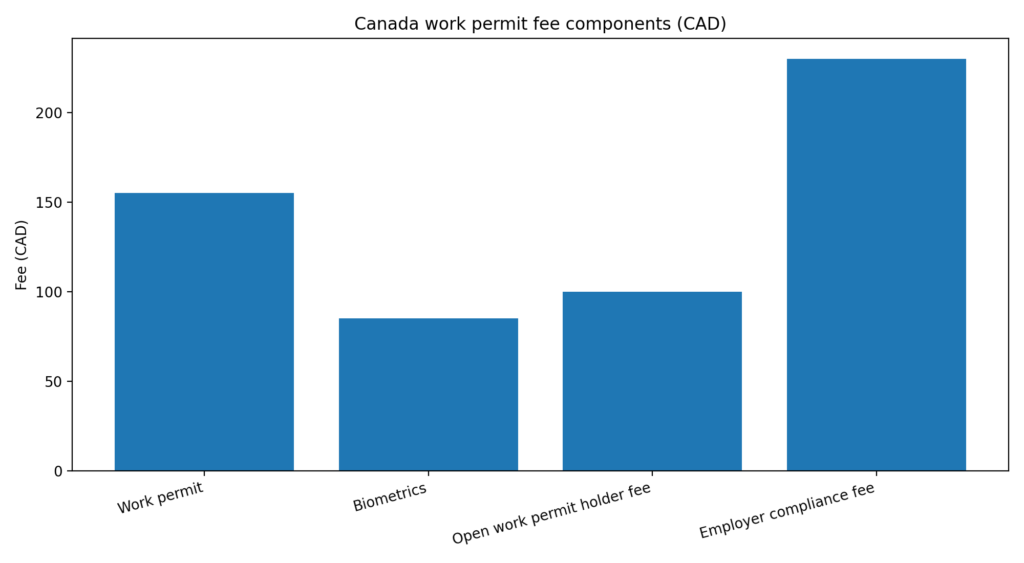
Canada work permit fee components
| Fee item | Amount | Usually paid by |
| Work permit processing fee | $155 | Applicant |
| Open work permit holder fee | $100 | Applicant where applicable |
| Biometrics | $85 | Applicant if required |
| Employer compliance fee | $230 | Employer in many LMIA-exempt employer-specific cases |
| Restoration as a worker | $246.25 | Applicant if restoring status |
Typical worker-side total: $155 to $340+, depending on the category and whether biometrics or open work permit fees apply.
Officers want a coherent application. They look for a real job, a real employer, and a real applicant who can actually do the work. They also look for a clear purpose and compliance with immigration rules. That means your documents should work together instead of competing with each other.
A stronger work permit application will often include a detailed support letter, a properly structured job offer, proof of qualifications, employment letters, education records, a resume that matches the role, financial and identity documents, and evidence that the employer is operating lawfully. Where a permit depends on a specific exemption, the submission should explain why the exemption fits. Where the applicant has a refusal history, the new filing should address those concerns directly rather than pretending they do not exist.
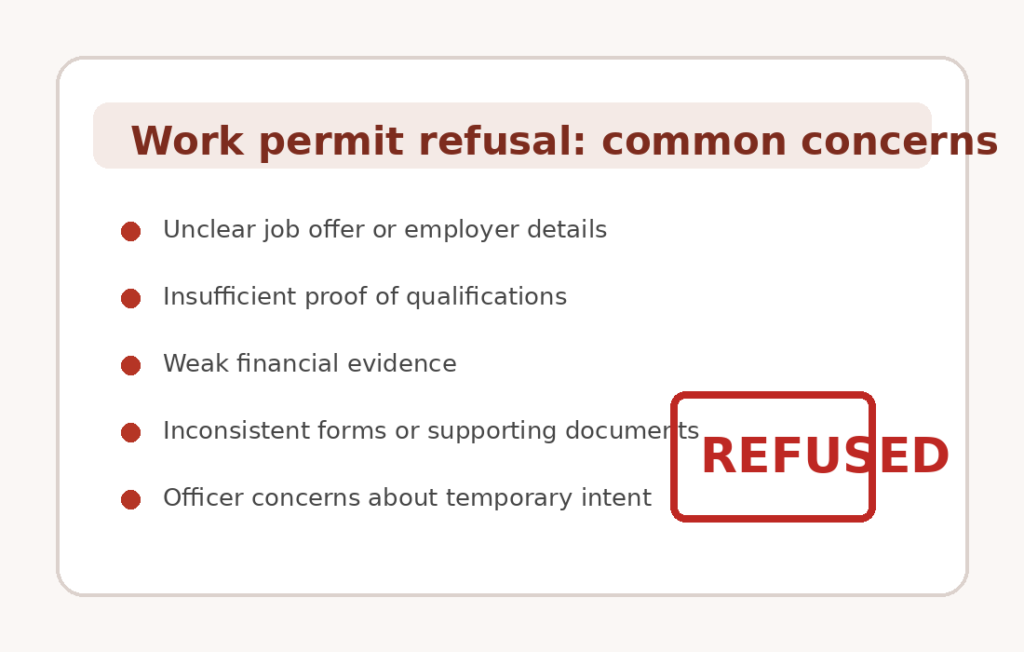
A refusal letter may look brief, but the real issue often sits deeper in the file. Officers refuse Canadian work permit applications when they are not satisfied that the job is genuine, the employer is credible, the foreign national is qualified, or the applicant will comply with the terms of admission. Refusals also happen when supporting evidence does not match the forms, when the wage or duties do not make sense for the proposed occupation, when employment history looks thin or inconsistent, or when the officer believes the purpose of travel has not been explained clearly enough. Some applicants run into problems because they rely on generic templates, weak employer letters, or incomplete records. Others underestimate how damaging even a small inconsistency can become once an officer starts questioning credibility. Financial evidence can also matter, particularly where the applicant must show they can support themselves during travel or initial settlement. Travel history, prior refusals, overstays, or status problems may raise further concern. In many cases, the refusal does not mean the person could never qualify. It means the application failed to persuade the decision-maker. That is why refusal analysis matters. A strong re-application should not simply resubmit the same package with a new payment receipt. It should confront the officer’s concerns, strengthen the narrative, and present better evidence from the beginning.
Purpose influences credibility. In many cases, applicants who are coming to Canada for a defined business purpose present a stronger overall profile than applicants whose plans revolve around leisure alone. A business-related purpose usually comes with structure: meetings, contracts, corporate roles, event schedules, project timelines, or operational goals. That structure can make the trip look more credible and easier to understand. Leisure travel, by contrast, can appear vague when the file lacks a clear plan, strong ties, or a persuasive explanation.
That does not mean business travel guarantees approval or that leisure travel always fails. It means organized, purpose-driven travel often gives the officer more objective reasons to trust the application. In the work permit context, a well-documented economic purpose can be especially helpful because it aligns with the reason the applicant wants to enter Canada in the first place.
• Choose the correct category. Many refusals begin with the wrong program choice.
• Document the employer properly. Business registration, active operations, payroll capacity, and a genuine role can make a major difference.
• Match the applicant to the job. The role, resume, education, and experience should line up clearly and naturally.
• Explain difficult facts head-on. Prior refusals, gaps, status issues, or unusual circumstances should be addressed with strategy, not ignored.
Clients contact our office because they want more than a checklist. They want practical legal guidance, a clear assessment of risk, and a strategy built around the real facts of their case. We help with first-time work permit applications, refused work permits, LMIA-exempt applications, employer-specific filings, open work permits, restoration issues, and broader immigration planning connected to work in Canada.


Immigration appeals allow individuals to challenge a refusal or removal decision through the Immigration Appeal Division or Federal Court in Canada.

A refused visa to Canada occurs when an application is denied due to reasons such as insufficient documentation, weak ties to the home country, or failure to meet IRCC requirements.

Misrepresentation in Canadian immigration occurs when false or misleading information is provided, which can lead to refusal and a potential five-year ban from entering Canada.