When your future depends on the details, every decision matters.
With us, your in good hands.

The Parent and Grandparent Super Visa is a special temporary resident visa for the parents and grandparents of Canadian citizens and permanent residents. It is designed for families that want a longer visit than the regular visitor stream usually offers. A well-prepared super visa file can let eligible parents and grandparents come to Canada for extended visits, maintain family connection, support childcare, help during recovery periods, or spend meaningful time with loved ones without relying on a short standard visitor timeline.
The program appears in search results under many names: parent super visa, grandparent super visa, Canada super visa for parents, super visa for grandparents, family reunification visa for parents, and long-stay visitor visa for parents and grandparents. From a legal and strategic perspective, those phrases all point to the same program. The real issue is not what people call it. The real issue is whether the application package proves eligibility, credibility, financial support, compliant insurance, and respect for Canada’s temporary resident rules.
A super visa applicant must be the parent or grandparent of a Canadian citizen or permanent resident. The application must be made from outside Canada and the visa is issued outside Canada. The host child or grandchild in Canada must provide an invitation letter and must meet the minimum necessary income. The applicant must also complete an immigration medical exam, show private health insurance that meets program rules, and satisfy the officer that the visit is genuine and temporary.
Relationship alone is not enough. Officers assess the whole file. They want a coherent family story, a believable purpose of travel, proper support in Canada, and evidence that the applicant will leave Canada at the end of the authorized stay.
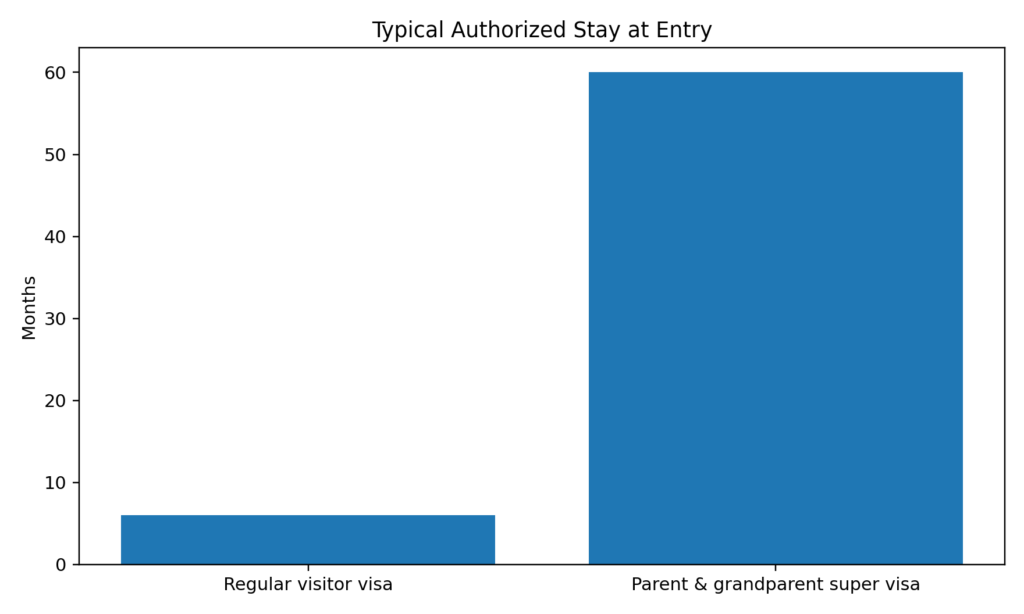
The parent and grandparent super visa is attractive because it can allow up to five years of authorized stay per entry. That is a major difference from the regular visitor pattern and it is one reason families use this route while waiting for other immigration options or while deciding whether permanent residence makes sense later. The longer stay also means the file receives close scrutiny. Officers want confidence that the applicant has adequate support, insurance, and a believable plan.
The host child or grandchild must meet the published minimum income threshold. This section is technical and often misunderstood. Families need the correct family-size calculation, clean tax evidence, and a coherent explanation of who is financially supporting the visit. A weak income package can damage an otherwise strong application.
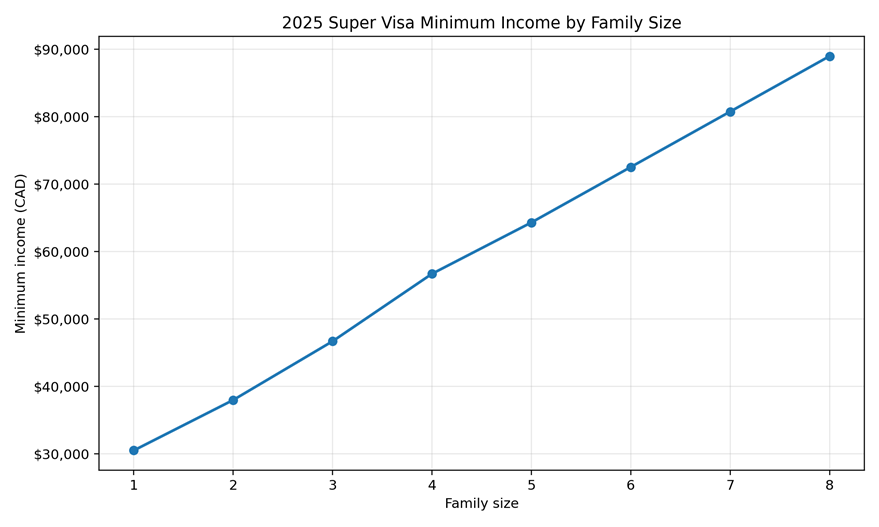
| Family size | 2025 minimum income |
| 1 | $30,526 |
| 2 | $38,002 |
| 3 | $46,720 |
| 4 | $56,724 |
| 5 | $64,336 |
| 6 | $72,560 |
| 7 | $80,784 |
| Each additional person above 7 | Add $8,224 |
Important timing note: IRCC announced that starting March 31, 2026, the super visa income assessment will shift from a one-year review to a two-year review, and visiting parents or grandparents will be allowed to supplement the host’s income in the new framework. Strategic timing can matter where that change may improve eligibility.
The current government fee for the super visa application is CAD $100 per applicant. Biometrics are generally CAD $85 per person, with a family maximum of CAD $170 when family members apply at the same time and place. For visa-exempt travellers who require an eTA to travel by air, the official eTA fee is CAD $7. Medical exams, translations, and private health insurance are not government filing fees, but they are real costs that should be budgeted properly.
| Fee item | Amount | Notes |
| Super visa / visitor visa application fee | CAD $100 | Per applicant |
| Biometrics | CAD $85 | Per person |
| Biometrics family cap | CAD $170 | When applying together |
| eTA | CAD $7 | For visa-exempt air travellers |
The super visa requires proof of private health insurance valid for at least one year from the date of entry to Canada. The policy must come from a Canadian insurance company or from a foreign insurer approved by the minister. Proof of valid insurance is needed on each entry. Families often run into trouble when they buy the wrong insurance product, misunderstand renewal conditions, or fail to show proper proof of coverage and payment.
| Feature | Super Visa | Parent and Grandparent Sponsorship |
| Status | Temporary resident visa | Permanent residence pathway |
| Length of stay | Up to 5 years per entry | Permanent residence if approved |
| Access | Open to eligible applicants | Invitation-based intake |
| Main use | Long family visits | Permanent family reunification |
Current IRCC guidance defines a common-law partner as someone who is not legally married to their partner, is at least 18 years old, and has lived with the sponsor in a marriage-like relationship for at least 12 consecutive months, with only short and temporary absences for reasons such as work or family obligations. Common-law sponsorship remains an active family class pathway. In appropriate cases, sponsored spouses or common-law partners in Canada can also apply for an open work permit while the permanent residence application is processed.
This matters on a super visa page because officers look at the full family picture. When a household has multiple immigration files underway, consistency matters. Addresses, timelines, employment history, and relationship details should line up across every application to avoid credibility concerns.
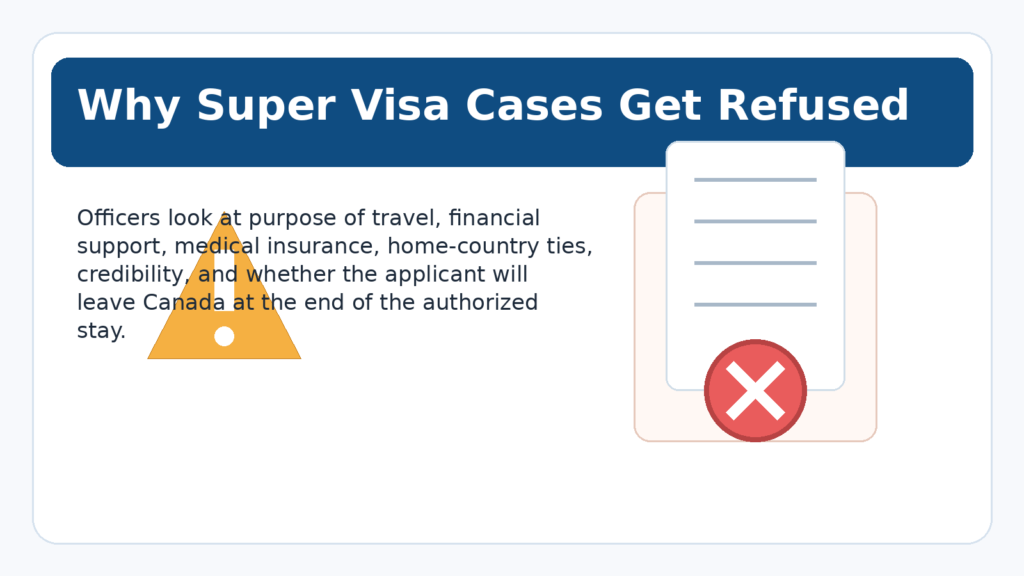
Refusal reasons in super visa cases usually flow from one central issue: the officer is not satisfied that the applicant truly meets the legal test for temporary entry. That concern can appear in several different ways. Sometimes the purpose of travel looks vague, unsupported, or too open-ended. In other files, the income documents are weak, the insurance policy does not meet program rules, the applicant’s home-country ties appear too thin, or the financial and family story does not make sense on paper. Officers may also refuse when they see inconsistent forms, unexplained travel history gaps, incomplete relationship proof, poor explanation letters, or signs that the applicant might remain in Canada beyond the authorized period. A refusal can also follow where the file contains incorrect information, missing details, or contradictions that damage credibility. Strong applications succeed because they answer these concerns before the officer raises them. Weak applications fail because they leave important questions unresolved.
A stronger super visa file starts with a detailed invitation letter that explains the relationship, purpose of travel, expected length of stay, accommodation, and financial support. It also includes clean tax and employment evidence for the host, compliant insurance, medical readiness, passport validity, and a clear documentary package showing the applicant’s ties abroad. Ties can include property, pension records, ongoing employment, business ownership, family obligations, social commitments, or financial assets. When facts are unusual or a refusal already exists, a legal submission can explain the context and reduce the chance of misunderstanding.
Purpose matters because officers assess whether the trip is believable, documented, and consistent with the evidence. In many situations, a structured business-related visit can appear stronger than a loosely documented leisure trip because business travel often comes with employer letters, meeting schedules, financial records, and clearer reasons to return home. That does not mean applicants should misstate their purpose. Accuracy is essential. It means truthful, well-supported purpose of travel almost always performs better than a generic explanation.
If you want your parents or grandparents in Canada for a meaningful, longer stay, do not leave the file to chance. YS Canada Visa Services helps families prepare strategic parent super visa and grandparent super visa applications, deal with prior refusals, and coordinate related family immigration issues. Call us to book your consultation.
This document is for general information and marketing purposes only and is not legal advice. Immigration rules and fees can change.


Immigration appeals allow individuals to challenge a refusal or removal decision through the Immigration Appeal Division or Federal Court in Canada.

A refused visa to Canada occurs when an application is denied due to reasons such as insufficient documentation, weak ties to the home country, or failure to meet IRCC requirements.

Misrepresentation in Canadian immigration occurs when false or misleading information is provided, which can lead to refusal and a potential five-year ban from entering Canada.