When your future depends on the details, every decision matters.
With us, your in good hands.

Canada’s labour shortages continue to affect restaurants, trucking companies, farms, manufacturers, health-related employers, construction businesses, and many other sectors. When a Canadian employer cannot find enough qualified citizens or permanent residents for a role, the Labour Market Impact Assessment process often becomes the key to hiring foreign talent legally. A strong LMIA strategy can open the door to a work permit, faster staffing, and more stable operations. A weak file can trigger a refusal, delay a project, and cost your business valuable time.
YS Canada Visa Services helps employers and workers navigate the LMIA process with strategy, precision, and practical advice. Our team works on Labour Market Impact Assessments, LMIA work permits, positive LMIA files, high-wage and low-wage stream applications, and related immigration matters. We do not treat an LMIA like a basic form package. We build a credible case that speaks to the officer’s real concerns. Book a consultation today if you need help with a Labour Market Impact Assessment in Canada, an LMIA-based work permit, or a refused LMIA file.
A Labour Market Impact Assessment, usually called an LMIA, is an assessment issued through Employment and Social Development Canada that determines whether hiring a foreign worker is likely to have a positive, neutral, or negative effect on Canada’s labour market. In simple terms, the government wants proof that the employer made real efforts to recruit inside Canada and still needs foreign talent for the position. Many people also search for this process using terms such as LMIA Canada, positive LMIA, LMIA application, Labour Market Assessment, Canadian LMIA for employers, or LMIA work permit support letter. Using those search variations matters because employers and workers often use different language while looking for help online.
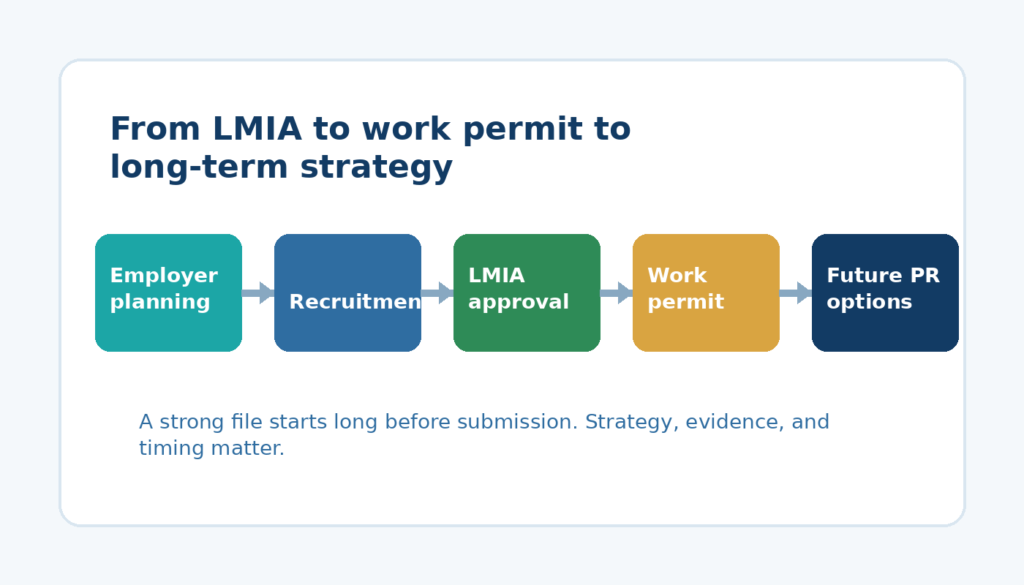
A positive LMIA usually allows the worker to move forward with a work permit application. In most cases, the employer starts the LMIA stage and the worker completes the work permit stage afterward. This distinction matters because employers often assume one approval automatically grants the next step. It does not. The LMIA supports the job offer. The worker still needs to meet immigration requirements when applying for the permit. That is why good planning at the beginning matters so much.
Businesses usually pursue a Labour Market Impact Assessment because they have a real staffing gap that local recruitment has not solved. Some employers need welders, cooks, heavy-duty mechanics, transport drivers, food service supervisors, agricultural workers, early childhood educators, or specialized staff with practical experience that remains hard to find in the local labour pool. Others need a reliable workforce to protect production schedules, customer service levels, and contract deadlines.
Growth also plays a major role. When a business wins new work, opens an additional location, or expands a product line, staffing pressure increases quickly. If the employer cannot fill those roles with Canadians or permanent residents after proper advertising, a Canadian LMIA application may become the most practical route. In that situation, the file must show more than urgency. It must prove recruitment, wages, business legitimacy, and a genuine need for the position.
Not every LMIA follows the same rules. The wage offered for the job often determines whether the position falls under the high-wage stream or the low-wage stream. Some occupations may fit agricultural pathways, the Seasonal Agricultural Worker Program, the permanent resident stream, or the Global Talent Stream. Choosing the wrong stream can weaken the application before an officer even reviews the substance. Employers therefore need to confirm the correct wage threshold, job classification, work location, and stream-specific obligations at the start.
A high-wage LMIA often requires a transition plan that explains how the employer will reduce long-term reliance on temporary foreign workers over time. A low-wage LMIA may trigger additional rules around transportation, housing, or workforce caps depending on the role and context. Global Talent Stream cases can move faster when the employer and occupation qualify. Agricultural streams have their own document requirements and practical expectations. Good legal strategy begins with stream selection because the evidence must match the rules that actually apply.
| Fee or cost | Current amount | Practical note |
| LMIA processing fee | $1,000 per position | Usually paid by the employer at the LMIA stage |
| Work permit application fee | $155 | Usually paid later by the worker when applying to IRCC |
| Biometrics fee | $85 | Often required for the worker, depending on the case |
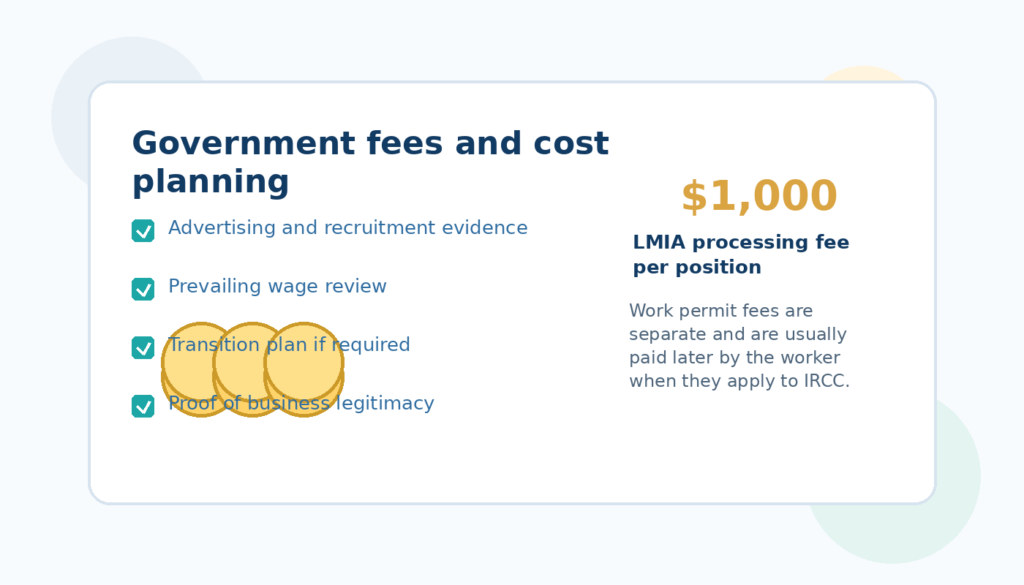
As of the current official federal guidance, the standard LMIA processing fee is 1,000 Canadian dollars for each position requested. That fee usually applies at the employer stage. If an LMIA is required, employers generally do not pay the separate Employer Compliance Fee that applies to many LMIA-exempt work permit cases. For the worker’s later work permit stage, the standard work permit application fee is 155 dollars, and the biometrics fee is usually 85 dollars when biometrics are required. Those work permit fees sit outside the LMIA fee and are commonly paid later in the process.
Real-world budgeting should also include recruitment advertising costs, document preparation time, payroll records, business support documents, translation where needed, legal fees, and any stream-specific expenses such as housing arrangements in certain low-wage or agricultural cases. Employers who treat the government fee as the only cost often underestimate how much detail a proper file requires. A stronger approach builds the case fully the first time instead of paying for avoidable delays later.
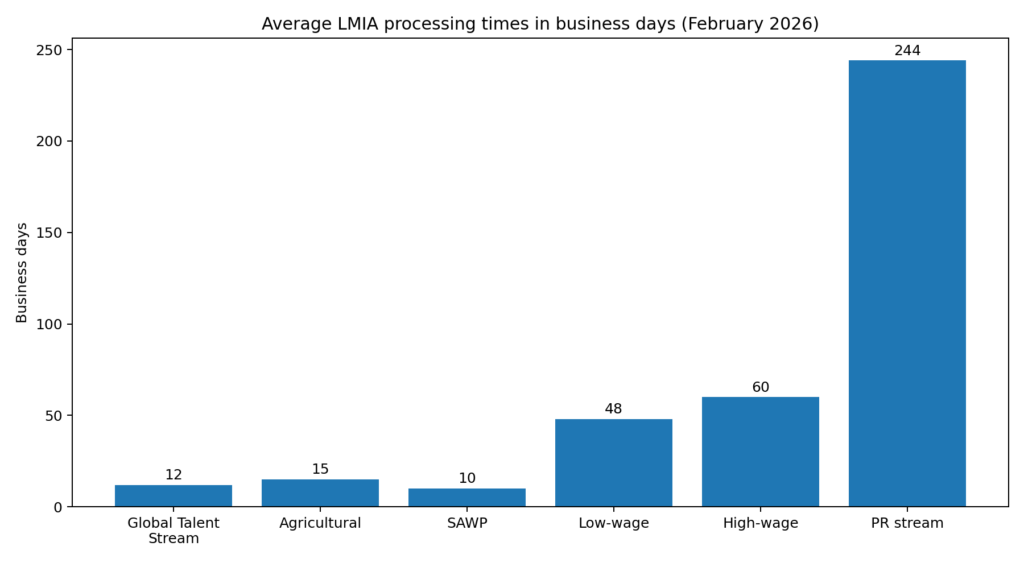
Processing times change frequently, and they vary by stream. Current federal processing information for February 2026 shows average LMIA processing times measured in business days at about 12 for the Global Talent Stream, 15 for the Agricultural stream, 10 for the Seasonal Agricultural Worker Program, 48 for the Low-wage stream, 60 for the High-wage stream, and 244 for the Permanent Residence stream. Those figures help employers plan, but they do not guarantee a result by a fixed date. Incomplete applications, missing signatures, or missing supporting documents can push a file off track quickly.
Smart employers use processing data for planning rather than wishful thinking. If your business has a hard project deadline or seasonal demand, you should not wait until the last minute. Recruitment steps, prevailing wage review, document gathering, and drafting all take time. Our office helps clients map the timeline backward so the file reaches the government in a more organized and defensible form.
Officers reviewing a Labour Market Impact Assessment want to see a genuine business, a real labour shortage, proper recruitment, accurate wages, and a position that makes operational sense. They look closely at whether the employer actively does business in Canada, whether payroll and revenue records support the hiring need, whether the advertisements meet the rules, and whether the job description reflects real duties instead of vague language. Wage issues also matter because the offered pay must align with the prevailing wage rules for the occupation and location.
Credibility runs through the entire file. If one part looks weak, the rest of the application feels weaker too. For example, a well-written recruitment summary will not save a file if the financial records suggest the company cannot actually support the position. In the same way, strong revenue numbers will not cure a poor job description that does not match the National Occupation Classification level or the daily reality of the work. Strong applications feel coherent from start to finish.
Employers can improve approval chances substantially when they prepare the file with evidence in mind rather than hoping the officer fills in the gaps. Start with the job itself. The title, duties, education level, wage, and schedule should reflect the actual role in the business. Then review the prevailing wage carefully and document recruitment in a disciplined way. Save advertisements, invoices, screenshots, posting dates, interview notes, and rejection reasons. Build a clear package that shows why local hiring efforts did not solve the problem.
Business records matter just as much. Officers often expect payroll information, tax records, business licenses, contracts, invoices, corporate documents, or proof of ongoing operations. A transition plan should sound realistic when the rules require one. Your narrative should explain why the role matters now, what the worker will do, and how the hiring decision fits the company’s actual growth or staffing needs. Our office helps employers tighten every part of the file so the evidence supports one clear story instead of a loose pile of documents.
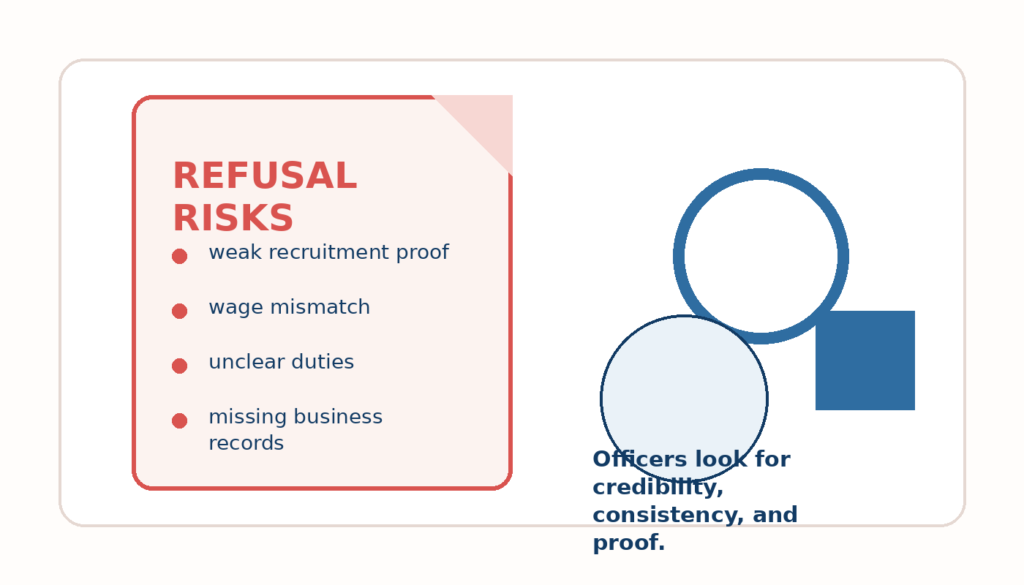
Many Labour Market Impact Assessment applications fail because the file does not persuade the officer that the hiring need is genuine, compliant, and properly documented. Recruitment errors remain one of the biggest refusal drivers. Employers sometimes advertise for the wrong duration, use the wrong platforms, keep poor records, or fail to explain why available applicants did not fit the role. Wage mistakes also create major problems. If the salary falls below the required standard or if the position appears designed to attract a foreign worker on terms that do not match the market, the file will immediately lose credibility.
Business legitimacy forms another major refusal theme. Officers want proof that the company is active, financially stable enough to support the worker, and truly in need of the position. Weak payroll records, thin financials, missing corporate documents, or vague operational explanations often hurt the case. Job descriptions can also sink an application. Titles alone do not prove anything. Duties must match the chosen occupation and the actual work to be performed. If an officer sees generic wording, inflated titles, or responsibilities that do not line up with the business model, refusal risk rises sharply. In some low-wage cases, the government may even refuse to process the application if the role falls above the allowable cap for low-wage positions at the work location. A refusal does not always mean the employer lacked a real need. Quite often, it means the file failed to present that need in a clear, credible, and compliant way. Strong strategy addresses those concerns before submission instead of reacting after a negative result arrives.
YS Canada Visa Services helps employers and workers approach the LMIA process strategically. We understand how officers read a file, where businesses often lose credibility, and how a small mistake in wages, duties, advertising, or evidence can derail the result. Our work focuses on preparation, clarity, and practical problem-solving. We help identify the right stream, organize recruitment proof, review wage compliance, assess refusal risks, and build a stronger narrative before the application goes out.
Clients often contact us after a refusal, but the best time to get advice is before submission. A well-built file can save months of delay, protect contracts, and reduce the cost of repeating the process. Whether you need a first LMIA application, a stronger file for a complex position, or guidance after a refusal, our office is ready to help.
If your company needs to hire foreign talent, if you want help with a positive LMIA strategy, or if you need to rebuild a refused Labour Market Impact Assessment application, book a consultation with us today. We can review the job, the wage, the stream, the evidence, and the practical risks before you move forward. One strong strategy now can save months of stress later.
Call our office to book your consultation and get clear, practical guidance on your LMIA matter.


Immigration appeals allow individuals to challenge a refusal or removal decision through the Immigration Appeal Division or Federal Court in Canada.

A refused visa to Canada occurs when an application is denied due to reasons such as insufficient documentation, weak ties to the home country, or failure to meet IRCC requirements.

Misrepresentation in Canadian immigration occurs when false or misleading information is provided, which can lead to refusal and a potential five-year ban from entering Canada.