When your future depends on the details, every decision matters.
With us, your in good hands.

Canada’s Express Entry system remains one of the most important immigration pathways for skilled workers who want permanent residence. It manages applications under the Federal Skilled Worker Program, the Canadian Experience Class, and the Federal Skilled Trades Program. On paper, the process looks simple. In reality, selection is competitive, documentation standards are strict, and small errors can have serious consequences.
Many people search for the same process using different terms. Some type “Express Entry Canada.” Others search “Canada PR through Express Entry,” “Express Entry immigration,” “Express Entry profile,” “CRS score Canada,” or “skilled worker permanent residence Canada.” A strong landing page should use those natural variations because search engine optimization matters. A strong legal strategy should do the same thing with your file: it should make your facts clear, consistent, and persuasive.
We help clients create stronger Express Entry profiles, improve their CRS strategy, respond to difficult documentation issues, and submit complete permanent residence applications after invitation. If you want focused legal help with Express Entry, call our office today and book a consultation.
Express Entry is IRCC’s online selection and application management system for three major economic immigration programs. First, the Federal Skilled Worker Program targets applicants with qualifying skilled work experience, language ability, education, and settlement readiness. Second, the Canadian Experience Class focuses on candidates who have qualifying skilled work experience in Canada. Third, the Federal Skilled Trades Program serves candidates in eligible trades who meet the rules for that class.
A candidate first creates an online profile. IRCC then assesses eligibility for one or more of the Express Entry programs and places eligible candidates in the pool. After that, the system assigns a Comprehensive Ranking System score, commonly known as a CRS score. IRCC runs rounds of invitations and invites the top-ranked eligible candidates in each round or category. Once a candidate receives an Invitation to Apply, the permanent residence application must be prepared carefully and submitted within the deadline.
The process starts long before anyone clicks submit. A strong profile needs accurate language test results, a proper education credential assessment when required, correct work history details, and a realistic strategy for points. Once the profile enters the pool, the CRS score becomes the central issue. That score can rise or fall based on age, education, language performance, Canadian work experience, foreign work experience, a valid job offer, provincial nomination, family factors, and other profile details.
IRCC continues to use general rounds, program-specific rounds, and category-based selection. Category-based selection now matters even more because IRCC has confirmed current categories that include French-language proficiency, health care and social services occupations, STEM occupations, trade occupations, education occupations, transport occupations, physicians with Canadian work experience, senior managers with Canadian work experience, researchers with Canadian work experience, and skilled military recruits. That means the best strategy is no longer just “get the highest CRS possible.” The better question is “how do we make this profile stronger for the types of invitations IRCC is actually issuing?”
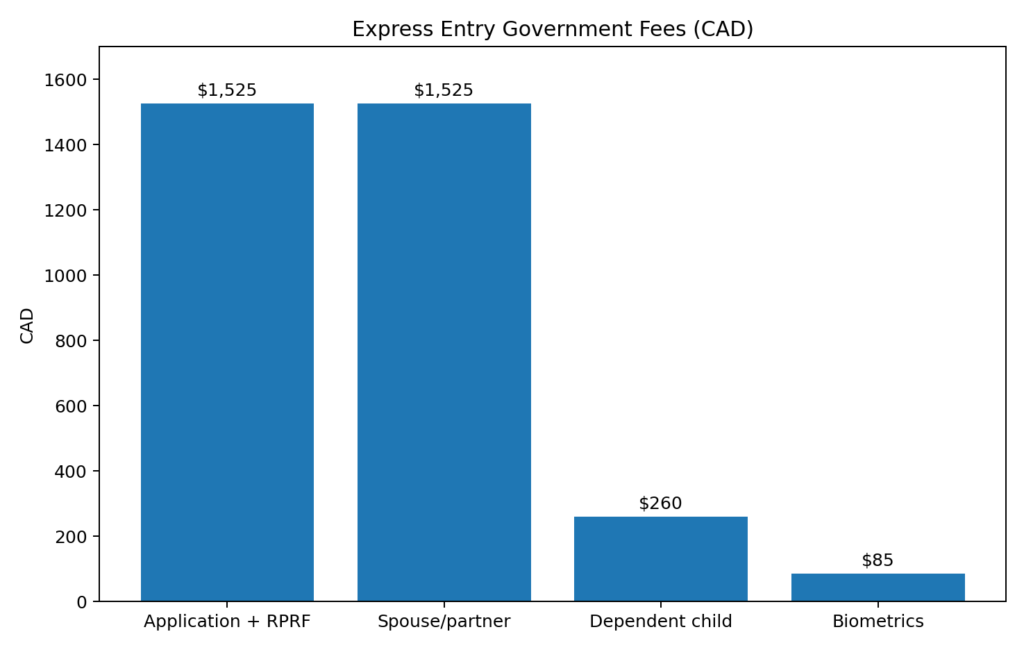
Government fees matter because applicants need to budget accurately from the start. For a principal applicant, the current federal fee is 950 Canadian dollars for processing plus 575 Canadian dollars for the right of permanent residence fee, for a total of 1,525 Canadian dollars. An accompanying spouse or common-law partner currently carries the same combined amount of 1,525 Canadian dollars. A dependent child currently adds 260 Canadian dollars per child. Biometrics start at 85 Canadian dollars per person when they apply.
Applicants should also budget for language testing, educational credential assessments, police certificates, medical exams, document translation, courier or scanning costs, and professional fees. A complete plan reduces stress and helps avoid delays when the invitation arrives.
The graph below gives a simple visual snapshot of the current federal fee structure that many applicants will see during the process. It does not include all third-party costs, but it helps families plan their core filing expenses clearly and early.
Proof of funds remains a major Express Entry issue, especially for Federal Skilled Worker and Federal Skilled Trades applicants. IRCC states that proof of funds is required for those programs unless the applicant is applying under the Canadian Experience Class or is authorized to work in Canada and has a valid Canadian job offer. IRCC also updated the proof-of-funds table in 2025. For one family member, the published amount is 15,263 Canadian dollars. For two family members, it is 19,001 Canadian dollars. For three, it is 23,360 Canadian dollars. For four, it is 28,362 Canadian dollars.
This requirement creates real problems when applicants assume they can show any bank balance at the last minute. The funds must be available, documented properly, and explained clearly. If the money was transferred recently, if the account history looks unusual, or if the documents do not match the declared family size, the application can become much weaker. We help clients review proof-of-funds evidence before the invitation stage whenever possible because a late scramble creates avoidable risk.
A stronger Express Entry strategy starts with the CRS score, but it does not end there. Language results often create the fastest point improvement, so retesting can be one of the most effective moves. Work history should match the right NOC classification and the right duties. Educational records should be reviewed early so there are no surprises at the ECA stage. A provincial nomination can transform the file. A valid job offer may also strengthen the profile depending on the facts. French ability can create a meaningful advantage in the right circumstances.
Beyond points, documentation quality matters. A strong profile becomes even stronger when the later permanent residence application can prove each claim cleanly. We often help clients test their own file by asking a simple question: if IRCC asks for hard proof of every point this profile claims, do the documents already exist? If the answer is unclear, the file needs work before it goes further.
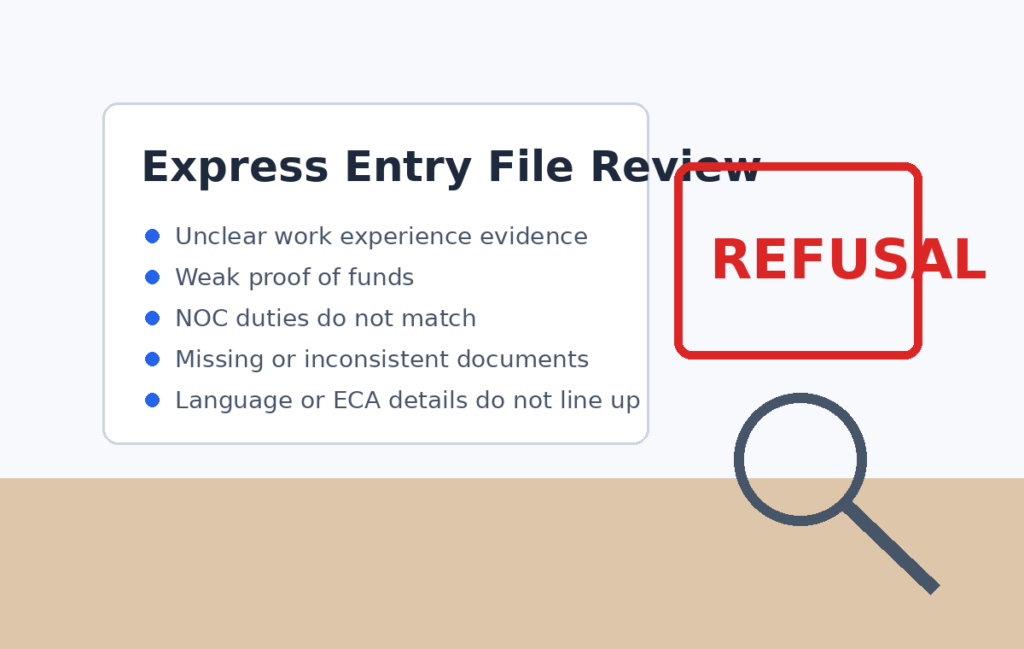
Express Entry refusals happen for many reasons, but most of them fall into a few predictable categories. Some applications fail because the work experience evidence does not prove what the profile claimed. An employer letter may list a title but not the right duties. The duties may not match the chosen NOC. Hours may be unclear. Dates may conflict with tax records, résumés, or old visa applications. When those details do not line up, IRCC may decide that the applicant never proved eligibility or points.
Other applications fail because the supporting documents arrive incomplete, inconsistent, or late. Language scores may expire. Educational records may not match the profile. Police certificates may be missing or outdated. Proof of funds may not be sufficient or may not be explained properly. Family structure details may be wrong. Medical or admissibility concerns may also affect the outcome. One of the most serious problems is misrepresentation. Even when a mistake was not intentional, an inaccurate answer or unsupported claim can still trigger refusal and serious future consequences.
The best way to reduce refusal risk is to build the file with officer review in mind. Every claimed point should have a document behind it. Every major life fact should appear consistently across the profile, the forms, and the supporting evidence. Every work letter should do more than confirm employment. It should prove the precise elements IRCC actually needs. At YS Canada Visa Services, we review Express Entry files strategically because a strong submission does more than complete a checklist. It tells a clean legal story that an officer can verify with confidence.
Our office understands both the ranking side and the evidence side of Express Entry. That matters because many applicants focus only on getting into the pool and forget that the permanent residence application must later prove the profile. We help clients strengthen CRS strategy, review NOC alignment, assess provincial nomination options, prepare cleaner work reference letters, analyze proof-of-funds issues, and respond to refusals or procedural concerns when they arise.
If you want help with Express Entry, Canada PR through Express Entry, CRS score strategy, category-based selection planning, or a refused permanent residence application, call us and book a consultation. The right strategy early can save time, money, and years of frustration later.
| Fee item | Amount | Comment |
| Principal applicant | $1,525 | Processing fee plus right of permanent residence fee |
| Spouse or common-law partner | $1,525 | Same combined amount as principal applicant |
| Dependent child | $260 | Per child |
| Biometrics | $85 | Per person when required |


Immigration appeals allow individuals to challenge a refusal or removal decision through the Immigration Appeal Division or Federal Court in Canada.

A refused visa to Canada occurs when an application is denied due to reasons such as insufficient documentation, weak ties to the home country, or failure to meet IRCC requirements.

Misrepresentation in Canadian immigration occurs when false or misleading information is provided, which can lead to refusal and a potential five-year ban from entering Canada.