When your future depends on the details, every decision matters.
With us, your in good hands.

A Procedural Fairness Letter (PFL) can change the direction of your immigration file in a matter of days. One letter from IRCC may raise concerns about misrepresentation, credibility, admissibility, genuineness, incomplete evidence, or your overall eligibility. That notice is not a routine update. It is your warning sign, your deadline, and your final chance to answer the officer before a refusal lands on your file.
We help applicants respond to fairness letters with speed, structure, and legal strategy. Our team reviews the allegations, identifies the risk level, organizes the evidence, and prepares a response that speaks directly to the officer’s concerns. When the stakes involve a visitor visa, study permit, work permit, permanent residence application, citizenship process, or sponsorship file, every sentence matters.
If you received a Procedural Fairness Letter (PFL) from Canada immigration, do not guess, do not delay, and do not send a rushed explanation. Call us to book a consultation and let us help you protect your future in Canada.
| Topic | PFL response fee | Typical issue | Priority |
| Procedural Fairness Letter | No separate IRCC fee | Officer concern that may lead to refusal | Respond before the deadline |
A Procedural Fairness Letter, often called a PFL, fairness letter, IRCC fairness notice, or procedural fairness notice, is a formal communication from Immigration, Refugees and Citizenship Canada telling you that an officer has concerns that may lead to refusal. The officer must usually give you a fair chance to respond before making a negative decision when those concerns involve information you may not have had an opportunity to address.
The letter will usually describe the issue, outline the concern, and set a response deadline. In some files the concern relates to misrepresentation. In others it may involve weak proof of funds, doubts about the genuineness of a relationship, employment discrepancies, inadmissibility, criminal records, travel history, previous refusals, missing records, or an unclear purpose of travel. Some applicants receive fairness letters after an interview. Others receive them because the documents in the file do not line up.
A PFL does not mean your case is already lost. It does mean the officer sees a problem serious enough to refuse the application unless your response changes that view.
Many people make the mistake of treating a PFL like a simple request for more documents. That approach can backfire. A weak response may confirm the officer’s concerns instead of resolving them. If the concern involves misrepresentation, the consequences can go far beyond one refusal. A finding of misrepresentation can lead to a five-year ban from Canada, problems with future applications, and serious credibility damage across your immigration history.
Quick action matters because deadlines are often short. Some applicants receive only a few days or a couple of weeks to respond. Strong responses need more than emotion. They need a coherent narrative, supporting documents, and legal analysis that addresses the issue point by point.
Procedural Fairness Letters appear in many types of immigration matters. Visitor visa applicants may receive a fairness notice because the officer doubts the purpose of travel, the source of funds, or the applicant’s intent to leave Canada at the end of the visit. Study permit applicants may face concerns about academic purpose, affordability, prior studies, or whether the proposed program makes sense. Work permit applicants may see allegations involving job genuineness, work history, employer documents, or the temporary nature of the stay. Permanent residence files can attract fairness concerns about work experience, relationship genuineness, medical or criminal inadmissibility, undeclared family members, or discrepancies between forms and evidence. Sponsorship and citizenship files can raise fairness issues when timelines, residence records, or supporting documents do not match.
Each type of fairness letter calls for a different response strategy. A misrepresentation allegation needs one approach. A genuineness concern needs another. A criminal inadmissibility issue may require a very different legal roadmap.
There is no separate government fee to respond to a Procedural Fairness Letter itself. The cost issue usually relates to the underlying immigration application.
Common government fees on files that often generate fairness concerns include:
• Visitor visa application: CAD 100
• Study permit application: CAD 150
• Work permit application: CAD 155
• Right of permanent residence fee in many PR cases: CAD 575
Other fees depend on the immigration category, the number of family members, and whether biometrics or additional processes apply. A fairness response has no IRCC filing fee of its own, but the financial risk of a refusal can be much larger than the original application fee because a refusal can delay business plans, travel, studies, reunification, and future immigration options.
| Application type | Current government fee | Comment |
| Procedural Fairness Letter response | No separate fee | The response itself does not carry a standalone IRCC filing fee. |
| Visitor visa | CAD 100 | Biometrics may be additional if required. |
| Study permit | CAD 150 | Biometrics may be additional if required. |
| Work permit | CAD 155 | Some categories may involve additional fees. |
| Right of permanent residence fee | CAD 575 | Commonly relevant in many permanent residence cases. |
Once you receive the fairness letter, the clock starts immediately. First, read the letter carefully and identify the exact allegation. Second, collect every document that answers that allegation directly. Third, compare your response against what is already in the application. A new explanation that clashes with an old form can make the case worse. Fourth, build a clean timeline. Fifth, prepare a legal submission that explains the facts, deals with the officer’s concerns, and highlights the legal standard that should apply.
Strong responses do not bury the key issue under twenty pages of irrelevant material. They stay focused. They answer the concern clearly. They provide evidence that is easy to follow. They also show why the officer should find the applicant credible.
Refusals happen when the officer remains unconvinced after reviewing the file, and that usually happens because the application leaves unanswered questions. In many cases, the real problem is not one dramatic mistake but a pattern of weak presentation. A job letter may not match the applicant’s work history. Bank records may arrive without a clear explanation of how the funds were accumulated. Travel history may not line up with prior forms. A relationship timeline may look sparse, inconsistent, or rushed. Previous refusals may be omitted or described inaccurately. Academic progression may appear illogical. Supporting records may come from sources that look generic, altered, or unreliable. Officers are trained to look for internal consistency, documentary reliability, and overall credibility. Once doubts start building, they spread across the file.
Misrepresentation concerns are especially serious because the officer does not need proof of a grand fraud scheme to raise the issue. An omission, a false answer, a document problem, or a material inconsistency can trigger a fairness letter if the information could affect the decision. Genuineness concerns also appear often in spousal, study, and work files. Officers may question whether a marriage is genuine, whether a job offer is legitimate, or whether a study plan reflects a real educational path. Temporary residence files face another recurring challenge: intent. The applicant must persuade the officer that the trip or stay fits the law and that the person will comply with immigration rules. In that context, a business-focused visit can sometimes present a stronger profile than a leisure visit because business travel often comes with a defined itinerary, meetings, commercial purpose, employer letters, or operational responsibilities that make the purpose of travel easier to verify. Leisure travel can still succeed, but it often needs stronger evidence of ties, finances, and travel purpose. When a fairness letter arrives, your response must close every gap the officer has identified and rebuild confidence in the file.
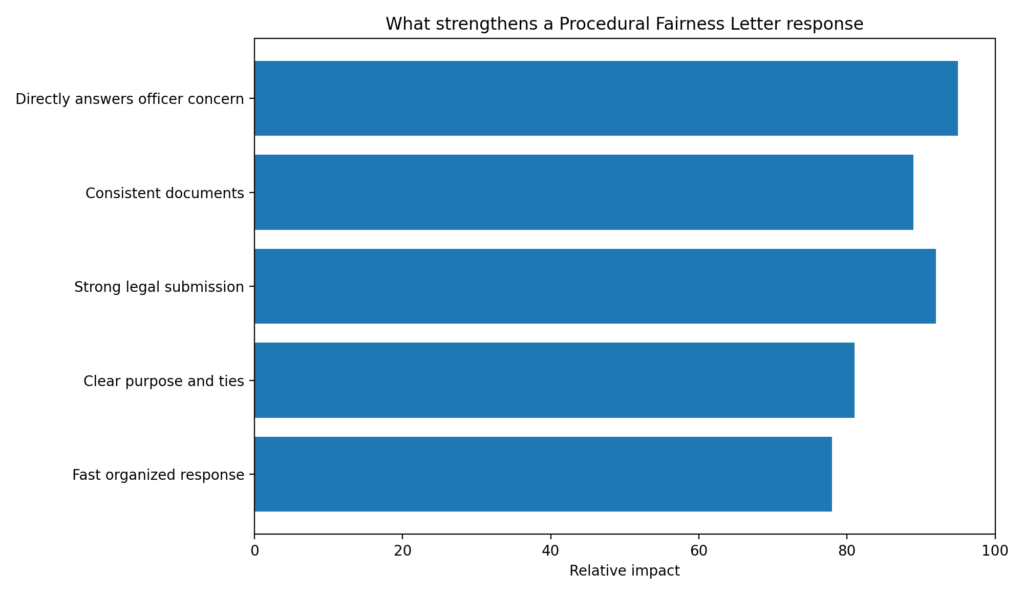
The chart summarizes common factors that help a response persuade an officer. Actual results always depend on the facts, documents, timing, and legal issues in the file.
You can make a Canadian immigration application stronger by thinking like the officer before the officer thinks like a refusal maker. That means checking every form for consistency, disclosing prior refusals honestly, making sure dates line up across every document, explaining unusual facts before IRCC asks, and providing evidence that is specific rather than generic. Strong files also show clear ties, a credible purpose, and a realistic story. If the application is temporary, the officer needs to see why the person will respect the terms of entry. If the purpose is business, show the meetings, conference details, partner communications, event registration, employer support, or commercial obligations. If the purpose is tourism or family travel, present a complete itinerary, financial proof, return plans, work obligations at home, and evidence of continuing ties outside Canada.
Applicants often underestimate the value of chronology. Officers read hundreds of files. A timeline that explains what happened, when it happened, and why it matters can transform a confusing file into a persuasive one. The more serious the concern, the more important it becomes to submit a structured legal response instead of a quick emotional explanation.
Our office handles complex immigration matters every day. We know how to review a refusal risk, spot inconsistencies, and build a response that fits the facts. We do not send generic fairness templates. We analyze the allegation, identify the material issue, organize the evidence, and prepare targeted submissions.
Clients come to us when they receive a misrepresentation fairness letter, a visitor visa fairness notice, a study permit fairness concern, a work permit fairness issue, a sponsorship fairness letter, or a permanent residence fairness allegation. We also assist clients who have already faced refusals and now need a stronger strategy for the next step. The goal is always the same: answer the officer clearly, protect credibility, and improve the chance of approval.


Immigration appeals allow individuals to challenge a refusal or removal decision through the Immigration Appeal Division or Federal Court in Canada.

A refused visa to Canada occurs when an application is denied due to reasons such as insufficient documentation, weak ties to the home country, or failure to meet IRCC requirements.
Misrepresentation in Canadian immigration occurs when false or misleading information is provided, which can lead to refusal and a potential five-year ban from entering Canada.