When your future depends on the details, every decision matters.
With us, your in good hands.

A valid permanent resident card does more than sit in your wallet. It helps you board a flight, prove your status, and move through daily life in Canada with far less stress. Once the card is close to expiry, many people search for PR renewal, permanent resident card renewal, PR card replacement, or renewal of permanent residency documents. Those searches usually lead to the same concern: how do you file a strong application without risking delay, refusal, or a painful request for more evidence?
YS Canada Visa Services helps permanent residents prepare clear, credible, and well-supported PR card renewal applications. Our team reviews your travel history, residency days, identity documents, tax records, address history, and any unusual absences before anything is filed. That approach matters because a renewal application is rarely just a form. It is a legal record that tells Immigration, Refugees and Citizenship Canada, or IRCC, whether you still meet the residency obligation and whether your supporting documents deserve confidence.
Many people use the term PR renewal even though the legal status itself does not simply expire when the card expires. Your PR card is evidence of status, while permanent resident status continues until it is formally lost, renounced, or replaced by citizenship. That distinction creates confusion. Some applicants wait too long because they think an expired card means immediate loss of status. Others rush to file a weak application without checking whether their travel history actually supports approval. Both mistakes can create unnecessary risk.
Our goal is simple. We want visitors to this page to understand the rules, avoid common pitfalls, and call our office to book a consultation before submitting a weak file. When the facts are straightforward, we help you organize a clean application. When the facts are difficult, we help you build a stronger legal strategy.
In everyday language, PR renewal usually refers to renewing a permanent resident card. You may also see people call it PR card renewal, permanent resident card renewal, PR status card renewal, Canadian PR card renewal, or renewal of a permanent resident card. Search engines treat those phrases as related, and so does most of the public. The core issue stays the same: you are asking IRCC to issue a new PR card because your current card is expiring, expired, lost, stolen, damaged, or never received.
A PR card is normally required for commercial travel back to Canada by plane, train, bus, or boat. IRCC also requires applicants to be in Canada when they apply for a PR card because the card is mailed to a Canadian address. If you are outside Canada without a valid PR card, you may need a Permanent Resident Travel Document, called a PRTD, to return. That is one reason timing matters so much. People often discover the problem when an international trip is already booked.
Eligibility also matters. To apply, you generally must have permanent resident status, be in Canada, and meet the residency obligation unless there is a strong legal basis to argue your status should still be preserved. IRCC guidance makes clear that permanent residents generally need at least 730 days in Canada during the last five years, although some time outside Canada can count in limited situations.
Government fees are the easy part. The PR card fee is currently 50 Canadian dollars. The same 50 dollar government fee also applies to a Permanent Resident Travel Document. On paper, that makes PR card renewal look simple and inexpensive. In reality, the true cost usually comes from weak filing strategy, missing documents, inaccurate travel disclosures, or refusal risk.
A low filing fee often gives applicants false confidence. They assume the process is routine, file it themselves, and only seek advice after IRCC raises concerns. We regularly see avoidable problems: unexplained time outside Canada, passport stamps that do not line up with declared dates, old addresses, missing tax records, and incomplete proof of life in Canada. Those issues can slow processing and create deeper credibility questions. A careful consultation at the beginning often saves far more time and stress than it costs.
| Application type | Government fee | Comment |
| PR card renewal or replacement | $50 CAD | Official IRCC filing fee. |
| Permanent Resident Travel Document | $50 CAD | May be needed outside Canada without a valid PR card. |
The biggest legal issue in most permanent resident card renewal files is the residency obligation. In general, a permanent resident must show at least 730 days of qualifying presence in the last five years. Those days do not need to be continuous. Some periods spent abroad can still count, but only in specific situations. For example, time outside Canada may count when a permanent resident accompanies a Canadian citizen spouse or parent, or when the person works abroad for a qualifying Canadian business and meets the legal requirements attached to that category.
The legal test sounds simple, yet the evidence can become messy. Passport stamps are incomplete. People travel through countries that do not stamp on entry. Some clients rely on memory instead of records. Others use airline bookings rather than actual entry and exit dates. IRCC officers look closely at consistency. A minor error does not always destroy a case, but repeated inconsistencies can damage credibility and push an otherwise workable file into a much more difficult position.
This is where legal review matters. A strong PR renewal application should not just list absences. It should tell a coherent story that matches passports, visas, border records, tax history, employment history, residential history, and family ties in Canada. When the dates are tight, every day matters. When the dates are weak, the legal explanation matters even more.
Most people should think about renewal well before travel becomes urgent. Filing early gives you time to gather travel records, correct inconsistencies, and prepare explanations for unusual absences. Waiting until the last minute creates pressure, and pressure produces sloppy applications.
Renewal timing also depends on your personal facts. Some applicants meet the residency obligation easily and only need a clean submission package. Others are close to the 730 day threshold and need a precise day count before filing. Another group has already spent too much time outside Canada and needs legal advice about risk, alternatives, and whether a humanitarian and compassionate argument may be needed if status is challenged.
Business travel can also affect strategy. For urgent processing or return planning, documented business obligations often create a stronger urgency narrative than purely discretionary leisure travel because they show a concrete need to travel and return. That does not replace the residency obligation, and it does not guarantee approval. It simply means that serious commercial obligations can be easier to document and explain than optional tourism. Leisure travel is not negative on its own, but it rarely adds urgency or legal strength to a borderline case.
Processing times change regularly, so any exact number can become stale quickly. IRCC updates its processing information on an ongoing basis and advises applicants to check the current official time before making travel plans. That means no lawyer should promise a fixed turnaround. A complete application, however, almost always moves better than an incomplete one.
Several factors can slow a file. Missing documents can cause return or delay. Complex travel patterns can trigger closer review. Identity questions, name changes, poor image quality, and unexplained absences can all lead to additional scrutiny. Clients often assume a delay means refusal, but delay and refusal are not the same. In many cases, delay simply means the file needs deeper review. Even so, delays can be disruptive when travel, employment, or family obligations depend on a valid card.
A PR card renewal refusal or negative residency finding usually starts with one theme: the officer is not satisfied that the applicant meets the legal requirements. Sometimes the problem is purely mathematical because the person does not have enough qualifying days. In other cases, the problem is evidentiary because the person may have enough days but does not prove them convincingly. Refusal can also stem from credibility concerns, incomplete disclosure, or confusion caused by inconsistent records.
One of the most common refusal patterns involves travel history. Applicants estimate dates instead of verifying them. They forget short trips to the United States. They overlook same day crossings. They count days incorrectly. They list one set of dates on the form and a different set in a supporting letter. Once those conflicts appear, the officer may question the rest of the file.
Another major issue involves weak proof of establishment in Canada. A strong application often includes tax filings, leases, utility bills, school records, employment records, health records where appropriate, bank activity, and other indicators that daily life was centered in Canada. A weak file may contain almost none of that. When a person claims to have lived in Canada but cannot show ordinary signs of living here, the application becomes harder to trust.
Some applications are refused because the applicant filed from a position of panic. They book travel, realize the card is expired, submit a rushed package, and hope the problem resolves itself. That rarely works well. Urgency does not excuse poor evidence. The legal burden remains the same.
There is also a strategic error we see often: people assume any compassionate explanation will automatically save a weak case. Humanitarian and compassionate factors can matter, but they must be detailed, credible, and supported. A vague statement about family stress or work difficulty usually does not carry enough weight. A persuasive case needs facts, documents, timeline, and legal framing.
The refusal discussion should also be honest about travel purpose. For PR card renewal itself, IRCC is not deciding between business and leisure in the same way a visitor visa officer does. Still, where urgent travel, return planning, or documentary urgency is involved, business obligations are often easier to prove because they come with letters, contracts, meetings, operational deadlines, and economic consequences. Leisure travel, by contrast, is usually discretionary. That difference can help explain urgency, but it never cures a residency problem. Good legal advice keeps those categories in their proper place instead of making promises the law does not support.
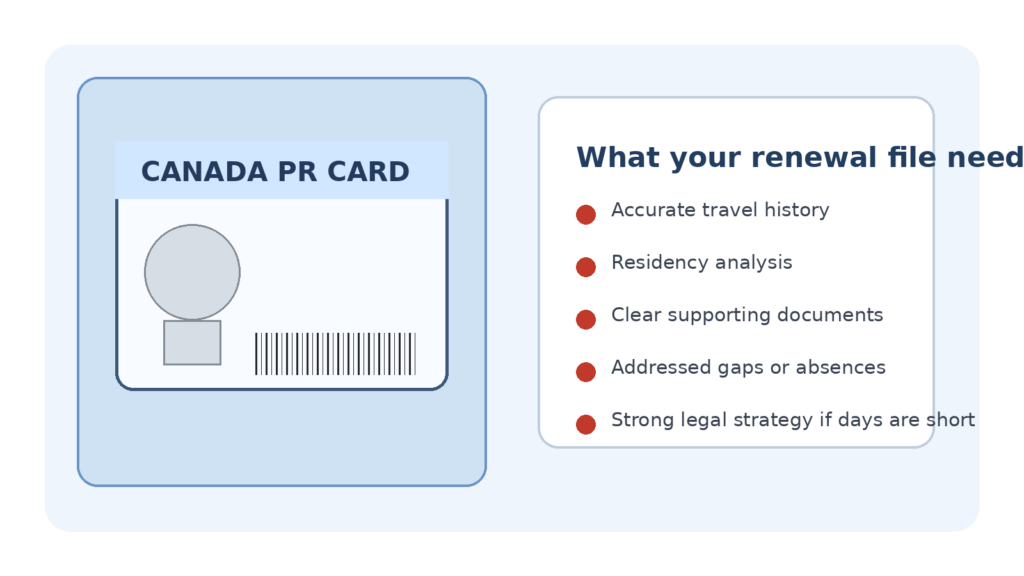
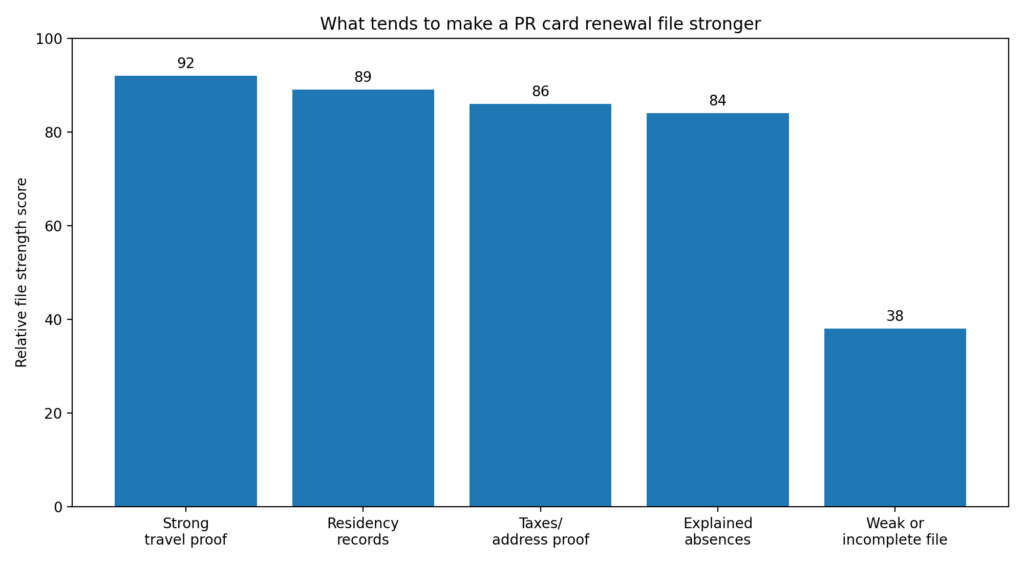
A strong PR card renewal file begins with discipline. First, confirm your exact travel history. Do not rely on memory if better records exist. Review passports, boarding passes, CBSA history where available, calendar entries, email confirmations, and employer records. Build one master chronology, then use that same chronology everywhere in the application.
Second, document your life in Canada. Tax filings, NOAs, pay stubs, T4s, leases, mortgage statements, utility bills, school records, business records, and banking activity can all help show where you genuinely lived. Not every case needs every document, but most strong files include a carefully chosen set of records that point in the same direction.
Third, explain the difficult facts instead of hiding them. If you spent long periods abroad, address those absences directly. If a passport stamp is missing, say so and explain how you reconstructed the date. If you travelled for an ill parent, a foreign work assignment, or a major family event, set that out clearly. Officers notice what is missing. They also notice when a file avoids obvious questions.
Fourth, organize the application like a legal submission, not a pile of paper. Clean indexing, short explanations, consistent dates, and sensible grouping of evidence make a real difference. Officers review many files. A package that is easy to follow gives your evidence a better chance to do its job.
Finally, get advice early when the math is tight. Once a borderline case is filed badly, the legal path forward becomes harder. A careful review before submission may show that waiting a little longer, gathering better evidence, or taking a different strategic approach would produce a much safer result.
Important: For PR card renewal itself, business travel does not replace the residency obligation. In urgent travel or return-planning contexts, documented business obligations can simply be easier to prove than optional leisure travel.
Long absences do not automatically end permanent resident status, but they create risk. Some people remain permanent residents on paper even after spending significant time abroad. The real problem appears when they need official proof of that status, return to Canada on a commercial carrier, or face a formal residency examination. At that point, every absence becomes relevant.
Cases involving long absences require much more than form completion. They need a day count, a review of whether any foreign time qualifies under the law, and a realistic analysis of exposure. In some situations, the best next step may be renewal from within Canada after sufficient time has been rebuilt. In other situations, a person outside Canada may need a PRTD and should understand the risk before filing. Strategy changes from case to case. That is exactly why consultation matters.
Humanitarian and compassionate considerations do not replace the residency obligation in ordinary renewal cases, yet they can become extremely important when status is in danger and the facts deserve relief. These cases are never one size fits all. A persuasive humanitarian argument usually depends on the whole picture: the reason for the absence, the person’s efforts to return, the degree of establishment in Canada, the impact on children, family dependency, medical evidence, business commitments, and the hardship that loss of status would create.
A serious humanitarian case is built, not improvised. Dates must line up. Documents must support the narrative. The legal submission must explain why fairness and compassion should influence the decision. Weak H and C arguments often fail because they remain general. Strong ones are specific, evidenced, and tightly connected to the legal problem in the file.
An expired PR card outside Canada can create immediate travel problems. Airlines and other commercial carriers usually want valid proof that allows boarding to Canada. If you are abroad and do not have a valid PR card, you may need a Permanent Resident Travel Document. That application can trigger a review of the same residency issues discussed on this page.
People often underestimate this situation. They assume the airline will accept an expired card, a COPR, or a verbal explanation. That is risky. Once travel plans, family emergencies, or work commitments are involved, the pressure builds quickly. Professional advice can help you decide whether to apply for a PRTD, whether you have the residency days to support it, and what evidence should go into the package.
YS Canada Visa Services does not treat PR renewal as a generic form service. We treat it as an immigration matter that can affect status, mobility, and future planning. Our office reviews the legal framework, the day count, the travel evidence, the pattern of life in Canada, and the practical risks connected to travel or delayed processing. We then help the client file a package that is accurate, coherent, and strategically sound.
Clients contact us for many reasons. Some need simple renewal help. Others have lost the card and need replacement guidance. Many are worried about days outside Canada. Some are abroad and do not know whether to pursue a PRTD. Business owners may need faster planning because meetings, contracts, site visits, or operational decisions require travel. Families may need help because children are settled in Canada and the consequences of a status problem would be severe. Every one of those situations deserves a tailored plan, not a recycled checklist.
Can you renew a PR card after it expires? Yes. An expired card does not automatically erase permanent resident status, but it can make travel and proof of status much harder.
Do you lose PR status the moment the card expires? No. Permanent resident status and the validity of the card are different issues. Status can still be lost through a formal legal process, failure to meet the residency obligation, renunciation, citizenship, or inadmissibility.
Can you apply for a PR card from outside Canada? In general, the PR card application itself must be made from inside Canada because the card is delivered to a Canadian address. People outside Canada often need a PRTD to return.
What if your days are close to 730? That is exactly when legal advice matters most. A careful count and evidence review can prevent a damaging filing mistake.
Is business travel better than leisure travel? For residency calculation, the law does not simply reward business travel. For urgent processing requests or return planning, however, documented business obligations can be easier to prove than optional leisure trips. That difference may help with urgency evidence, but it does not fix a legal deficiency in residency days.


Immigration appeals allow individuals to challenge a refusal or removal decision through the Immigration Appeal Division or Federal Court in Canada.

A refused visa to Canada occurs when an application is denied due to reasons such as insufficient documentation, weak ties to the home country, or failure to meet IRCC requirements.

Misrepresentation in Canadian immigration occurs when false or misleading information is provided, which can lead to refusal and a potential five-year ban from entering Canada.