When your future depends on the details, every decision matters.
With us, your in good hands.

Canada offers a valuable LMIA-exempt option for eligible citizens of the United States and Mexico who want to work in Canada through a trade-based category. Many people still search for a NAFTA work permit, while Canadian government materials now use the term CUSMA work permit because the Canada–United States–Mexico Agreement replaced NAFTA. Both phrases point to the same practical goal for most applicants: a faster route to work authorization in Canada when the facts fit the rules.
YS Canada Visa Services helps professionals, business visitors, investors, traders, and multinational employees prepare strong cross-border work permit files. Our goal is simple. We want to present a clear application that answers officer concerns before those concerns turn into refusal reasons. If you need help with a NAFTA visa for Canada, a CUSMA professional work permit, or an LMIA-exempt work permit under the trade agreement, call our office and book a consultation today.
A NAFTA work permit is the common search term many applicants still use for the Canadian work authorization issued under CUSMA. In practical terms, this category lets certain U.S. and Mexican citizens work in Canada without a Labour Market Impact Assessment. That matters because LMIA processes often add time, cost, and employer burden. Under the right facts, CUSMA can create a cleaner path.
You may also see search terms such as CUSMA work permit, Canada NAFTA professional visa, Canada work permit for Americans, Canada work permit for Mexicans, treaty-based work permit, or LMIA-exempt professional work permit. A strong landing page should use natural keyword variation, so this page uses several of those terms to support search visibility while still reading like a real human explanation.
Canadian employers often prefer this route because it can reduce friction. Applicants often prefer it because it can lead to a faster and more strategic application. Our office helps clients decide whether their case fits a professional category, an investor or trader category, a business visitor category, or an intra-company transfer category.
Eligibility depends on the exact category. Professionals typically need a qualifying profession, appropriate credentials, and a genuine Canadian job offer that matches the listed role. Intra-company transferees usually need a qualifying corporate relationship and a transfer into an executive, managerial, or specialized knowledge position. Traders and investors need evidence of qualifying trade or investment activity. Business visitors must show that they are entering for permitted business activities rather than entering the Canadian labour market directly.
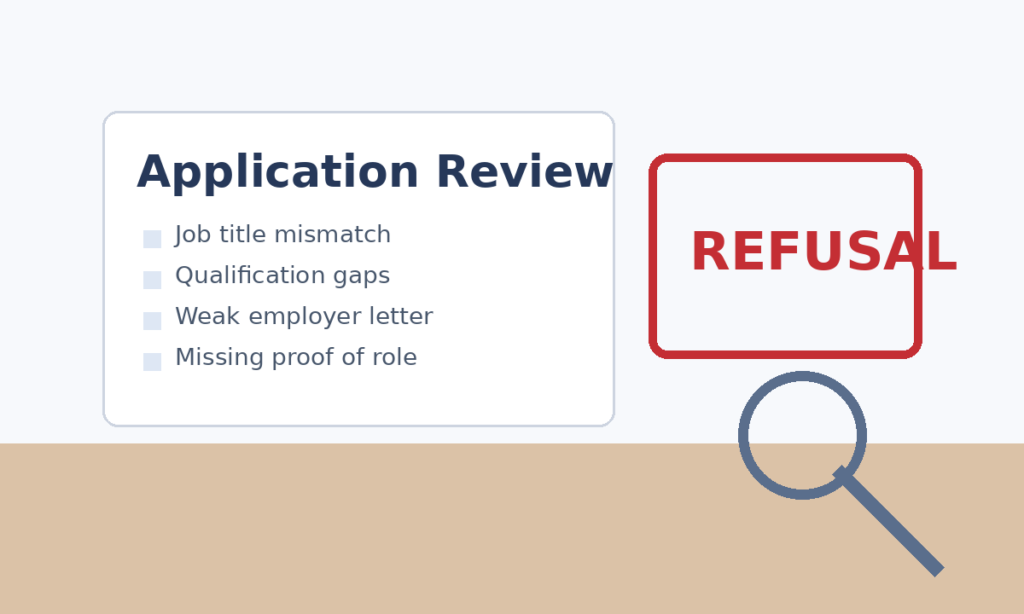
That distinction matters. Officers do not approve these applications based on labels alone. They review the substance of the job, the real duties, the employer support documents, and the applicant’s background. If the role sounds like one profession but the duties look like another, the file weakens. If the education does not match the occupation, the case may stall or fail. If the company letter is generic, the officer may question whether the offer is genuine. A persuasive file does not leave those questions unanswered.
Employers and workers like the NAFTA or CUSMA work permit route because it can eliminate the LMIA step, simplify the process, and support time-sensitive business goals. Companies use it to move talent quickly, launch projects, support Canadian clients, transfer internal expertise, and create smoother North American mobility. Professionals use it to accept Canadian opportunities without starting from zero.
A well-prepared trade-based work permit can also fit into a broader immigration strategy. Some clients come for a short assignment and later explore permanent residence. Others need immediate work authorization first and then build long-term options. That is why strategy matters from day one. The initial work permit should not solve only the next month. It should support the next chapter as well.
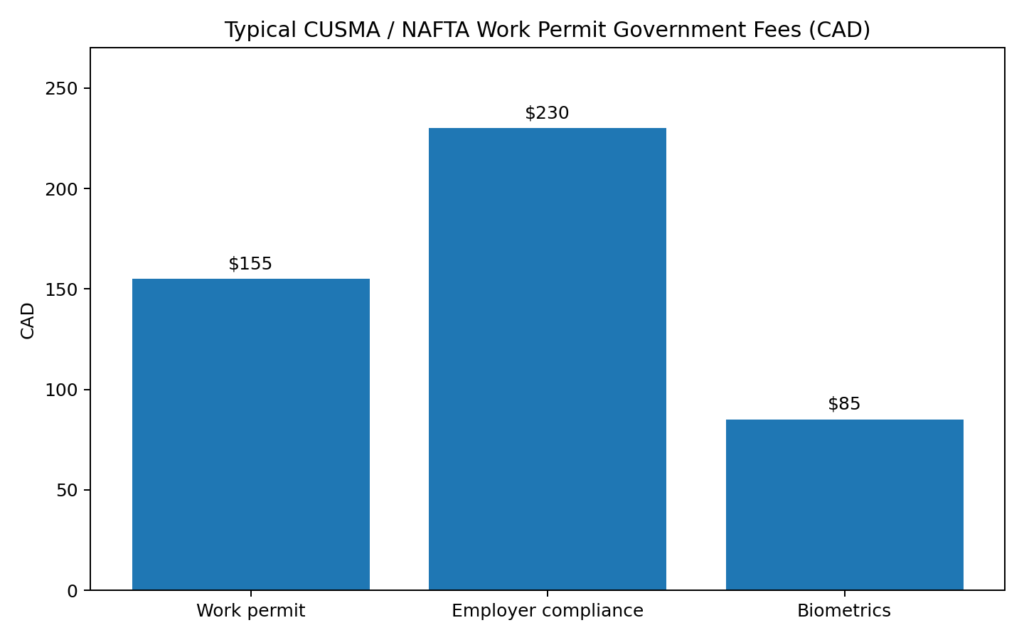
Government fees form only one part of the overall planning, but they still matter. As of the latest official guidance, the standard work permit processing fee is 155 Canadian dollars. When the case is employer-specific and processed through the International Mobility Program, employers usually pay a 230-dollar employer compliance fee through the Employer Portal. If biometrics are required, the biometrics fee starts at 85 dollars per person. Those figures affect budgeting, employer planning, and filing strategy.
Legal fees, translation fees, credential gathering costs, and travel planning costs can add to the total. We review the full picture with clients before filing so there are no surprises halfway through the process.
Purpose matters in immigration. Officers want to understand why you are coming to Canada, what you will do here, how long you plan to stay, and whether your documents support that purpose. Business-related entry often looks stronger because it usually comes with structure. There is a client, a meeting, a work assignment, a timeline, a job description, a project, or a commercial objective. Leisure travel, by contrast, may look more open-ended and less connected to a defined legal category.
That does not mean tourism is bad. It means structured business purpose often answers more officer questions up front. In a NAFTA or CUSMA file, a clearly documented business purpose can strengthen credibility. When the job offer, employer letter, corporate documents, credentials, and cross-border rationale line up, the case becomes easier to understand and easier to approve.
Strong files share common traits. They define the category clearly. They match the job to the correct profession or treaty category. They show the applicant’s qualifications in a clean and organized way. They explain what the Canadian employer needs and why this role fits the trade agreement. They maintain consistency across forms, letters, résumés, contracts, and supporting records.
We often strengthen applications by rewriting employer support letters, clarifying job duties, tightening credential evidence, and drafting legal submissions that explain exactly why the category applies. We also review travel history, prior refusals, border issues, and credibility risks. Those details can shape the outcome. One vague letter can weaken a good case. One sharp, well-supported explanation can change the file completely.
Refusals happen for reasons that are often predictable. In many cases, the problem is not that the applicant had no chance. The problem is that the file did not explain the chance properly. Officers may refuse a NAFTA or CUSMA work permit when the occupation does not fit the treaty category, when the credentials do not support the role, when the employer’s letter is too vague, when the job duties drift away from the listed profession, or when the overall purpose of entry remains unclear. Some cases fail because the applicant tries to stretch a category too far. Others fail because the documents are technically correct but strategically weak. An officer reviewing a border application or an online work permit file has limited time. If the business purpose sounds loose, the employment relationship looks thin, or the paperwork creates more questions than answers, refusal becomes much more likely. Prior refusals, inconsistent timelines, weak evidence of qualifications, poor explanation of specialized knowledge, or confusion between business visitor activity and actual work can also trigger negative decisions. The strongest way to reduce refusal risk is to build a file that is specific, organized, and persuasive. Every supporting document should point in the same direction. Every letter should explain something useful. Every factual detail should reinforce credibility. Our office prepares applications with that standard in mind because a strong file does more than submit forms. It tells a coherent legal story officers can follow with confidence.
Our firm understands business immigration, border strategy, work permit refusals, and the practical realities that employers and professionals face. We do not treat a treaty-based work permit like a form-filling exercise. We treat it like a legal presentation that must stand up to officer review.
Clients work with us because we identify weak points early, fix documentation issues before filing, and build applications that align the facts with the law. If you need help with a NAFTA work permit, a CUSMA professional application, a Canada work permit for a U.S. citizen, a Canada work permit for a Mexican citizen, or an intra-company transfer under the trade agreement, call our office to book a consultation.
A strong NAFTA or CUSMA work permit application can save time, avoid refusal, and protect long-term immigration options. A weak file can do the opposite. If you want help preparing a professional, strategic, and approval-focused application, contact YS Canada Visa Services today. Book a consultation and let us help you move forward with confidence.
| Fee item | Amount | Comment |
| Work permit processing fee | $155 | Standard filing fee |
| Employer compliance fee | $230 | Usually paid by the employer in employer-specific IMP cases |
| Biometrics fee | $85 | Applies if biometrics are required |


Immigration appeals allow individuals to challenge a refusal or removal decision through the Immigration Appeal Division or Federal Court in Canada.

A refused visa to Canada occurs when an application is denied due to reasons such as insufficient documentation, weak ties to the home country, or failure to meet IRCC requirements.
Misrepresentation in Canadian immigration occurs when false or misleading information is provided, which can lead to refusal and a potential five-year ban from entering Canada.