When your future depends on the details, every decision matters.
With us, your in good hands.

The Canadian Experience Class, often called CEC, remains one of the strongest permanent residence pathways for people who already built real work history in Canada. It sits inside Express Entry and rewards candidates who can show recent skilled Canadian work experience, valid language results, and a file that matches the legal requirements. Many people search for Canadian Experience Class Canada, CEC Express Entry, CEC immigration Canada, Canada PR through work experience, or permanent residence after Canadian work experience. A strong landing page should use those natural variations for search engine optimization, and a strong legal application should do the same thing with your facts: make every part of the case clear, consistent, and persuasive.
We help clients prepare Canadian Experience Class applications with strategy instead of guesswork. We review work history, National Occupation Classification alignment, reference letters, language scores, admissibility issues, and Express Entry profile details before small mistakes turn into major refusal problems. If you want help with a Canadian Experience Class application, call today to book a consultation.
Canadian Experience Class is an Express Entry program for skilled workers who gained qualifying work experience in Canada and now want permanent residence. Official IRCC guidance says applicants need at least one year of skilled work experience in Canada within the last three years, must meet the language requirement that matches the job’s TEER level, and must plan to live outside Quebec. The work experience must be authorized and must fit the program rules. Work experience gained without authorization does not count, and self-employment or work completed while you were a full-time student usually does not count toward CEC eligibility under IRCC’s current framework.
That legal structure makes CEC attractive because it focuses on Canadian work history. In practical terms, the program rewards people who have already contributed to the labour market in Canada. It also fits many temporary residents who started with a work permit, a post-graduation work permit, or another authorized pathway and now want to move from temporary status to permanent residence.
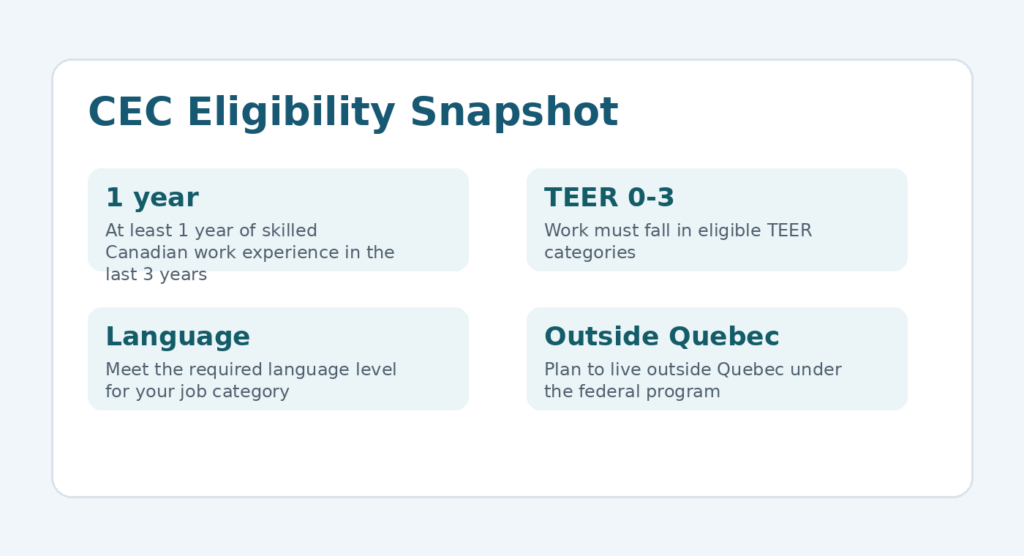
Eligibility sounds simple on paper, but officers and processing teams still look closely at the evidence. A strong CEC file usually needs qualifying Canadian work experience in the last three years, correct NOC or TEER alignment, the required language score, accurate personal history, and consistent supporting records. The job duties matter far more than the title. A person can call themselves a manager, analyst, coordinator, or specialist, but the application still rises or falls on what the documents actually prove.
Applicants also need to be admissible to Canada. Criminal issues, prior misrepresentation, unresolved medical concerns, or inconsistent immigration history can all complicate a Canadian Experience Class application. A legal review early in the process often saves time because it identifies whether the file needs a straightforward submission or a more strategic package with additional explanation.
Canadian Experience Class remains popular because it gives real value to Canadian work experience, and it often suits candidates who already understand life and work in Canada. Unlike some other Express Entry pathways, proof of settlement funds is generally not required for CEC candidates. That alone makes the program more accessible for many workers inside Canada. CEC also stays important because category-based draws and changing invitation patterns can favour people already contributing to the Canadian economy.
IRCC announced in February 2026 that Canadian Experience Class draws continued through early 2026 to prioritize candidates already contributing to Canada’s economy. That does not guarantee an invitation for every candidate, but it confirms that CEC remains part of current Express Entry strategy. Applicants who already have Canadian work history should pay close attention to that signal and make sure their profiles are strong before the next opportunity appears.
CEC is not a stand-alone paper process. It works through the Express Entry system. First, a candidate creates a profile. Next, IRCC assigns a Comprehensive Ranking System score. After that, the candidate waits in the pool until an invitation arrives through a general round, a program-specific round, or a category-based round. Once invited, the candidate files the permanent residence application with supporting records.
That sounds straightforward, but every stage affects the outcome. A weak profile can miss an invitation. A strong profile with poor documentation can attract an invitation and still fail later. A careful legal strategy looks at both stages together. It aims to improve the candidate’s chance of receiving an invitation and then prepares the evidence needed to support the application after the invitation arrives.
The latest official rounds information published by IRCC shows a Canadian Experience Class draw on February 17, 2026, with 6,000 invitations issued and a CRS cut-off score of 508. The general rounds page also shows a March 18, 2026 round with 4,000 invitations and a CRS cut-off of 393, although that was not a CEC-specific round. These numbers matter because they give candidates a real sense of competition in the pool and show why profile improvement still matters.
A strong CEC strategy does not rely only on hope. It looks at the current rounds, current category-based selection policies, language points, Canadian work history, possible arranged employment points, spouse factors, and profile accuracy. Even small score improvements can become decisive when the cut-off stays tight.
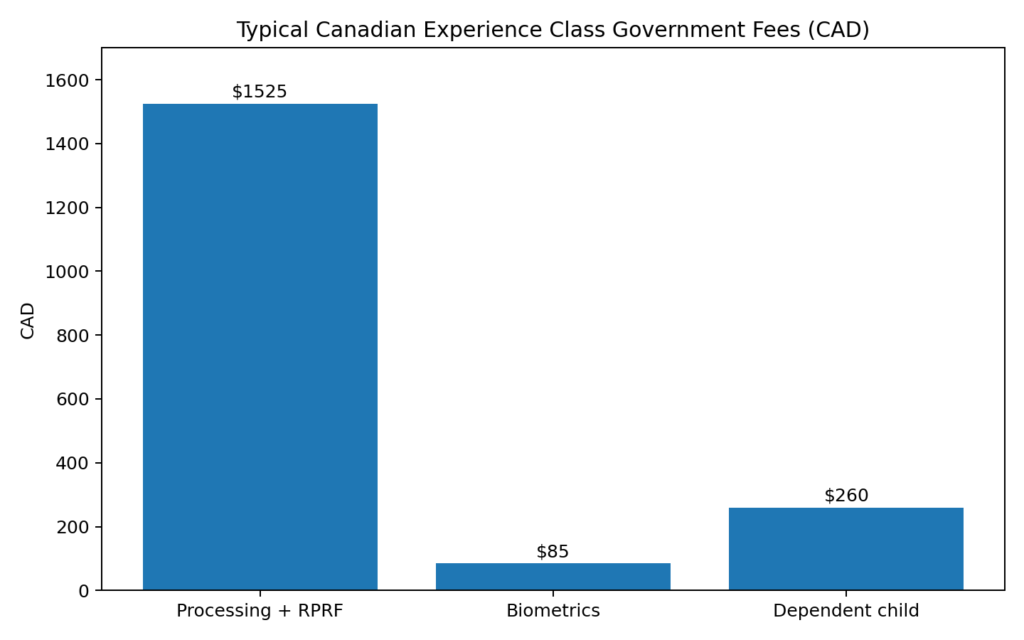
Current IRCC fee guidance lists the permanent residence processing fee and right of permanent residence fee together at 1,525 Canadian dollars for the principal applicant. The same combined amount applies to an accompanying spouse or common-law partner. The fee for each dependent child is 260 dollars, and biometrics start at 85 dollars per person. Those are core government fees. Applicants may also pay for language testing, educational credential assessments when relevant, police certificates, medical exams, and legal representation.
Fee planning matters because a rushed application often becomes an expensive application. We review the full cost picture with clients before filing so there are no surprises once an invitation arrives.
Strong CEC files do not rely on generic employment letters or broad statements. They prove the details. A stronger application will usually include detailed reference letters that confirm job title, dates, hours, pay, and duties. It will align those duties with the claimed NOC or TEER category. It will preserve valid language results through the filing stage. It will explain gaps, overlaps, and status issues before IRCC asks questions.
We also look beyond the obvious. Some files need careful attention to work-permit history, implied status periods, payroll support, tax records, promotions, business travel, leaves of absence, or employer closures. Others need a misrepresentation-risk review because old applications contain inconsistent employment dates or education details. A precise legal strategy can strengthen a file before an officer ever reads it.
Many Canadian Experience Class candidates also ask about spouses and partners, especially where a spouse or common-law partner may accompany them or may affect CRS points. IRCC’s current help-centre guidance says a common-law partner is someone who is at least 18 years old, is not legally married to you, and has lived with you in a conjugal relationship for at least 12 consecutive months. Short and temporary absences, including work or business travel, can still fit within that definition.
That definition matters because family composition affects both profile accuracy and permanent residence processing. If a candidate claims to be single while meeting the common-law definition, the risk becomes serious. Accuracy here is not optional. It is critical.
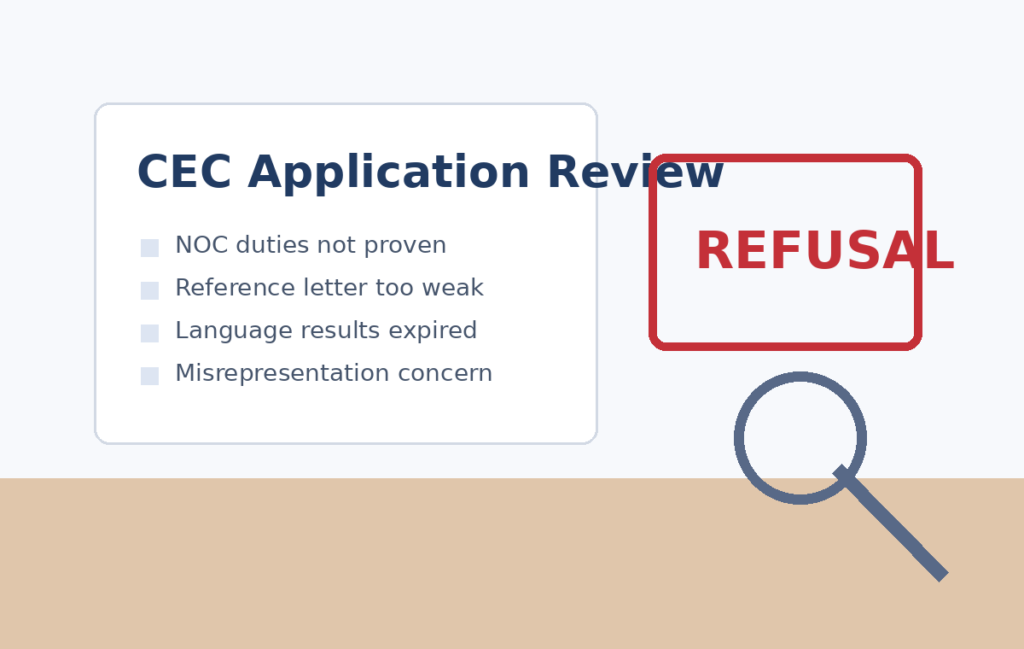
Canadian Experience Class refusals often happen because the file leaves too many questions unanswered. The most common problem is weak proof of work experience. Officers want more than a title on company letterhead. They want a real picture of the role: duties, dates, hours, wages, and evidence that the work was authorized and skilled. If the duties do not line up with the NOC or TEER category, the application can fail even when the candidate honestly worked in Canada. Reference letters that are vague, missing, inconsistent, or obviously drafted without detail can weaken the case fast. Language results can also cause problems if they expire or do not meet the required threshold. In other files, the refusal grows out of misrepresentation concerns. That can happen where dates do not match old applications, where foreign and Canadian work history overlap in a way that makes no sense, or where a marital status issue was not disclosed properly. Some candidates lose their case because they assume payroll records alone are enough. Others run into trouble because they rely on employer letters that do not describe the duties accurately. A refusal does not always mean the person lacked real eligibility. Very often, it means the application did not present the facts properly. Strong legal preparation can reduce that risk by making the narrative coherent, supported, and easy for the officer to follow.
Our office understands the Canadian Experience Class from both the legal and practical side. We know how Express Entry profiles interact with permanent residence evidence. We know how officers assess work experience claims. We know how small issues with NOC alignment, language timing, status history, or common-law disclosure can become larger problems later.
Clients work with us because we identify weak points early, improve reference letters, review profile consistency, and prepare stronger applications. If you need help with a Canadian Experience Class application, a CEC refusal, or a broader Express Entry strategy, call our office to book a consultation.
| Fee item | Amount |
| Principal applicant | $1,525 |
| Accompanying spouse/common-law partner | $1,525 |
| Dependent child | $260 |
| Biometrics | $85+ |


Immigration appeals allow individuals to challenge a refusal or removal decision through the Immigration Appeal Division or Federal Court in Canada.

A refused visa to Canada occurs when an application is denied due to reasons such as insufficient documentation, weak ties to the home country, or failure to meet IRCC requirements.

Misrepresentation in Canadian immigration occurs when false or misleading information is provided, which can lead to refusal and a potential five-year ban from entering Canada.