When your future depends on the details, every decision matters.
With us, your in good hands.

Canadian citizenship offers more than a passport. It brings voting rights, wider access to employment opportunities, a secure sense of belonging, and freedom from relying on a permanent resident card as your main travel proof. People search for this process using many terms, including Canadian citizenship, Canada citizenship, citizenship in Canada, becoming a Canadian citizen, and citizenship application Canada. Each phrase points to the same goal: a complete, accurate, and credible filing.
Many permanent residents assume that citizenship is automatic once enough time passes. It is not. IRCC still reviews physical presence, taxes, identity, language requirements where applicable, prohibitions, and the internal consistency of the whole file. A carefully prepared package can reduce delay and lower the chance of extra requests.
Key requirements
Important timing notes
Government fees change from time to time, so current numbers matter. As of March 24, 2026, the official IRCC fee list shows an adult citizenship application fee of $649.75. That total includes a $530 processing fee and a $119.75 right of citizenship fee. The current fee for a minor citizenship application is $100.
| Application type | Government fee | What it includes |
| Adult citizenship application (18 and over) | $649.75 | $530 processing fee + $119.75 right of citizenship fee |
| Minor citizenship application (under 18) | $100 | Processing fee |
| Document replacement or related requests | Varies | Depends on the exact request and form |
IRCC currently indicates that citizenship processing is about 13 months. That figure is not a guarantee. Some straightforward applications move faster, while files involving residence questions, identity gaps, incomplete histories, or follow-up interview issues can take longer. The process usually includes receipt, background verification, physical presence review, language review where required, the citizenship test, possible interview, decision, and ceremony scheduling.
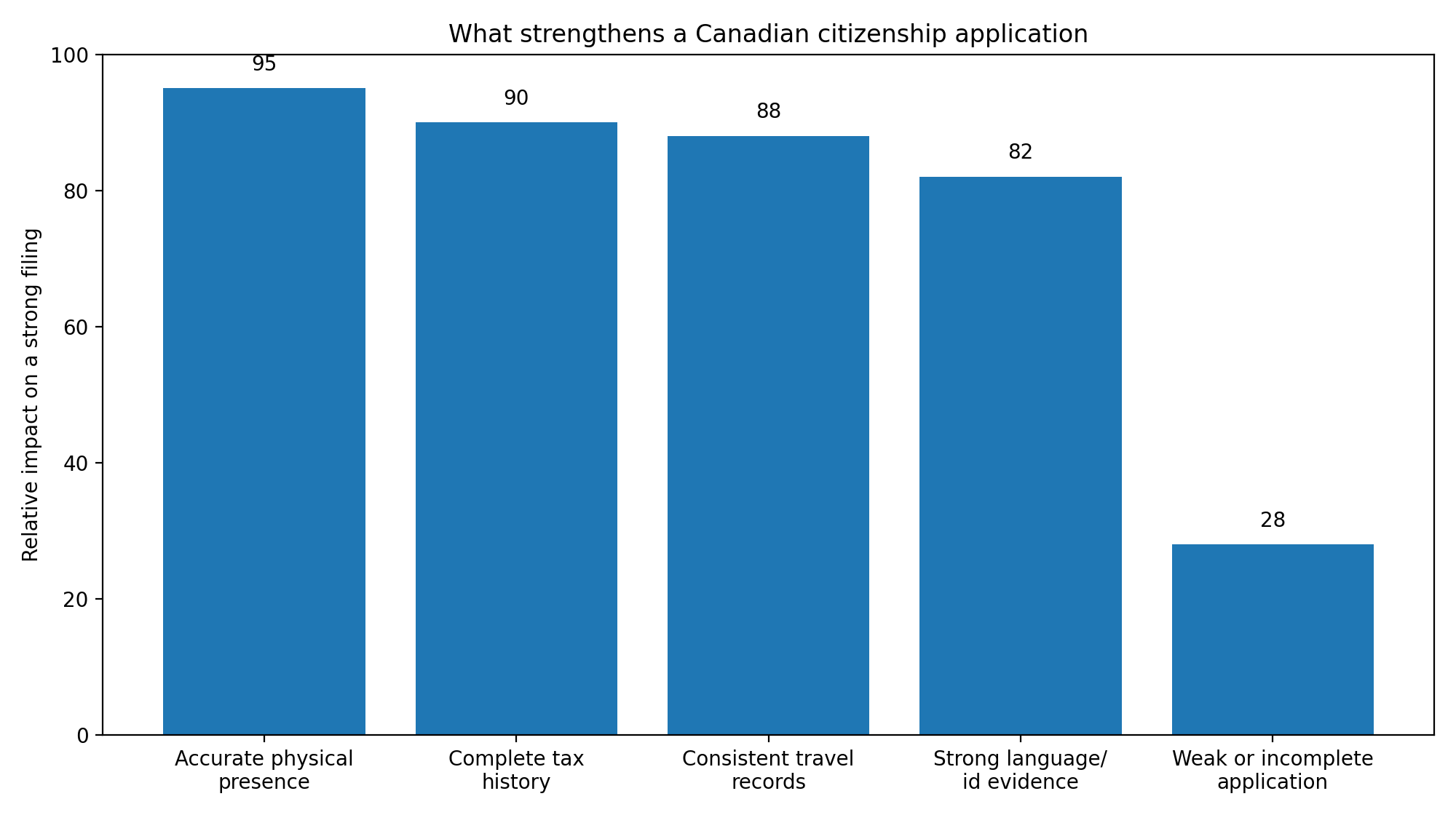
Citizenship refusals often grow out of smaller issues that combine into a weak file. Physical presence problems remain one of the biggest risk areas. Applicants may count days incorrectly, miss a trip, rely on memory instead of records, or fail to reconcile travel dates with passport stamps and CBSA history. Tax issues can also create trouble when the application does not match the applicant’s filing record. Language proof sometimes falls short because the wrong document was submitted or the evidence does not meet the required standard. Another common issue involves prohibitions, such as certain criminal matters, unresolved legal issues, or facts that make the applicant ineligible at the time of review. In other files, IRCC becomes concerned by inconsistencies in names, dates, previous addresses, or earlier immigration forms. When an officer sees contradictions, the file becomes harder to trust. Even a technically eligible applicant can face delay or refusal when the package looks rushed, unsupported, or inaccurate.
Start with a reliable physical presence calculation. Then support it with passport copies, travel records, tax filings, employment records, leases, school records, and any other documents that show you genuinely lived in Canada during the claimed period. A clear chronology helps IRCC understand your story quickly. Review past immigration filings before you submit. If a previous temporary resident visa, work permit, study permit, PR application, or PR card renewal contains facts that do not align with the citizenship package, address the issue directly rather than hoping IRCC will ignore it.
Stay ready for the citizenship test, interview questions, updated passport requests, and ceremony notices. A strong application does not end at filing. Good preparation continues through the entire process.
Citizenship decisions are not approved or refused simply because you came to Canada for business rather than leisure. IRCC decides citizenship cases based on legal eligibility, physical presence, taxes, language where required, and prohibitions. Still, in the broader immigration context, business travel can sometimes create stronger documentary evidence than leisure travel because it may be supported by employer letters, contracts, meeting schedules, and other objective records. Leisure travel often leaves a thinner paper trail. For applicants with complex movement histories, documented business activity can therefore help explain where they were, why they travelled, and how their timeline fits together. Whatever the purpose of travel, the key is consistency across every record.


Immigration appeals allow individuals to challenge a refusal or removal decision through the Immigration Appeal Division or Federal Court in Canada.

A refused visa to Canada occurs when an application is denied due to reasons such as insufficient documentation, weak ties to the home country, or failure to meet IRCC requirements.

Misrepresentation in Canadian immigration occurs when false or misleading information is provided, which can lead to refusal and a potential five-year ban from entering Canada.