When your future depends on the details, every decision matters.
With us, your in good hands.

Denied entry to Canada can disrupt business travel, family visits, urgent events, and long planned trips. A Temporary Resident Permit, often called a TRP, can create a lawful path to enter Canada despite inadmissibility when the circumstances are strong enough and the case is built properly.
Who often needs a Canada TRP permit
• Travellers with a DUI or criminal conviction
• People refused entry at the airport or border
• Applicants with an overstay or removal history
• Business visitors with urgent meetings in Canada
• Family members attending important life events • Applicants not yet eligible for Criminal Rehabilitation
| TRP Temporary entry despite inadmissibility | POE Same day border strategy in urgent cases | CR Long term fix through Criminal Rehabilitation | ARC Return after certain removal situations |
Under section 24(1) of the Immigration and Refugee Protection Act, an officer may issue a Temporary Resident Permit to a foreign national who is inadmissible or who does not otherwise meet the requirements of the Act if the officer believes the permit is justified in the circumstances. In practice, the officer weighs your need to enter Canada against any risk to Canadian society. A TRP does not erase inadmissibility forever. It does not automatically cure a criminal record. It does not guarantee later admission at the border. Instead, it gives temporary resident status for a limited period and can carry conditions. That limited but powerful discretion makes the TRP one of the most important tools for people who have been refused entry to Canada or who know a past issue could trigger a border problem.
You may need a Temporary Resident Permit for Canada if you have a criminal conviction, a DUI, impaired driving history, theft, assault, fraud, a prior overstay, a removal order, an exclusion order, a misrepresentation issue, or certain medical inadmissibility concerns. Many travellers are surprised to learn that even one offence from years ago can cause a refusal at the airport or land border. Others only discover the problem when they answer a question about a past arrest and the officer opens a deeper admissibility review. A Canadian TRP application becomes especially important when the offence is too recent for Criminal Rehabilitation, when your matter is urgent, or when there is a pressing reason to travel now rather than years from now.
Most people do not search for a Temporary Resident Permit because they enjoy paperwork. They search because something has already gone wrong or because they fear it will. A business executive needs to attend meetings in Toronto. A truck driver cannot cross the border because of an old conviction. A fiancé or spouse has been refused entry. A parent wants to visit a child in Canada but has a criminal inadmissibility problem. An investor has meetings that affect jobs, contracts, and revenue. In each of those situations, the legal question stays the same: can the need to enter Canada be presented in a way that is credible, documented, and strong enough to outweigh the concern that caused the inadmissibility finding?
Business travel usually produces a stronger Temporary Resident Permit case than leisure travel. That does not mean tourism cases always fail. It does mean officers can often measure business necessity more easily. A board meeting, site visit, conference presentation, contract negotiation, emergency technical repair, or investor meeting creates a concrete timeline and a clear benefit. Supporting evidence is also easier to gather. Invitation letters, corporate letters, conference registrations, contracts, proof of economic impact, and evidence that the meeting cannot be handled remotely give the officer something tangible. Leisure travel sits on a weaker footing because it usually involves preference rather than necessity. A vacation, sightseeing plan, or casual visit can still succeed if the circumstances are compelling, but the application must work much harder to prove why entry should be granted despite inadmissibility. For that reason, applicants coming to Canada for business rather than leisure often have better chances when the file is properly prepared and supported.

There is no single TRP strategy that fits every case. Some applicants seek a Port of Entry TRP at the airport or land border. That route can produce a same day decision, but it also carries real risk because the officer will assess the case on the spot and can refuse entry immediately. Other applicants choose a visa office or consular TRP application before travel. That route often takes longer, yet it allows more time to organize evidence, legal submissions, court records, and rehabilitation material. In many cases, a combined strategy also makes sense. Someone may need a Temporary Resident Permit now for urgent travel while also preparing a Criminal Rehabilitation application to fix the inadmissibility permanently later. A strong legal plan looks beyond the next trip and builds a sequence that serves both short term entry and long term admissibility.
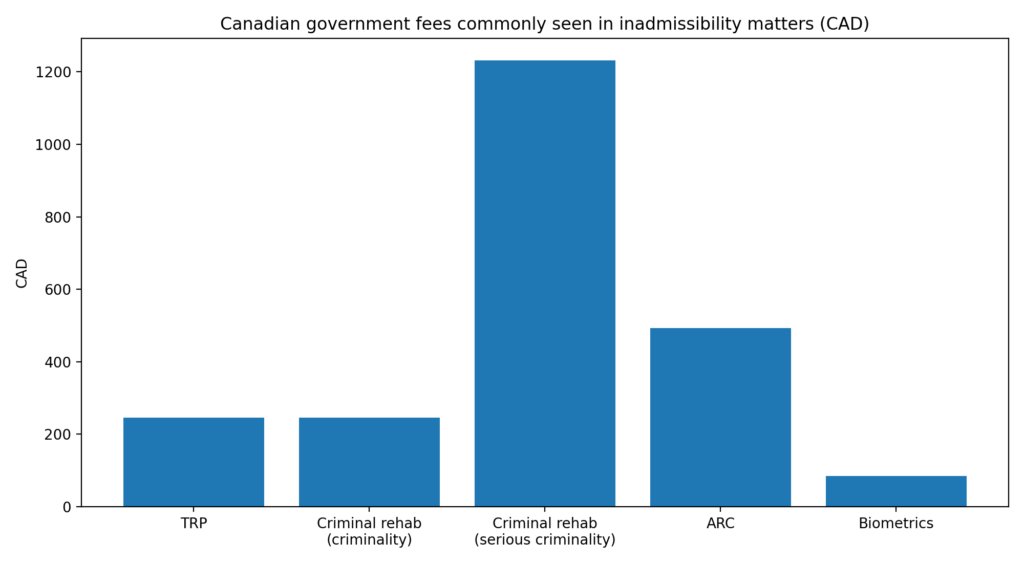
Government fees matter because applicants often plan travel, biometrics, legal work, and supporting documents at the same time. As of the current IRCC fee schedule, the government fee for a Temporary Resident Permit is CAD 246.25 per person. If Criminal Rehabilitation is also needed, the government fee is CAD 246.25 where the inadmissibility is on grounds of criminality and CAD 1,231.00 where the inadmissibility is on grounds of serious criminality. An Authorization to Return to Canada application, when required after certain removal situations, carries a government fee of CAD 492.50. Biometrics can add CAD 85 per person when required, and the maximum family biometrics fee for visitor visa applications is generally CAD 170. These government fees do not include legal fees, translation costs, police certificates, court record retrieval, or other supporting evidence expenses. A serious application budget should account for the full picture before deadlines become urgent.
| Application or Cost Item | CAD |
| Temporary Resident Permit | 246.25 |
| Criminal Rehabilitation – criminality | 246.25 |
| Criminal Rehabilitation – serious criminality | 1,231.00 |
| Authorization to Return to Canada | 492.50 |
| Biometrics, when required | 85.00 |
| Family biometrics cap for visitor applications | 170.00 |
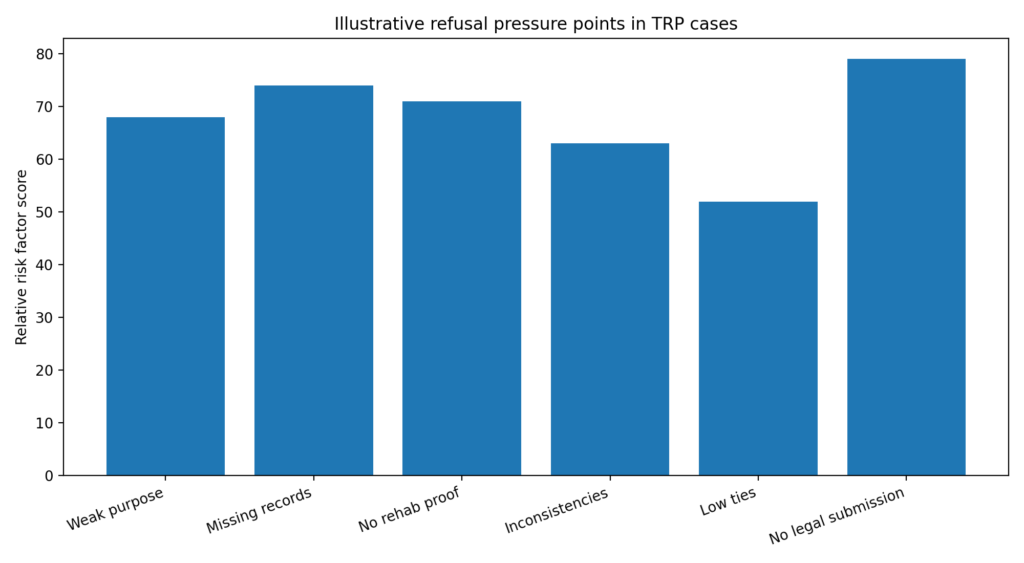
Officers look at several themes when they assess a Temporary Resident Permit application. They examine the seriousness of the inadmissibility issue, the amount of time that has passed, the evidence of rehabilitation, the purpose of travel, the credibility of the applicant, the urgency of the trip, the anticipated length of stay, and the risk to the Canadian public. They will also consider whether the person has complied with past immigration rules, whether the documents line up with the story being told, and whether the person seems likely to respect the limits of the permit. When the case is built well, the application tells one coherent story from start to finish. Every document supports the same narrative. Every concern is answered before it becomes a reason for refusal.
| Need for Entry Why must you enter Canada now? Urgency should be specific, measurable, and supported by documents. | Risk Analysis What caused the inadmissibility and how has that concern changed over time? Rehabilitation evidence matters. | Credibility Every date, record, and explanation should line up. Consistency increases confidence in the file. |
Refusals usually happen for reasons that are visible long before the officer writes the decision. A weak file often starts with an underdeveloped explanation of the offence or immigration issue. The applicant may say there was a misunderstanding, but they do not provide certified court records, sentencing documents, proof of sentence completion, or a clear timeline. Another file may include a purpose of travel that sounds important in conversation but looks vague on paper because there is no invitation letter, no meeting agenda, no business correspondence, no travel schedule, and no proof that the event will actually happen. Some applicants damage otherwise good cases by minimizing the past conduct rather than addressing it directly. Officers notice when the facts feel incomplete, selective, or inconsistent. Dates that do not match, court outcomes that are described inaccurately, unexplained arrests, missing police certificates, and conflicting travel histories all weaken credibility. Leisure cases face another challenge because the reason to travel may not feel urgent enough to overcome the inadmissibility concern. Even where the purpose is family related, the file can still fail if the emotional need is not supported by documents. Problems also arise when applicants submit a stack of papers without legal framing. A Temporary Resident Permit is not won by volume. It is won by showing that the need for entry outweighs the risk, that the applicant understands the issue, and that the evidence supports every essential point. When a submission does not perform that balancing exercise clearly, refusals become much more likely.
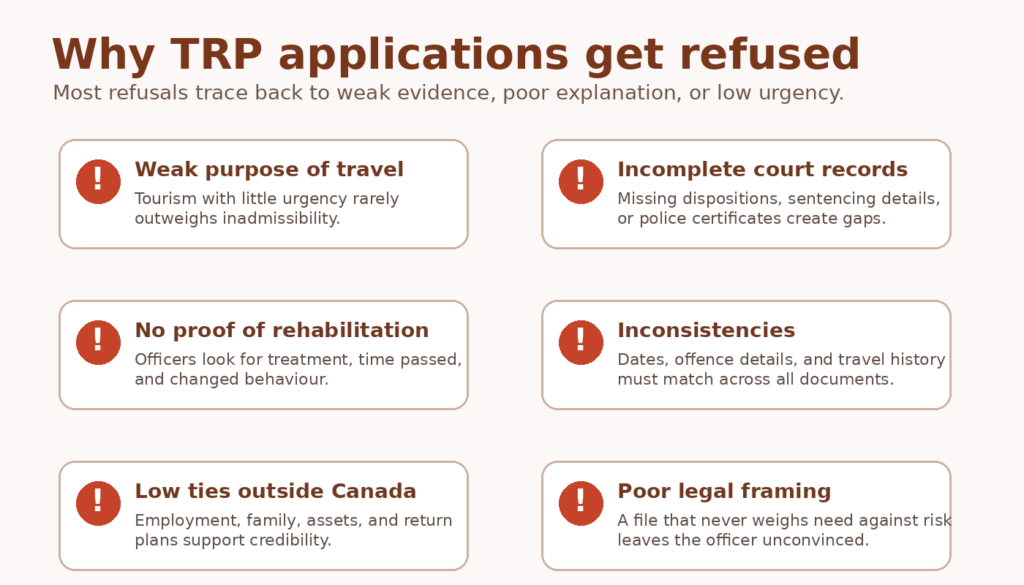
A stronger TRP application starts with full disclosure. The officer should never discover a problem before your application explains it. Next comes documentation. Certified court records, police certificates where appropriate, sentencing materials, proof that fines were paid, proof that probation or treatment ended, and personal evidence of rehabilitation all matter. After that, the reason for travel must be concrete. Business records, invitations, employer support letters, proof of family events, medical letters, conference confirmations, and timelines should show why the trip matters now. Finally, the application needs legal framing. The submission should acknowledge the inadmissibility, assess the risk honestly, and explain why the circumstances justify temporary entry. Good applications do not pretend the problem does not exist. They show why the case still merits approval despite the problem.
| Strong file checklist • Certified court and police records where needed • Proof the sentence ended and all conditions were completed • Evidence of rehabilitation, counselling, treatment, or lifestyle change • Clear travel purpose with invitations, agendas, letters, and bookings • Proof of ties outside Canada and a realistic return plan • Legal submissions that weigh need for entry against risk |
We understand that a denied entry problem is rarely just a border problem. It affects business plans, family events, immigration strategy, and peace of mind. Our role is to diagnose the inadmissibility issue clearly, gather the right evidence, build a persuasive legal submission, and position the matter in a way that speaks to how officers actually decide these files. We also help clients decide whether a Port of Entry approach makes sense, whether a visa office filing is safer, whether Criminal Rehabilitation should be pursued at the same time, and whether an Authorization to Return to Canada issue may also need attention. That practical strategy matters because the best result often comes from choosing the right path before the application is filed, not after a refusal.
People often ask whether a Temporary Resident Permit guarantees entry to Canada. It does not. Officers still examine travellers on arrival, and they can refuse entry if new issues appear or if the person does not satisfy the conditions of travel. Clients also ask whether a TRP removes inadmissibility forever. It does not. Criminal Rehabilitation may be needed for a permanent fix. Another frequent question is whether a DUI always blocks travel to Canada. Many DUI cases do create criminal inadmissibility, especially after legal changes in Canada elevated impaired driving consequences. Timing, equivalency, disposition, and sentence details all matter, so an accurate legal review is essential before travel. Applicants also ask whether they should try at the border without preparing anything. That is rarely wise. Same day border decisions can happen, but last minute attempts with weak documentation often lead to refusal and a more difficult record for future applications.
If you have been denied entry to Canada, warned that you may be inadmissible, or need to travel to Canada for business, family, or urgent personal reasons, this is the right time to get clear legal advice. A Temporary Resident Permit can open the door, but only when the strategy is built properly. Call us to book a consultation and get a focused plan for your denied entry, TRP, Criminal Rehabilitation, or related inadmissibility matter. The sooner the case is assessed, the stronger the opportunity to prepare it the right way.
Call us to discuss denied entry to Canada, Temporary Resident Permit applications, Criminal Rehabilitation, and related inadmissibility matters.


Immigration appeals allow individuals to challenge a refusal or removal decision through the Immigration Appeal Division or Federal Court in Canada.

A refused visa to Canada occurs when an application is denied due to reasons such as insufficient documentation, weak ties to the home country, or failure to meet IRCC requirements.

Misrepresentation in Canadian immigration occurs when false or misleading information is provided, which can lead to refusal and a potential five-year ban from entering Canada.