When your future depends on the details, every decision matters.
With us, your in good hands.

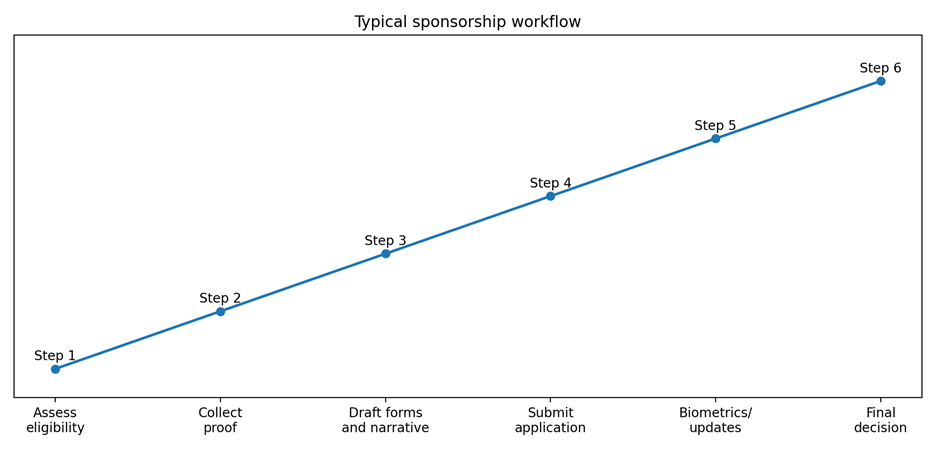
Spousal sponsorship should bring families together, not trap couples in paperwork, delay, and uncertainty. Many people start the process thinking the application is straightforward. Then reality hits. Immigration officers want evidence, context, consistency, and a credible story. A marriage certificate alone will not carry the file. A few photos will not answer hard questions. A rushed package can trigger delays, document requests, interviews, or refusal.
YS Canada Visa Services helps couples prepare stronger spousal sponsorship applications from the beginning. We build cases around the real issue officers examine: whether the relationship is genuine and whether the application meets the legal and documentary requirements of Canada’s family sponsorship program. When your future in Canada matters, strategy matters too.
If you want to sponsor your spouse, common-law partner, or conjugal partner, speak with our team and book a consultation. We help clients inside Canada and outside Canada who need guidance on sponsorship, visitor entry during processing, refusals, appeals, interviews, and complex relationship cases.
Under Spousal Sponsorship, also called spouse sponsorship Canada, marriage sponsorship, partner sponsorship, family class sponsorship, and sponsorship of a spouse or common-law partner, allows a Canadian citizen or permanent resident to sponsor an eligible partner for permanent residence. Once approved, the sponsored person can live in Canada as a permanent resident and build a long-term future here.
The program covers several relationship categories. Spouses are legally married partners. Common-law partners have generally lived together in a marriage-like relationship for at least twelve continuous months. Conjugal partners may qualify in limited situations where significant barriers prevented marriage or cohabitation. The correct category matters. Choosing the wrong one can weaken the application before an officer even reviews the evidence in detail.
Strong applications do more than answer questions on a form. They show how the relationship began, how it developed, how the couple stayed connected, how families became involved, how finances or plans were shared, and why the relationship is real. Officers read for patterns. They compare timelines. They notice missing periods, unexplained travel gaps, cultural concerns left unanswered, and contradictions between forms, letters, and attachments.
A professionally prepared package can address concerns before they become problems. Our office helps couples organize evidence, prepare written statements, explain sensitive facts, and present a clear narrative that matches the documents. That work often makes the difference between a routine approval and a stressful refusal.
A sponsor usually must be at least eighteen years old and must be a Canadian citizen or permanent resident. The sponsor must not be barred from sponsoring because of prior sponsorship defaults, certain criminal issues, bankruptcy restrictions, or social assistance rules that apply in some situations. The sponsor also signs an undertaking to support the applicant financially for the required period.
Applicants also need to meet admissibility requirements. That means a sponsorship file can involve more than relationship proof. Medical issues, criminal history, misrepresentation findings, prior removals, or past visa refusals may require separate strategy. Some couples need to deal with a Temporary Resident Permit, Criminal Rehabilitation, or an Authorization to Return to Canada alongside the sponsorship plan.
Couples often ask whether they should file inland or outland. Inland sponsorship usually refers to the spouse or common-law partner in Canada class. It may be appropriate when the applicant is already in Canada and the couple is living together here. In many cases, the applicant may also seek an open work permit if eligible. Outland sponsorship usually runs through the family class outside Canada and may be preferable when the applicant lives abroad or needs greater travel flexibility.
The right path depends on travel plans, status history, urgency, admissibility, and practical risk. Some applicants want to visit Canada while the case is in process. Others already live in Canada and want stability. A careful review helps determine which route gives the couple the strongest position.
Government fees change from time to time, so applicants should always verify them before filing. As of the current IRCC fee schedule, sponsoring a spouse or partner generally includes an eighty-five dollar sponsorship fee, a five hundred forty-five dollar principal applicant processing fee, and a five hundred seventy-five dollar Right of Permanent Residence Fee. That brings the common base total to one thousand two hundred five Canadian dollars, not including biometrics if required. Biometrics are generally eighty-five dollars per person when they apply.
Additional fees may arise if the file includes dependent children, medical exams, translations, police certificates, courier charges, or related applications. Couples who need to solve inadmissibility issues may face separate government fees for a Temporary Resident Permit, Criminal Rehabilitation, or an Authorization to Return to Canada. Good planning prevents last-minute surprises and helps avoid filing delays caused by missing payments.
| Fee type | Amount |
| Sponsorship fee | CAD $85 |
| Principal applicant processing fee | CAD $545 |
| Right of Permanent Residence Fee | CAD $575 |
| Biometrics, if required | CAD $85 |
| Typical base total | CAD $1,205 + biometrics if applicable |
Immigration officers do not assess love in the abstract. They assess evidence. They look at chronology, communication, visits, cohabitation, cultural context, family knowledge, financial interdependence, and credibility. They also apply the genuineness test under Canadian immigration law. That means officers want to know whether the relationship is genuine and whether it was entered into primarily for immigration purposes.
A strong case usually includes a timeline of the relationship, photos from different stages, communication records, travel records, money transfers where relevant, joint documents where available, letters from family and friends, and detailed personal statements. Not every couple will have the same kind of evidence. The key is not quantity alone. The key is whether the evidence fits together and makes sense.
Many applicants also ask about visiting Canada while the sponsorship is in process. Purpose matters. If the sponsored spouse seeks temporary entry, a business-related purpose can sometimes present a clearer and more structured case than leisure travel. Business travel often comes with meeting schedules, event registrations, employer letters, conference details, and fixed dates. Those documents can help show a focused reason for travel.
Leisure travel can still work, but it often needs stronger explanation and more supporting evidence. Officers may worry that a person with a permanent immigration plan will not leave Canada if asked to do so. That concern can grow when the file offers only a vague tourism purpose. A strategic temporary entry package should explain the trip clearly, address ties and travel history, and present the facts honestly. Each case turns on its own details, so couples should not assume that a visitor application will succeed just because a sponsorship application is underway.
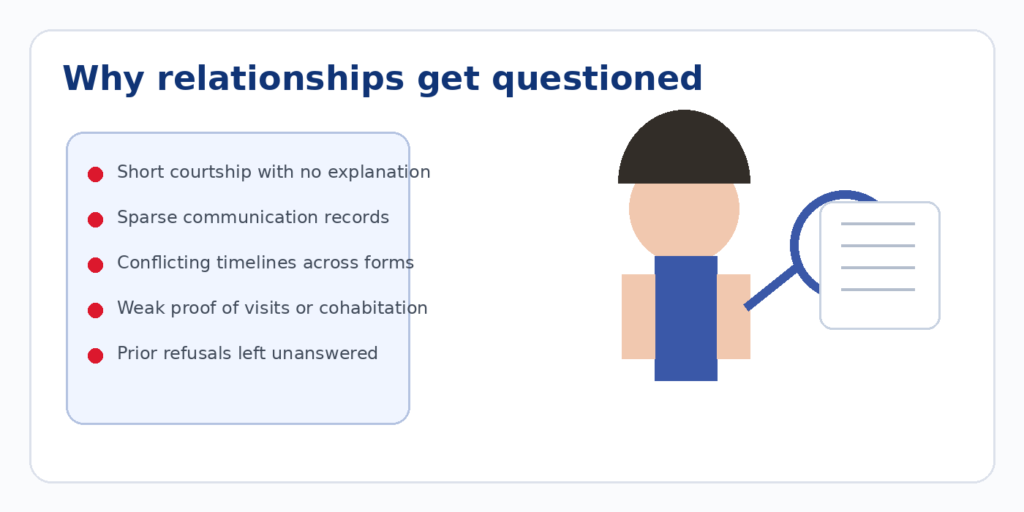
Refusals usually happen for one reason: the file did not satisfy the officer. Sometimes the problem is missing evidence. Sometimes the issue is inconsistency. Other times the couple never explained obvious concerns. Officers may question a relationship when the courtship was very short, the age gap is large, the religion or language background differs significantly, the marriage happened quickly after a refusal or status issue, or the documents do not show how the couple actually maintained the relationship. None of those facts automatically cause refusal. Silence does.
Weak forms also hurt cases. Couples sometimes answer questions too briefly, leave dates vague, or submit statements that sound generic and identical. Officers notice when narratives feel scripted. They also notice when documents contradict the forms. If the travel records, employment history, address history, and communication records do not line up, the officer may question the truthfulness of the entire application. Once that doubt grows, approval becomes harder.
Another common problem involves underestimating common-law proof. Some couples genuinely qualify but cannot prove twelve continuous months of cohabitation in a clear way. Others rely on screenshots and selfies but provide almost no practical evidence that their lives joined together over time. Applications can also run into trouble when earlier refusals, prior marriages, separation history, criminal issues, or immigration violations remain unaddressed.
For that reason, the strongest files do not just submit evidence. They interpret it. They explain the relationship, answer likely concerns, and organize the material so the officer can follow the story without confusion.
Relationship refusals often grow from a pattern of unanswered questions rather than one fatal flaw. An officer may start with a minor concern, such as a short courtship, but that concern can become serious when it combines with sparse communication records, inconsistent dates, little proof of visits, and weak family involvement. The file starts to feel thin. Then the officer looks harder at everything else.
Some couples provide many pages of chat logs but almost no evidence showing real-life commitment. Others provide wedding photos but little proof of contact before or after the ceremony. A few applicants overlook the importance of context. If cultural practices influenced the way the relationship developed, the application should explain that. If the couple lived apart because of work, study, visa issues, or family obligations, the package should show how they sustained the relationship despite the distance.
Refusals also happen when people try to hide difficult facts. Prior marriages, past sponsorships, criminal matters, medical issues, children from previous relationships, age differences, religion differences, or prior visa refusals do not automatically destroy a case. They become dangerous when applicants minimize them or leave them out. A strong application confronts the facts directly. Officers respect clarity more than avoidance. When the package is honest, detailed, and supported by documents, credibility rises. When it feels evasive or chaotic, refusal risk rises with it.
A stronger application begins with a complete relationship timeline. From there, every document should support the story. That may include travel stamps, airline tickets, boarding passes, screenshots of calls and messages, engagement or wedding records, receipts, shared leases, joint accounts where available, beneficiary designations, insurance records, letters from friends and relatives, and proof of ongoing future plans.
Written statements also matter. Each partner should explain the history of the relationship in a natural voice, using specific details that match the documents. The best statements answer questions before the officer asks them. Why did the relationship move quickly? Why did you live apart for a period? How do you communicate across distance? What plans have you made for life in Canada? Why were certain family members absent from the wedding? A clear explanation can reduce suspicion and keep the officer focused on the real evidence.
Organization matters too. Evidence should be labeled, chronological where possible, and easy to review. A legal submission letter can highlight the strongest facts, address concerns directly, and connect the evidence to the applicable legal test. That structured approach gives the file more force.
Useful evidence may include marriage certificates, proof of divorce from any prior relationship, passports, entry stamps, boarding passes, hotel confirmations, message records, call logs, social media history, photographs from different points in the relationship, money transfer records, proof of gifts, letters from family and friends, shared bills, leases, bank statements, insurance documents, and records showing future plans such as housing or employment preparation in Canada.
No two couples will have the same evidence. Genuine relationships can look different across cultures and life circumstances. The goal is to present enough credible documentation to show continuity, commitment, and authenticity.
| Relationship proof | Shared life proof | Context proof |
| Messages and call logs Photos across time Travel and visit records | Joint leases or bills Money transfers or support Family letters and declarations | Timeline statements Explanations for gaps Future plans in Canada |
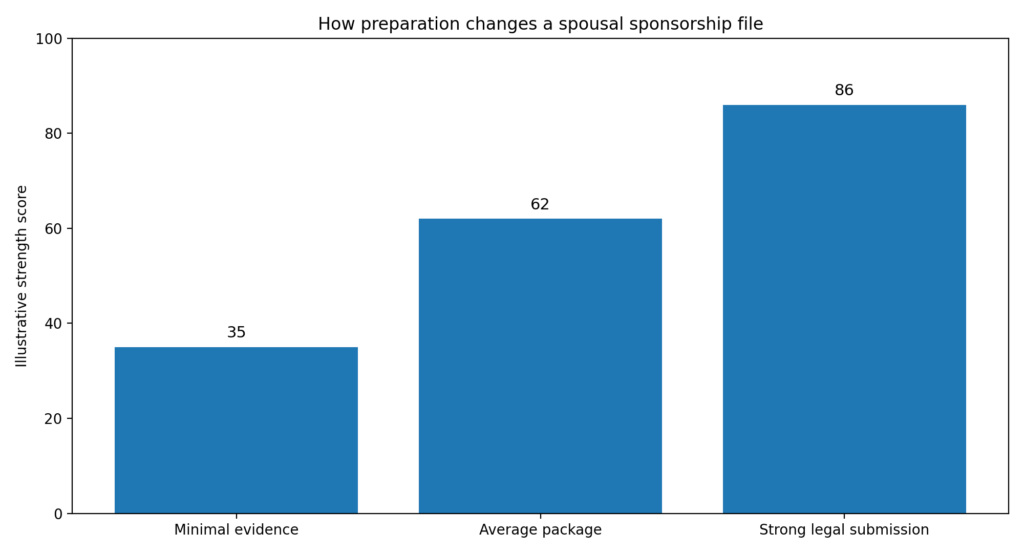
The chart below is illustrative rather than official. It shows a practical truth we see every day: files with weak evidence face a much higher risk of refusal, average files produce mixed outcomes, and well-prepared applications with a clear legal and factual narrative tend to perform far better. Immigration decisions remain discretionary and fact-specific, but preparation changes the quality of the file dramatically.
Our team understands that spousal sponsorship is not just a form package. It is your marriage, your family, your timeline, and your future in Canada. We help couples prepare strong files, respond to document requests, address red flags, and build better answers when the relationship does not fit a simple pattern. We also advise on temporary entry strategy, interviews, inadmissibility issues, and post-refusal options where available.
If you want a stronger path forward, book a consultation. We can review your facts, identify the weak points, and tell you what your case needs before you file.
You do not have to guess your way through a spousal sponsorship application. A careful strategy at the beginning can save time, stress, and money later. Call YS Canada Visa Services today to book a consultation and get a tailored plan for your spouse sponsorship, partner sponsorship, marriage sponsorship, or common-law sponsorship matter. We are here to help you reunite your family in Canada with a clearer, stronger application.
| Book a Consultation Call YS Canada Visa Services to discuss your spouse sponsorship, common-law sponsorship, or partner sponsorship case before you file. |


Immigration appeals allow individuals to challenge a refusal or removal decision through the Immigration Appeal Division or Federal Court in Canada.

A refused visa to Canada occurs when an application is denied due to reasons such as insufficient documentation, weak ties to the home country, or failure to meet IRCC requirements.
Misrepresentation in Canadian immigration occurs when false or misleading information is provided, which can lead to refusal and a potential five-year ban from entering Canada.