When your future depends on the details, every decision matters.
With us, your in good hands.

A permanent solution for many people who have been denied entry to Canada because of a past conviction.
A criminal record does not always end your ability to enter Canada. Many travellers, business owners, professionals, truck drivers, conference speakers, and family visitors discover at the border that an old offence still makes them inadmissible. That shock often happens after flights are booked, meetings are scheduled, and relatives are waiting. Criminal Rehabilitation gives eligible applicants a path to solve that problem permanently.
YS Canada Visa services helps clients who have been denied entry to Canada, warned about criminal inadmissibility, or told they need special permission before they travel. Our goal is simple: build a strong, strategic application that shows you are rehabilitated, stable, and no longer a risk. If you want to enter Canada for work, business, family, or an important event, book a consultation and let us map out the right plan.
Criminal Rehabilitation is an application that can permanently overcome criminal inadmissibility to Canada. Once approved, it removes the need to keep asking for temporary permission each time you travel, as long as you do not create new inadmissibility issues in the future. Immigration, Refugees and Citizenship Canada assesses whether enough time has passed, whether every part of the sentence is finished, and whether the evidence shows you are unlikely to commit another offence.
People often search for this process using several different terms. Some call it Canada criminal clearance, criminal record rehabilitation for Canada, permanent inadmissibility solution, entry to Canada after DUI, or how to overcome criminal inadmissibility. Many people also search for Temporary Resident Permit wording at the same time, such as Temporary Resident Permit, TRP Canada, Canada entry permit, temporary inadmissibility waiver, or permit to enter Canada with a criminal record. That is why a smart legal strategy must compare both options instead of assuming one solution fits every file.
Criminal Rehabilitation and a Temporary Resident Permit do not do the same job. A Temporary Resident Permit, often called a TRP, is temporary. It can allow entry for a limited period when the officer decides that your reason for coming to Canada outweighs the risk. A TRP works best when travel is urgent and you do not yet qualify for Criminal Rehabilitation or when you need a short-term bridge while a long-term solution is prepared.
Criminal Rehabilitation is different because it aims to solve the inadmissibility permanently. If you qualify, this option usually offers much more freedom than relying on a Temporary Resident Permit, temporary resident permit waiver, or Canada inadmissibility permit every time you travel. In many files, the strongest approach involves both: a TRP for immediate travel needs and a Criminal Rehabilitation application for future travel without repeated discretionary decisions.
You may need Criminal Rehabilitation if you were convicted of an offence outside Canada that would be a crime in Canada, or if you committed an act outside Canada that would amount to an offence here. Common examples include DUI or impaired driving, reckless driving tied to criminal consequences, theft, assault, fraud, drug possession, or certain property offences. Even one offence can make a person inadmissible.
Eligibility usually turns on timing and completion of the sentence. In general, a person may apply five years after the sentence is completed. Completion can include much more than the date of conviction. Immigration officers may count the end of jail, probation, parole, licence suspensions connected to the sentence, community service, treatment conditions, and full payment of every fine or restitution order. One missing detail can derail an otherwise approvable file, which is why sentence-completion analysis is one of the first things we review in consultation.
Current government fees matter because applicants often plan around them. IRCC’s fee list shows that Criminal Rehabilitation for inadmissibility on grounds of criminality is currently CAD 246.25, while Criminal Rehabilitation for serious criminality is CAD 1,231.00. If a Temporary Resident Permit becomes part of the strategy, the current TRP fee starts at CAD 246.25. If biometrics apply, the individual biometrics fee is generally CAD 85.00. Applicants sometimes also need to consider other costs, such as police certificates, court record retrieval, certified translations, fingerprints, passport renewal, or an Authorization to Return to Canada fee if a prior removal order is part of the history.
| Application item | Current fee | Notes |
| Criminal Rehabilitation – criminality | CAD 246.25 | For inadmissibility on grounds of criminality. |
| Criminal Rehabilitation – serious criminality | CAD 1,231.00 | For more serious cases. |
| Temporary Resident Permit (TRP) | CAD 246.25 | Short-term entry solution where urgent travel exists. |
| Biometrics | CAD 85.00 | May be required depending on the file. |
| Authorization to Return to Canada (ARC) | CAD 492.50 | May apply where a past removal order exists. |
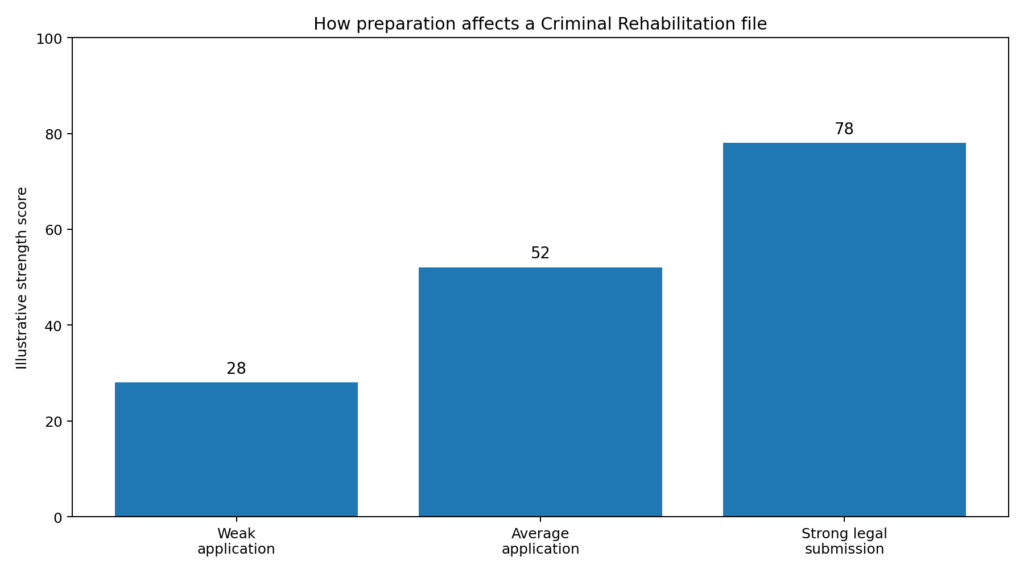
A strong legal file is never just about paying the fee. The government fee gets the application in the system, but the evidence package carries the weight. Court dockets, certified dispositions, sentencing terms, proof that every condition ended, proof of treatment or counselling, letters of support, work records, travel history, and a carefully written submission letter often decide whether the application looks organized and credible or weak and incomplete.
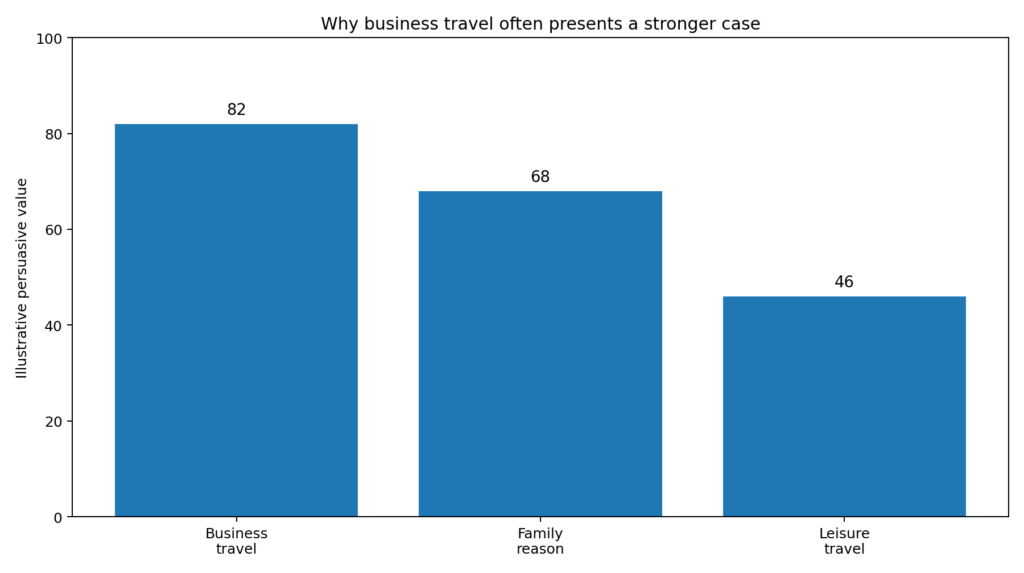
Business travel usually gives officers a clearer, more measurable reason to approve temporary entry. A person attending contract negotiations, a trade show, a mining site visit, a board meeting, a factory installation, or a commercial conference can often show urgency, economic value, fixed dates, and supporting documents from Canadian companies. That type of travel does not guarantee approval, but it can make the purpose of travel look concrete, serious, and easy to verify.
Leisure travel can still succeed, but it often faces more scrutiny because tourism does not carry the same built-in urgency. If the travel purpose is a vacation, the file must work harder to explain why entry should be allowed and why the officer should exercise discretion in your favour. When we prepare a case, we look at the purpose of travel with brutal honesty. If the facts support business travel, we build the package around that strength. If the purpose is family or leisure, we focus on credibility, organization, ties, and evidence that the travel is legitimate and time-limited.
Refusals often happen because the applicant submits a file that tells only half the story. Immigration officers do not approve Criminal Rehabilitation just because time has passed. They want a complete record of what happened, proof that every sentence term ended, and persuasive evidence that the applicant now leads a stable life. A file can fail when court records are incomplete, when the applicant misstates dates, when a fine remains unpaid, when the personal statement sounds generic, or when the evidence does not explain what changed after the offence. Problems also arise when applicants minimize the conduct, blame others, or ignore the seriousness of the event. Officers notice those gaps quickly.
Another common reason for refusal is poor strategy. Some applicants should first use a Temporary Resident Permit because urgent travel is coming up and the rehabilitation timeline is not yet available. Others qualify for Criminal Rehabilitation but submit only a thin package with a few forms and no real legal argument. Some people forget that one country’s record terminology does not automatically translate to Canadian immigration law. A plea, diversion, dismissal after conditions, or reduced state charge still needs careful analysis against Canadian equivalency. Refusals also happen when applicants hide prior refusals, omit arrests, forget old offences, or submit documents that conflict with previous visa applications. Consistency matters. Credibility matters. Timing matters. A strong application anticipates the officer’s questions before the officer has to ask them.
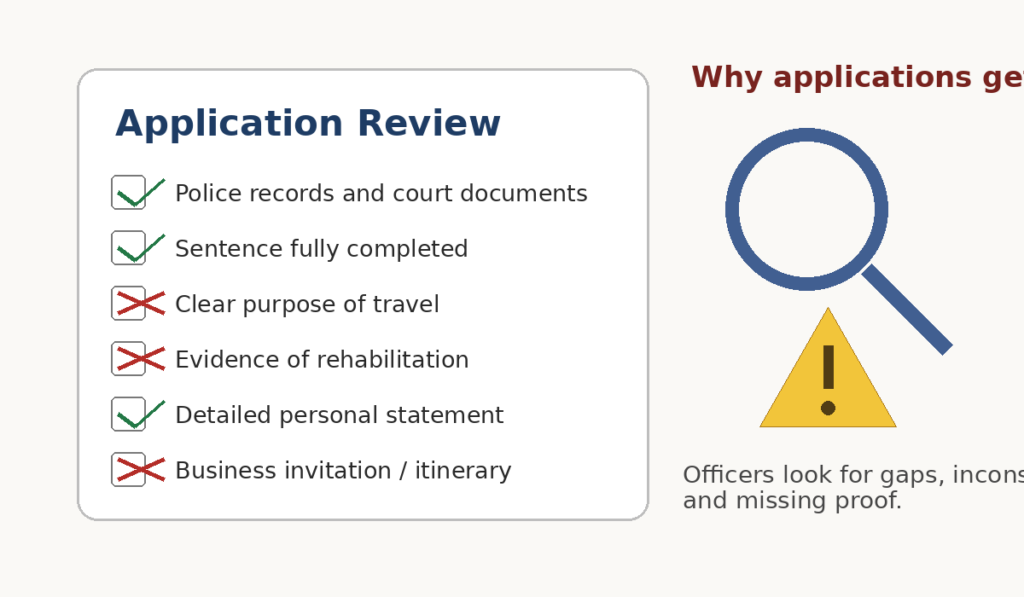
A stronger file starts with full disclosure and disciplined evidence collection. We want the complete criminal history, not the polished version. That means police certificates where appropriate, charging documents, court dockets, judgments, sentencing terms, probation completion proof, payment receipts for fines, and any records showing that treatment, education, or counselling was completed. After that, we shape the story. The personal statement should explain the circumstances of the offence, take responsibility without sounding scripted, and show what changed afterward. We also look for positive anchors: stable employment, business ownership, family responsibilities, community service, education, professional licensing, and a clean period after sentence completion.
Legal framing matters just as much as evidence. Officers need a roadmap. A good submission letter explains the Canadian equivalency issue, the timing calculation, the sentence completion date, the rehabilitation factors, and the purpose of travel if travel urgency exists. Character reference letters help when they are specific and credible instead of vague praise. Business invitation letters help when they explain dates, commercial purpose, and why the applicant’s presence matters. A file becomes much stronger when every document supports the same theme: the offence is in the past, the sentence is complete, the applicant is stable, and future risk is low.
Some travellers hear that they may be deemed rehabilitated and assume they no longer need to do anything. That assumption can be dangerous. Deemed rehabilitation depends on the nature of the offence, the number of offences, the equivalent offence in Canada, and the amount of time that has passed since the sentence was completed. Serious criminality can remove that option altogether. Because of that, a person who believes they are deemed rehabilitated should still analyze the case carefully before appearing at the border.
This issue becomes even more important for DUI-related cases because Canadian law and penalties changed over time. A file that looked manageable years ago can require a very different analysis today. Border officers do not rely on wishful thinking, and airlines do not resolve admissibility problems at check-in. Before travelling, it is better to know whether you need Criminal Rehabilitation, a Temporary Resident Permit, both, or neither. A careful legal review can prevent a refused entry, lost money, and a damaging note on the immigration record.
YS Canada Visa Services prepares Criminal Rehabilitation files with the end decision in mind. We do not treat these applications like basic form-filling exercises. First, we analyze the offences and sentence timeline. Next, we identify missing evidence and weak spots. Then we build a coherent package that explains the history, proves eligibility, and presents rehabilitation in a persuasive way. When urgent travel exists, we also assess whether a Temporary Resident Permit strategy should run alongside the permanent solution.
Clients contact us after border refusals, before trade shows, before weddings, before family emergencies, and before important business travel. Each file needs a tailored answer. Some people need a direct Criminal Rehabilitation application. Some need a TRP first. Some need both. The right plan depends on the offence, the sentence, the destination, the purpose of travel, and the timeline. That is exactly what a consultation is for.


Immigration appeals allow individuals to challenge a refusal or removal decision through the Immigration Appeal Division or Federal Court in Canada.

A refused visa to Canada occurs when an application is denied due to reasons such as insufficient documentation, weak ties to the home country, or failure to meet IRCC requirements.

Misrepresentation in Canadian immigration occurs when false or misleading information is provided, which can lead to refusal and a potential five-year ban from entering Canada.