When your future depends on the details, every decision matters.
With us, your in good hands.

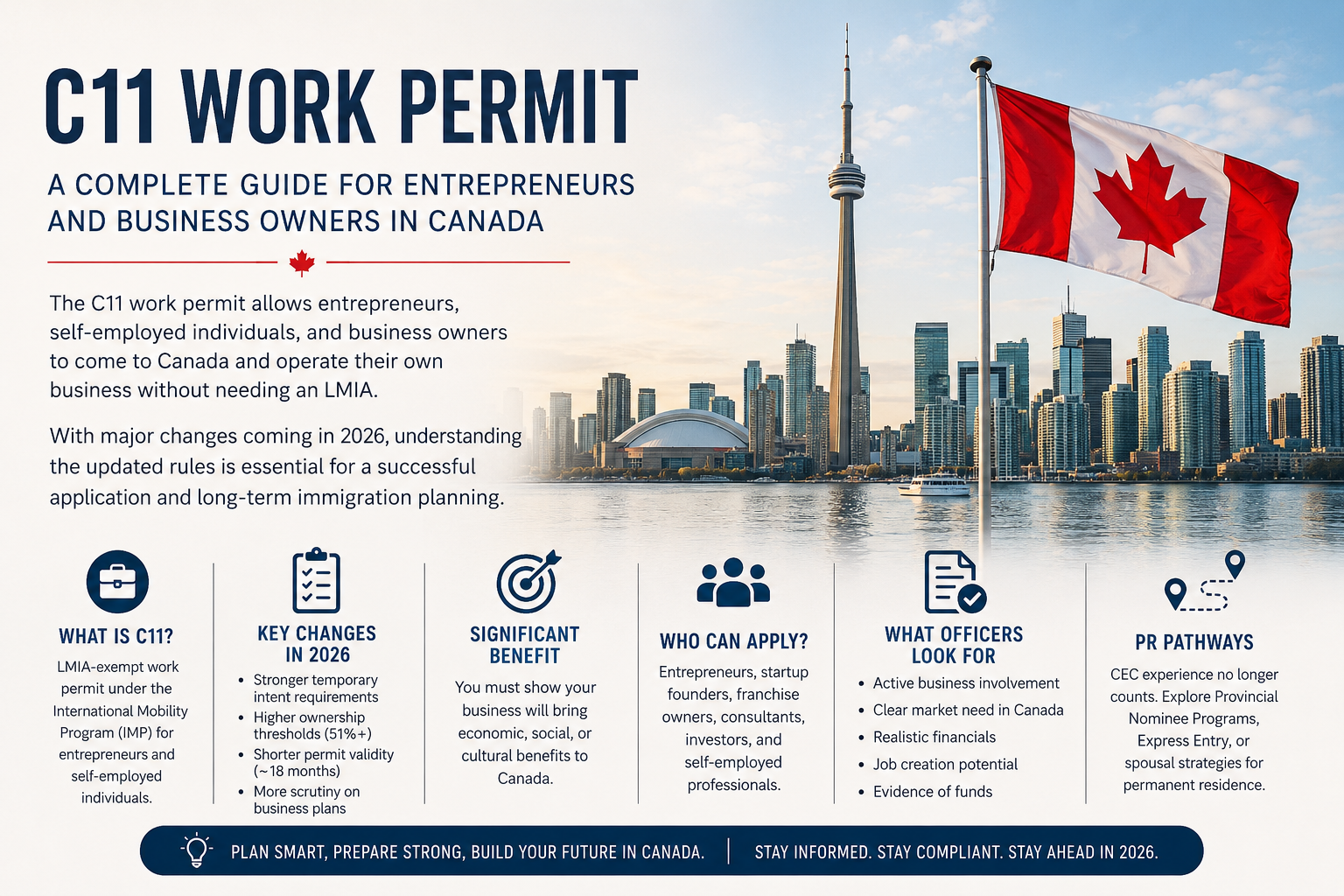
Canada continues to attract entrepreneurs from around the world because of its stable economy, strong banking system, global market access, and high quality of life. For many business owners and self-employed professionals, one of the most flexible immigration pathways is the C11 Work Permit.
However, the C11 landscape changed significantly in 2025 and 2026. Many older blog posts and YouTube videos now contain outdated information that could seriously hurt an application strategy.
This updated guide explains:
The C11 work permit is an LMIA-exempt work permit issued under Canada’s International Mobility Program (IMP).
It allows foreign entrepreneurs and self-employed individuals to operate businesses in Canada if they can demonstrate that their activities will provide a significant economic, social, or cultural benefit to Canada.
Unlike traditional employer-sponsored work permits, the C11 category does not require a Labour Market Impact Assessment (LMIA). That means applicants avoid the lengthy recruitment and advertising process required under many other work permit streams.
The C11 category is commonly used by:
The biggest mistake applicants make in 2026 is relying on outdated information.
Canada significantly tightened and restructured the C11 pathway beginning in May 2025.
These changes dramatically altered how immigration officers assess applications.
One of the biggest changes is the official emphasis on temporary intent.
The C11 permit is now viewed more strictly as a temporary residence pathway, not a direct permanent residence shortcut.
Applicants must now provide stronger evidence that:
Officers increasingly assess:
This has become one of the most important parts of modern C11 applications.
Another major update is the stricter ownership requirement.
In 2026, applicants are generally expected to own at least 51% of the Canadian business or otherwise demonstrate clear controlling interest.
This change was designed to prevent passive investment applications.
Immigration officers now want to see:
Passive shareholders generally do not qualify.
This is arguably the biggest strategic change.
Previously, many entrepreneurs used the C11 work permit as a stepping stone toward permanent residence through the Canadian Experience Class (CEC).
That pathway is now effectively closed. IRCC confirmed that work experience gained under the C11 category does not count toward Canadian Experience Class eligibility.
This means applicants now need a completely different permanent residence strategy from day one.
Historically, many applicants received permits valid for two years.
Recent policy shifts reduced the practical duration for many C11 permits to approximately 18 months.
Extensions are possible, but officers now expect evidence such as:
Simply incorporating a business is no longer enough.
Business plans in 2026 are now heavily scrutinized.
Generic templates are often refused quickly.
Immigration officers expect:
Strong documentation is now essential.
Canada’s immigration system has experienced major reforms across nearly every temporary residence stream.
The government has increased scrutiny on:
These reforms are part of broader efforts to manage immigration volumes and strengthen program integrity.
As a result, C11 applicants now face:
The core legal requirement remains the same: applicants must show that their work in Canada will create a significant benefit.
This benefit can be:
Most entrepreneur applicants focus on economic benefits.
Examples include:
The strongest applications clearly explain:
Certain business models tend to perform better than others.
Tech startups continue to be strong candidates, especially businesses involving:
Canada continues prioritizing innovation-driven industries.
Experienced contractors and trade business owners can succeed if they demonstrate:
Consultants with proven international experience often qualify in fields such as:
However, applicants must demonstrate real Canadian demand.
Franchises are often viewed positively because:
Online businesses may qualify if they demonstrate:
Purely remote foreign businesses without Canadian activity often face difficulties.
In 2026, officers increasingly look for substance over promises.
They want evidence such as:
Applications lacking operational credibility are commonly refused.
Poorly written plans with unrealistic projections are major refusal triggers.
Applicants must show enough money to:
Separate proof for business capital and personal settlement funds is increasingly important.
Officers reject applications where the applicant appears to be merely investing money without actively managing operations.
Businesses that fail to demonstrate Canadian demand may be refused.
This is one of the fastest-growing refusal reasons in 2026.
Applicants who appear focused solely on permanent residence may face problems.
Because the CEC pathway no longer works for C11 holders, applicants now need alternative PR strategies.
Possible options include:
Some provinces still operate entrepreneur immigration programs, including:
These often require:
Applicants with strong:
may still qualify independently through Express Entry.
Some families strategically rely on the spouse’s Canadian employment to pursue permanent residence pathways.
Processing times vary significantly depending on:
Applicants should expect more scrutiny and slower processing than in previous years due to broader immigration reforms across Canada.
For the right applicant, absolutely.
The C11 remains one of the few pathways allowing foreign entrepreneurs to:
However, it is no longer a simple immigration shortcut.
Success now depends on:
Applicants who treat the C11 as a serious business immigration program — rather than just an immigration loophole — still have strong opportunities in Canada.
The C11 work permit has evolved significantly.
In 2026, successful applications require:
Canada continues to welcome entrepreneurs, but immigration officers now expect stronger evidence, more realistic planning, and genuine business operations.
For entrepreneurs who prepare properly, the C11 pathway can still provide an excellent opportunity to establish a successful future in Canada.


Immigration appeals allow individuals to challenge a refusal or removal decision through the Immigration Appeal Division or Federal Court in Canada.

A refused visa to Canada occurs when an application is denied due to reasons such as insufficient documentation, weak ties to the home country, or failure to meet IRCC requirements.

Misrepresentation in Canadian immigration occurs when false or misleading information is provided, which can lead to refusal and a potential five-year ban from entering Canada.