When your future depends on the details, every decision matters.
With us, your in good hands.

Misrepresentation happens when an applicant gives information that is false, incomplete, misleading, or material to the decision. The issue does not always involve forged documents. Officers also look at omitted facts, inconsistent timelines, hidden refusals, inaccurate work history, missing family details, and answers that do not match earlier applications.
Canadian immigration misrepresentation can arise in visitor visa files, study permit applications, work permit cases, permanent residence matters, citizenship matters, sponsorship applications, and border examinations. A person may face a concern after filing an application with IRCC, after speaking to an officer, or when CBSA compares current information with older records.
Many people assume intent always controls the outcome. In reality, immigration authorities focus on whether the missing or inaccurate information could affect the decision. That means even a careless omission can trigger a serious problem. A well-prepared response needs to explain what happened, why it happened, and why the record should not support a finding of misrepresentation.
Misrepresentation concerns appear in many different forms. Some of the most common examples include failing to disclose an earlier visa refusal, listing work experience that does not match the duties or dates in supporting letters, omitting a spouse or child, submitting bank statements or educational records that cannot be verified, hiding a previous overstay, or giving conflicting answers across multiple applications.
Relationship cases can raise different issues. Officers may compare chat records, travel history, marriage dates, and household evidence. Employment files often attract scrutiny when a job offer lacks credibility or when the employer’s records do not match the applicant’s version of events. Temporary resident applications can also suffer when the purpose of travel, source of funds, or ties outside Canada remain vague.
Every version of the problem carries the same lesson: accuracy, consistency, and supporting proof matter.
A finding of misrepresentation can have severe consequences. Officers may refuse the application immediately. A foreign national can become inadmissible to Canada for five years. Someone inside Canada may face enforcement consequences. A permanent resident can face proceedings that place status in jeopardy. Future applications can become harder because the immigration history now contains a credibility issue.
The practical impact often reaches beyond the refusal itself. Families get separated. Employers lose key staff. Students lose program start dates. Business plans stall. Travel becomes impossible. A single allegation can also affect parallel applications for spouses or dependants.
Prompt legal strategy can make a major difference. When we assess a case early, we can often identify whether the issue relates to omission, misunderstanding, translation error, poor drafting, consultant error, or documentation weakness. That analysis shapes the response.
There is no stand-alone government fee to answer a misrepresentation allegation or respond to a Procedural Fairness Letter. The government fees usually relate to the underlying application. Current standard IRCC fees often seen in these matters include a visitor visa fee of $100, a study permit fee of $150, a work permit fee of $155, and a Temporary Resident Permit fee of $239.75. Permanent residence and citizenship matters involve different filing costs depending on the category.
The real financial risk usually comes from refusal, delay, and the long-term effect on future immigration options. A weak response can lead to a five-year bar, which creates far more damage than the original filing fee ever could. Strategic preparation often saves time, money, and opportunity.
| Application type | Government fee |
| Visitor visa | $100 |
| Study permit | $150 |
| Work permit | $155 |
| Temporary Resident Permit | $239.75 |
Fees may change. Verify the latest IRCC schedule before filing.
Immigration Canada refuses applications when credibility, eligibility, or intent remains unclear. Officers compare forms, supporting documents, travel records, prior submissions, and any statements made at the border or during interviews. When the story does not line up, concern grows quickly.
A file may fail because the applicant left out a prior refusal, described work experience too broadly, relied on documents that look unreliable, or submitted timelines that clash with passport stamps. Some refusals happen because the purpose of travel lacks detail. Others arise because the officer does not believe the applicant will comply with the conditions of entry or stay. Temporary resident files receive close scrutiny on this point.
Business travel often presents a stronger picture than leisure travel when the evidence supports a genuine commercial purpose. A person coming to Canada for meetings, site visits, contract work discussions, conferences, investment review, or operational oversight can sometimes show a clearer reason for entry, tighter schedules, stronger documentation, and better ties to an employer or company abroad. Leisure travel can still succeed, but business-related travel often gives an officer more measurable facts to assess, especially when the itinerary, invitation letters, employer support, and return plans are organized.
Misrepresentation findings grow out of the same refusal logic. Once an officer starts to doubt the truth or completeness of the file, the entire application becomes harder to defend. That is why a strong submission must rebuild trust with facts, not emotion.
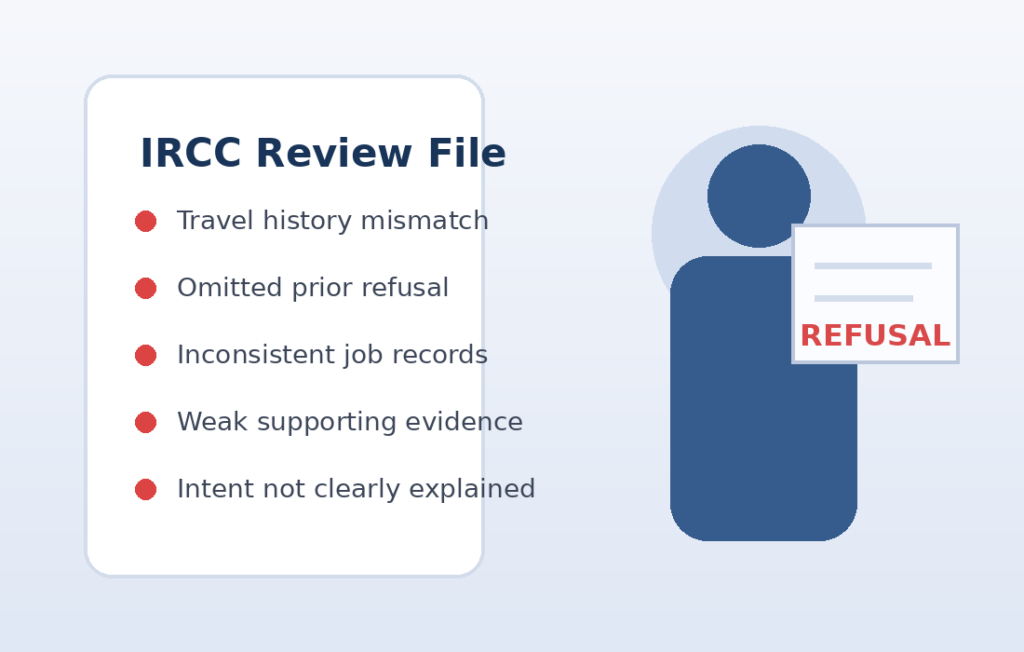
Refusal reasons in misrepresentation files often start with one inconsistency and then spread across the rest of the application. An officer may notice that a prior visa refusal was not disclosed, that employment dates changed between two forms, or that a bank record seems inconsistent with declared income. Once that concern appears, officers frequently review every part of the file with greater skepticism.
The most common refusal themes include omitted immigration history, conflicting personal details, weak proof of funds, unverifiable employment letters, unclear travel purpose, inconsistent family information, problematic translations, and documents that do not match government records. In some cases the applicant relied on an agent or consultant and signed forms without reading them carefully. That mistake can still lead to a refusal because applicants remain responsible for what goes into their file.
A refusal also becomes more likely when the response to a fairness letter only repeats the original story without addressing the evidence gap. Officers want direct answers. They want a clean explanation for the discrepancy, documentary support for the corrected version, and a logical reason why the issue should not be treated as material misrepresentation. Emotional language, blame, or generalized statements rarely solve the problem. Precision does.
When our office prepares a response, we analyze the concern line by line, gather records that actually speak to the issue, and build a legal narrative that restores coherence to the file. That approach gives the officer a structured basis to step back from a negative conclusion.
A strong immigration file starts with disciplined preparation. Review every form carefully before signing. Make sure dates, addresses, employment history, travel history, education, family details, and prior refusals match across the entire package. If an older application contains an error, correct it clearly rather than hoping it goes unnoticed.
Applicants should also provide evidence that matches the real issue in the case. If the concern relates to work history, submit detailed reference letters, pay records, tax records, contracts, and corporate material that align with the timeline. If the issue involves travel purpose, provide a coherent itinerary, invitations, business records, proof of funds, return plans, and documents that show the purpose makes sense. If the concern involves family composition or sponsorship history, include civil documents, explanation letters, and records that tie the family story together.
A complete response does more than dump paperwork into a file. It explains the facts, connects the evidence, answers the officer’s concern point by point, and presents the case in a format that is easy to review.
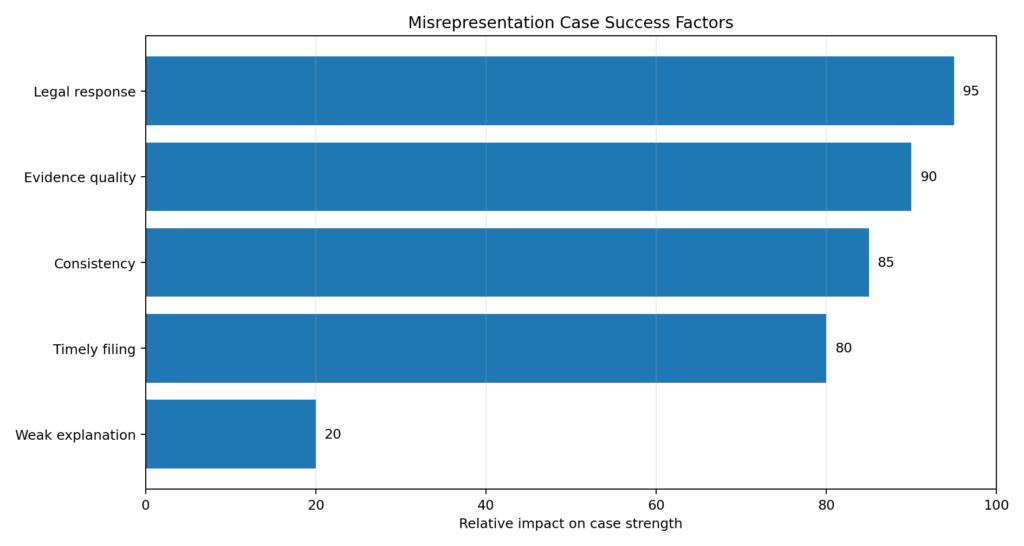
Our office handles misrepresentation responses, Procedural Fairness Letter submissions, inadmissibility strategy, and application rebuilding for temporary and permanent pathways. We begin with a detailed review of the allegation and the immigration history. From there, we identify the strongest legal and factual arguments, prepare a tailored evidence checklist, and build a submission that addresses the concern directly.
Clients often come to us after a refusal warning, a fairness letter, or an application that was prepared poorly the first time. We know how officers read these files. We know which contradictions matter most. Most importantly, we know how to turn scattered facts into a persuasive response.
If your application has been questioned, do not wait for the deadline to get closer. Early preparation creates options.
Misrepresentation issues move fast and carry serious consequences. A careful legal response can protect your credibility, preserve future options, and improve the strength of your file. Whether you received a Procedural Fairness Letter, worry that an older application contains a problem, or need help after a refusal, YS Canada Visa Services is ready to help.
Call our office today to book a consultation and get a clear strategy for your Canadian immigration misrepresentation matter.


Immigration appeals allow individuals to challenge a refusal or removal decision through the Immigration Appeal Division or Federal Court in Canada.

A refused visa to Canada occurs when an application is denied due to reasons such as insufficient documentation, weak ties to the home country, or failure to meet IRCC requirements.

Misrepresentation in Canadian immigration occurs when false or misleading information is provided, which can lead to refusal and a potential five-year ban from entering Canada.