When your future depends on the details, every decision matters.
With us, your in good hands.

Being removed from Canada can feel final. Many people hear the words departure order, exclusion order, or deportation order and assume they have lost every chance to come back. Canadian immigration law does not work that way. In many cases, a person can return lawfully, but they must first secure the right authorization and present the case properly.
An Authorization to Return to Canada, commonly called an ARC, gives certain foreign nationals a legal way to re-enter Canada after a removal order. A strong ARC package explains what happened, shows what changed, and proves why the applicant now deserves another opportunity. That process demands strategy, detail, and credibility from the first page to the last.
YS Canada Visa Services helps clients who need an Authorization to Return to Canada for business travel, family reasons, urgent humanitarian situations, study, work, or long-term immigration planning. Our goal is simple: build a persuasive application that answers officer concerns directly and puts you in the strongest position possible.
An Authorization to Return to Canada is an approval issued by Immigration, Refugees and Citizenship Canada when a person who was previously removed from Canada needs permission to come back. The requirement depends on the type of removal order and on whether the person complied with the order correctly. Some people do not need an ARC at all, while others cannot return without one.
ARC is not the same as a visitor visa, work permit, study permit, eTA, or permanent residence approval. It is also different from a Temporary Resident Permit. An ARC deals with your past removal from Canada. A Temporary Resident Permit, also known as a TRP, temporary entry permit, inadmissibility waiver, or temporary resident authorization, deals with inadmissibility. In some files, a person needs only an ARC. In other files, the applicant needs both an ARC and a Temporary Resident Permit because the removal issue and the inadmissibility issue exist at the same time.
Officers reviewing an ARC want clear answers to practical questions. Why were you removed? Did you respect the terms of the removal? Have the problems that caused the removal been resolved? Why do you need to return now? Will you follow Canadian immigration laws this time? A complete application must address every one of those questions with documents, logic, and a credible personal explanation.
• ARC addresses a prior removal from Canada.
• A Temporary Resident Permit addresses inadmissibility.
• Some cases require both applications together.
• A careful legal strategy can prevent expensive filing errors.
The type of removal order matters. A departure order may not require an ARC if you left Canada within the required time and properly confirmed your departure. If you did not comply with those steps, that departure order may become a deportation order, which changes the analysis significantly.
An exclusion order usually bars return for one year. If the exclusion order arose from misrepresentation, the bar is generally five years. Once the period ends, a person may be able to return without an ARC if they have the required proof of departure and no separate issue blocks their entry. A deportation order is more serious. A person who received a deportation order always needs an ARC before returning.
Many applicants get refused because they misunderstand the order on their file. Some people think time alone fixes the issue. Others assume a new visa application automatically solves the problem. Neither assumption is safe. Before filing anything, you need to confirm the exact removal order, the enforcement date, and whether you left Canada in compliance with the order.

You may need an ARC if you received a deportation order, failed to comply with a departure order, or want to return before the exclusion period on an exclusion order has ended. You may also need one if a previous immigration problem led to your removal and you now wish to apply again for a visitor visa, work permit, study permit, permanent residence, or entry at the border.
People often contact our office after a refusal at the visa stage, at the airport, or at a land border. Others discover the problem during a background review for a work permit or sponsorship application. Business owners, employees, truck drivers, conference speakers, family visitors, students, and returning former residents can all face ARC issues. The key is not your profession alone. The key is whether your removal history makes formal permission necessary.
| Application or fee | Current amount (CAD) | Why it matters |
| Authorization to Return to Canada (ARC) | $492.50 | Required in eligible return-after-removal cases. |
| Biometrics | $85.00 | Required for many temporary residence applications. |
| Temporary Resident Permit (TRP) | From $246.25 | May be needed if inadmissibility still exists. |
| Criminal Rehabilitation – criminality | $246.25 | Used to resolve criminal inadmissibility permanently in eligible files. |
| Criminal Rehabilitation – serious criminality | $1,231.00 | Applies to more serious criminal matters. |
Government fees matter because ARC cases often overlap with other applications. As of the current IRCC fee schedule, the government processing fee for an Authorization to Return to Canada is CAD 492.50. Biometrics, when required, cost CAD 85.00 per person. If your file also requires a Temporary Resident Permit, the current TRP fee starts at CAD 246.25. If criminal inadmissibility is part of the case, Criminal Rehabilitation fees currently start at CAD 246.25 for criminality and CAD 1,231.00 for serious criminality.
These amounts can change, so every applicant should verify fees before filing. The right strategy often requires more than one application. For example, a person with a past deportation order and a criminal conviction may need an ARC plus a Temporary Resident Permit, or an ARC plus Criminal Rehabilitation, depending on timing and urgency. Filing the wrong combination wastes money, delays travel, and can trigger avoidable refusals.
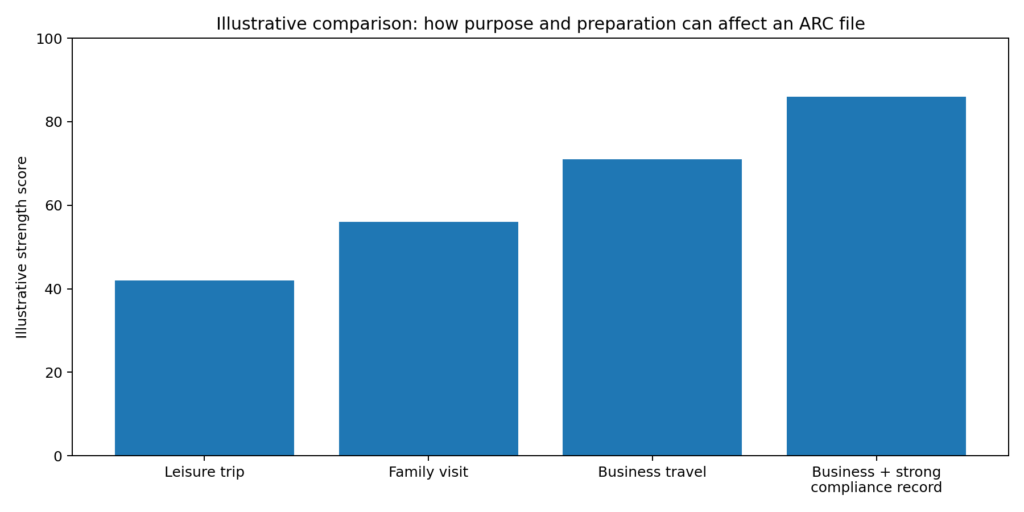
Purpose of travel can strongly influence the outcome. When a person seeks to enter Canada for business, the application often carries more weight because the purpose looks concrete, time-sensitive, and verifiable. A business trip can involve contracts, trade shows, client meetings, project launches, site visits, training, or negotiations. Those reasons usually come with invitation letters, schedules, corporate support, and evidence of economic value.
Leisure travel can still succeed, but officers often scrutinize it more closely. Tourism, casual visits, or open-ended plans may look less urgent if the file already contains a removal history. That does not mean leisure cases fail automatically. It means the application must work harder to show credibility, strong ties outside Canada, a realistic itinerary, and full respect for immigration rules.
When business travel exists, we make that purpose central. We connect the timing, documents, and benefit to Canada in a clear narrative. If leisure travel is the main purpose, we strengthen the file with structure, proof of funds, travel history, detailed plans, and a strong explanation for why the applicant will leave Canada as required.
ARC refusals usually happen because the application leaves the officer with unanswered questions. Missing proof of departure can create doubt about whether the removal order was ever enforced properly. Weak explanations about the original removal can make the applicant look evasive. Contradictions between old applications and new statements can damage credibility immediately. Sparse travel plans can make the reason for return look unimportant. Little or no evidence of changed circumstances can suggest the same problem could happen again.
Officers also refuse ARC files when applicants ignore the root cause of the removal. Someone removed for overstaying must show much more than a promise to comply next time. The officer needs evidence of stable employment, family obligations, lawful travel since removal, financial capacity, and a well-documented reason to enter Canada now. A person removed for unauthorized work or study must explain the past conduct honestly and show clear understanding of the rules. If the case involves previous misrepresentation, the application must address that history with exceptional care because trust becomes the central issue.
Another frequent problem involves filing the wrong application. Some people apply only for a visa when they need an ARC. Others apply only for an ARC when criminal inadmissibility also blocks entry, meaning a Temporary Resident Permit or Criminal Rehabilitation may be required as well. In complex cases, a weak strategy fails before the officer even reaches the merits. Strong ARC work starts with correct issue spotting, then moves to a full documentary package, a persuasive legal explanation, and a practical plan for travel.
A stronger ARC application starts with precision. First, identify the exact removal order and gather proof of enforcement or departure. Next, explain the events that led to the order in a direct and honest way. Then show what changed. If you now have stable employment, a clean travel history, family obligations, or a well-established business, those facts should appear in the evidence and in the submission letter.
Quality documents matter. We often include passport pages, travel records, proof of current status in the country of residence, employment letters, business records, invitation letters, tax documents, bank records, proof of family ties, prior immigration records, and a carefully drafted personal statement. In business cases, we also highlight the economic impact of the trip and why the visit cannot easily be postponed or replaced.
The legal narrative matters just as much as the documents. Officers need a coherent story that connects the past problem to the present solution. A persuasive submission does not dodge bad facts. It acknowledges them, explains them, and shows why the applicant now presents a low immigration risk. That kind of preparation can shift a file from weak and uncertain to credible and compelling.
Many ARC cases overlap with a Temporary Resident Permit, so it helps to understand the difference. A Temporary Resident Permit, often searched as a TRP Canada, temporary resident permit Canada, temporary entry permit, Canada inadmissibility permit, or permit to enter Canada with inadmissibility, allows a person to enter or stay in Canada temporarily when the need to enter outweighs the risk. A TRP does not erase a removal order. An ARC does not erase criminal inadmissibility. Each application solves a different problem.
This distinction matters for search engine visibility and for real-life case strategy. Someone denied entry because of a past deportation may need an ARC. Someone denied entry because of a DUI may need a Temporary Resident Permit or Criminal Rehabilitation. Someone with both issues may need a combined strategy. Many online articles blur these categories, which leads applicants toward expensive mistakes. A tailored legal review can prevent that from happening.
How long does ARC processing take?
Processing times vary by office, application type, and complexity. There is no universal timeline. The quality of the package and the underlying travel application often affect how smoothly the file moves.
Can I apply for ARC together with a visa or permit?
Yes. Many people submit an ARC at the same time as a visitor visa, work permit, or study permit application. The exact process depends on how they travel and what document they need.
Do I need an ARC forever?
No. Whether you need an ARC depends on the type of removal order, the time that has passed, and whether you complied with the order correctly. Deportation orders usually require an ARC whenever you want to return.
Can I return to Canada for business more easily than for vacation?
Business travel often provides stronger evidence because the purpose is specific, urgent, and supported by records. Leisure travel can still work, but the file must be especially well documented.

Immigration appeals allow individuals to challenge a refusal or removal decision through the Immigration Appeal Division or Federal Court in Canada.

A refused visa to Canada occurs when an application is denied due to reasons such as insufficient documentation, weak ties to the home country, or failure to meet IRCC requirements.

Misrepresentation in Canadian immigration occurs when false or misleading information is provided, which can lead to refusal and a potential five-year ban from entering Canada.