When your future depends on the details, every decision matters.
With us, your in good hands.

Being denied entry to Canada can feel humiliating, expensive, and urgent all at once. For some people it happens at an airport inspection. For others it happens at a land border crossing after hours of travel. In many cases, it happens before travel even begins, when a visitor visa, work permit, study permit, or electronic travel authorization is refused because an officer believes the person is inadmissible or does not meet the legal requirements to enter Canada.
The good news is that a refusal is not always the end of the road. The real issue is understanding why it happened, whether the problem is temporary or permanent, and what legal path gives you the best chance of coming to Canada successfully the next time. That is where focused legal strategy matters.
SY CANADA VISA SERVICES helps clients who have been denied entry to Canada, refused at the Canadian border, turned away at the airport, or told they are inadmissible because of a criminal record, a DUI, a past immigration issue, misrepresentation concerns, medical concerns, or weak documentation. Our goal is simple: identify the exact barrier, build the right legal solution, and move your matter forward with clarity and urgency.
The phrase denied entry to Canada covers several situations. It can mean a border officer refused to admit you at a port of entry. It can mean Immigration, Refugees and Citizenship Canada refused your visa or permit application. It can also mean you were refused an eTA, reported for inadmissibility, or told you require special authorization before you can return to Canada.
Under current federal guidance, if a person is found inadmissible, they can be denied a visa or eTA, refused entry when they arrive, or removed from Canada. That is why the legal analysis has to focus on admissibility first, not just the travel booking or the application form.

Learn about Temporary Resident Permit
Learn about Criminal Rehabilitation
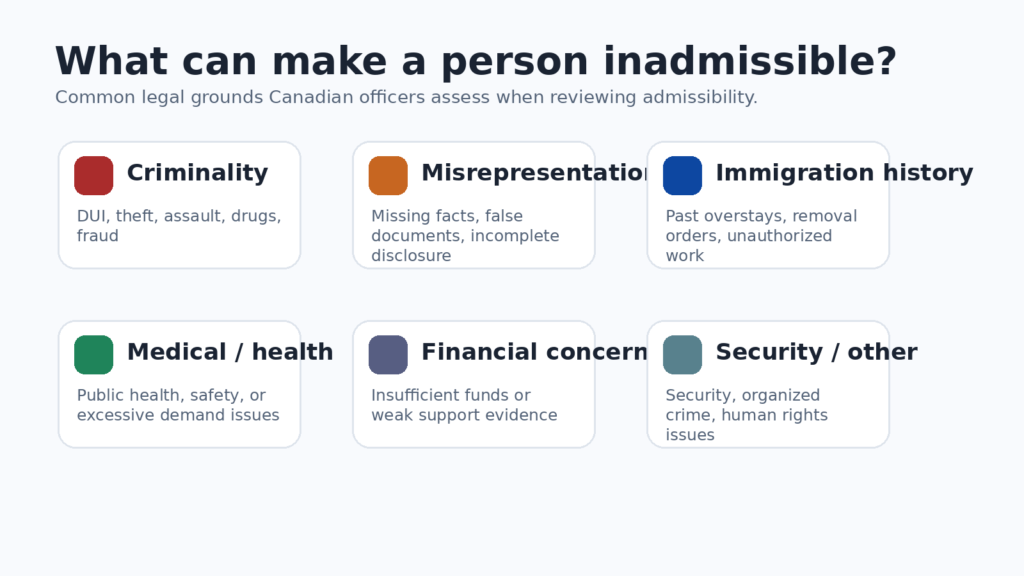
Canadian officers can assess admissibility at the application stage and again at the border. The legal grounds are broader than many travelers expect. The most common grounds affecting temporary entry are criminality, serious criminality, misrepresentation, prior immigration violations, financial concerns, and medical or public safety issues. In more serious cases, security issues, organized criminality, or human and international rights concerns can also lead to refusal.
Criminal inadmissibility is the issue that surprises the largest number of travelers. IRCC specifically lists offences such as theft, assault, dangerous driving, driving under the influence of drugs or alcohol, and drug possession or trafficking as examples of conduct that can make a person criminally inadmissible to Canada. In practice, even one old offence can create a major problem if it has not been assessed properly under Canadian law.
Misrepresentation is another major ground of refusal. This does not only mean fake documents. It can also include leaving out important details, failing to disclose a previous refusal, understating a criminal history, or providing inconsistent facts that could affect the officer’s decision. A misrepresentation finding can have long-lasting consequences, which is why every application must be prepared with full disclosure and careful legal framing.
Yes. A simple DUI can absolutely create inadmissibility issues for Canada. IRCC expressly includes driving under the influence of drugs or alcohol in its criminal inadmissibility guidance. Justice Canada’s impaired driving materials state that many impaired driving offences carry a maximum penalty of up to 10 years of imprisonment. Because Canadian immigration law evaluates foreign offences by comparing them to Canadian law, a single DUI can trigger serious admissibility concerns even if the offence seemed minor where it happened.
That is why travelers are often shocked when they are stopped at the airport or land border for an offence they believed was resolved years ago. Completing a fine, probation, education program, or local court requirements does not automatically make the immigration issue disappear for Canadian purposes. The person may still need a Temporary Resident Permit, a criminal rehabilitation application, a deemed rehabilitation analysis, or a legal opinion that explains why the offence does not make them inadmissible under Canadian equivalency rules.
The key point is this: do not assume an old DUI is harmless. It is one of the most common reasons U.S. and other foreign nationals are refused entry to Canada. A proper legal review before travel can prevent an embarrassing refusal and reduce the risk of making the problem worse through incomplete answers at the border.
Clients often ask whether they have better chances of entering Canada for business than for vacation. The careful answer is that business travel is not a free pass, but a well-documented business purpose can sometimes be easier to justify than discretionary leisure travel when an officer is deciding whether a person should receive temporary entry despite a problem.
Official IRCC guidance on Temporary Resident Permits emphasizes two practical questions: whether the reason to travel is justified in the circumstances and whether the person poses an acceptable level of risk despite the inadmissibility issue. In real-life decision-making, a short business trip tied to meetings, contractual obligations, a conference, technical support, or a commercial transaction may be easier to explain than a general holiday because the necessity, timing, and economic purpose are more concrete.
That does not mean leisure travel is impossible. It means the travel purpose must be presented honestly and strategically. The stronger the supporting documents, the clearer the itinerary, and the lower the demonstrated risk, the better the case becomes.

The correct solution depends on the ground of inadmissibility, the age of the issue, the urgency of the travel, and the traveler’s long-term plans. The most common solutions in denied-entry cases are a Temporary Resident Permit, criminal rehabilitation, deemed rehabilitation analysis, authorization to return to Canada in removal cases, and a carefully reworked application supported by legal submissions.
A Temporary Resident Permit, often called a TRP, is a temporary solution. Current IRCC guidance states that a TRP grants temporary resident status for a limited time and can be cancelled at any time. It does not permanently erase inadmissibility. It is typically used where the travel is justified now and the person’s risk is manageable.
Criminal rehabilitation is different because it is aimed at permanently resolving criminal inadmissibility. IRCC states that a person may apply for rehabilitation once at least five years have passed since completion of the sentence. In some cases, deemed rehabilitation may also be available, depending on how much time has passed, how serious the offence is, and whether the equivalent Canadian offence is punishable by a maximum term of less than 10 years.
Where the refusal is not criminal but documentary or credibility-based, the solution may be a much stronger reapplication. That can include correcting missing information, addressing officer concerns directly, adding financial evidence, clarifying the purpose of travel, and explaining prior refusals instead of pretending they did not happen.
Many people talk about being denied entry to Canada when the problem actually started with an application refusal. IRCC’s visitor visa guidance makes clear that an application may be refused if the officer is not satisfied the applicant will leave Canada by the end of the authorized stay, or if the applicant is inadmissible to Canada. In real practice, refusal letters often mention a broader mix of concerns: travel purpose, financial resources, employment situation, travel history, family ties in Canada and abroad, past compliance, and overall credibility.
Work permits and study permits can also be refused where the officer is not persuaded that the legal requirements are met, the supporting documents are weak, the plan in Canada is not credible, or admissibility concerns remain unresolved. Many refusals happen because applicants submit forms and documents without building a persuasive narrative. They assume the officer will piece the story together. Usually, the officer will not.
A stronger application does more than upload documents. It identifies likely concerns before the officer does. It organizes evidence logically. It explains the purpose of travel in plain language. It addresses past refusals, criminal history, financial capacity, home-country ties, family situation, and timing. Most importantly, it aligns every document with the story the application is trying to tell.
A stronger application starts with honesty. Never hide an offence, a past refusal, or a weak fact you think the officer might dislike. In immigration law, hidden problems usually become bigger problems. A controlled explanation supported by law and documentation is far better than an inconsistency that looks like misrepresentation.
Second, match your documents to your purpose. If the trip is for business, include the invitation, meeting schedule, company background, business relationship, contracts, conference details, or urgency evidence. If the trip is for family reasons, provide the family records, medical records where relevant, proof of relationship, and a clear travel timeline. If the issue is a criminal record, include court records, sentence completion evidence, police checks where useful, rehabilitation evidence, and a legal analysis of the foreign-to-Canadian offence equivalency.
Third, answer the officer’s likely questions before they arise. Why will you return home? Who is paying? What changed since the last refusal? Why is the travel necessary now? Why is the person not a risk? A strong application is not only complete. It is pre-emptive.
Denied-entry matters are rarely solved by generic templates. They require detailed legal reading, timing strategy, and careful positioning. One client may need a border-ready legal opinion and emergency TRP plan. Another may need a long-term criminal rehabilitation file. Another may have no inadmissibility at all and simply needs a proper reapplication that fixes a weak refusal history.
Our firm approaches denied-entry cases with the same mindset we bring to serious immigration files: diagnose first, strategize second, file with purpose, and prepare for the decision-maker’s real concerns. We help clients understand what happened, what the officer likely saw, what the law actually says, and what practical route gives them the best chance of success.
If you have been denied entry to Canada, refused entry at the border, refused a visitor visa, worried about a DUI, or told you may be inadmissible because of a criminal record or past immigration issue, the safest next step is a legal consultation before you try again.
A refused entry record can follow you. A weak reapplication can waste months. A casual attempt at the border can turn a manageable issue into a larger one. The smartest move is to get legal advice before the next filing or trip.
Book a consultation with us to review your denied-entry matter, your criminal or immigration history, your travel purpose, and the strongest available solution. Whether you need a Temporary Resident Permit, criminal rehabilitation, a legal opinion, or a strategically rebuilt application, we can help you move forward with a plan instead of guesswork.
Call us today to schedule your consultation and let us help you build the strongest path back to Canada.
| Option | When Used | What It Does | Important Caution |
| Temporary Resident Permit (TRP) | Urgent or justified travel where inadmissibility still exists | Allows temporary entry for a limited period | Does not permanently erase inadmissibility |
| Criminal Rehabilitation | At least 5 years after sentence completion in eligible cases | Can permanently resolve criminal inadmissibility | Requires careful legal analysis and records |
| Deemed Rehabilitation | Possible in limited cases depending on offence seriousness and time passed | May mean no formal application is required | Not available for every offence, including many serious cases |
| Reapplication with stronger evidence | Weak visa or permit refusal without permanent inadmissibility | Addresses officer concerns and improves credibility | Should not be filed casually without fixing the refusal reasons |
Can I try entering Canada again after I was denied?
Sometimes yes, but trying again without fixing the underlying problem often leads to another refusal. The right approach depends on why you were denied the first time.
Can one DUI really stop me from entering Canada?
Yes. A single DUI can create criminal inadmissibility issues for Canada and should be assessed before travel.
Is a TRP a permanent fix?
No. A Temporary Resident Permit is temporary. Criminal rehabilitation is the route that can permanently resolve criminal inadmissibility in eligible cases.
Yes, in many cases you can reapply, but you should only do so once the refusal reasons have been addressed with new evidence or stronger legal submissions.
Source note: Updated with current public guidance reviewed March 19, 2026. Key legal references consulted for this page include IRCC guidance on inadmissibility, criminal inadmissibility, Temporary Resident Permits, rehabilitation, deemed rehabilitation, and visitor visa refusals; CBSA guidance on inadmissibility and border entry; and Justice Canada materials on impaired driving penalties.
Denied Entry to Canada? Here’s Exactly How to Fix It
Being denied entry to Canada is not just stressful – it can disrupt your business, your family, and your future. Whether you were refused at the Canadian border, denied a visa, or found inadmissible due to a DUI or criminal record, the reality is this: you are not alone, and this is fixable. At YS Canada Visa Services, we help people who have been denied entry to Canada, turned away at the border, or refused temporary status applications. We do not just submit forms. We identify the legal issue, explain the available remedies, and build a strategy designed to improve your chances of approval.
What Does ‘Denied Entry to Canada’ Actually Mean?
If you have been denied entry to Canada, it means an officer has determined that you are inadmissible under Canadian immigration law or that your application did not satisfy the officer that you meet the requirements for entry. This can happen at an airport, at a land border crossing, or through an application such as a visitor visa, study permit, or work permit. People also search for this issue using terms such as refused entry to Canada, entry denied to Canada, turned away at the Canadian border, border refusal Canada, and inadmissible to Canada. These phrases all relate to the same core problem: immigration authorities have concerns about whether you can legally enter or remain in Canada.
Reasons for Refusal to Enter Canada
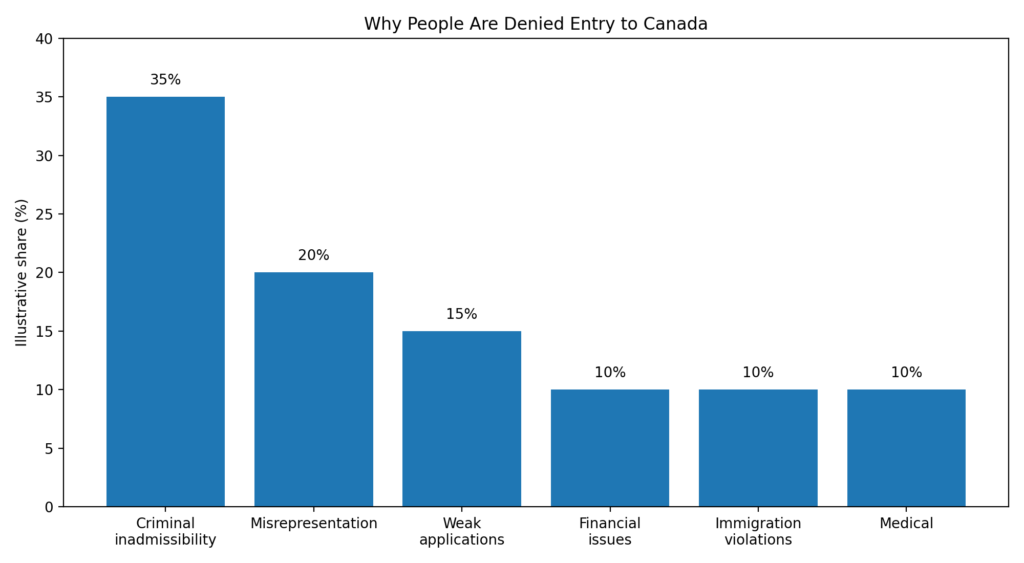
Being refused entry to Canada can happen for a variety of reasons, and in many cases, it is not just one issue but a combination of factors that raises concerns for the officer reviewing your case. One of the most common reasons is criminal inadmissibility, where even a seemingly minor offence – such as a single DUI – can result in immediate denial at the border because Canada treats impaired driving as a serious criminal offence. Beyond criminality, misrepresentation plays a major role; if an applicant fails to disclose past charges, previous refusals, or provides incomplete or misleading information, officers may determine that the individual is not credible, which can lead to refusal and even a multi-year ban. Another frequent issue is weak documentation or poorly prepared applications, where individuals fail to clearly demonstrate their purpose of travel, financial stability, or ties to their home country, leading officers to believe they may overstay or work without authorization. Previous immigration violations, such as overstaying a visa, working without proper authorization, or being previously removed from Canada, also significantly impact admissibility and can trigger additional requirements like an Authorization to Return to Canada. In some cases, financial insufficiency becomes a concern if applicants cannot prove they have enough funds to support themselves during their stay, while a lack of strong ties to their home country – such as stable employment, property, or family commitments – can lead officers to question whether the individual will leave Canada at the end of their visit. Additionally, medical inadmissibility may arise if a condition is deemed a risk to public health or could place excessive demand on Canada’s healthcare system. Ultimately, officers are given broad discretion, and even small inconsistencies or gaps in an application can result in refusal, which is why a strategic, well-documented, and transparent approach is essential when attempting to enter Canada or overcome a previous refusal.
The #1 Reason People Are Denied Entry to Canada
Criminal inadmissibility is often the issue that catches travelers by surprise. Even a single DUI can make you inadmissible to Canada. That is true even if the offence happened years ago, even if it was considered minor in the country where it occurred, and even if you already paid your fines or completed probation. Other offences including theft, assault, drug offences, or fraud-related convictions – can also create serious border problems.
Other Reasons You May Be Refused Entry to Canada
Other common refusal reasons include misrepresentation, weak applications, financial concerns, lack of strong ties to your home country, prior immigration violations, and medical inadmissibility. Many people assume that if they have a genuine reason to visit Canada, that reason alone will carry the application. In practice, officers want to see a complete and credible picture: why you are coming, how long you will stay, how you will support yourself, and why you will leave Canada at the end of the authorized period.

Immigration appeals allow individuals to challenge a refusal or removal decision through the Immigration Appeal Division or Federal Court in Canada.

A refused visa to Canada occurs when an application is denied due to reasons such as insufficient documentation, weak ties to the home country, or failure to meet IRCC requirements.

Misrepresentation in Canadian immigration occurs when false or misleading information is provided, which can lead to refusal and a potential five-year ban from entering Canada.