When your future depends on the details, every decision matters.
With us, your in good hands.

Building a future with your partner should feel exciting, not uncertain. Yet many couples discover that common-law sponsorship in Canada involves far more than completing forms and uploading a few photos. Immigration, Refugees and Citizenship Canada reviews these files closely because officers need to confirm that the relationship is genuine, ongoing, and not entered into mainly for immigration status.
At YS Canada Visa Services, we help couples present common-law partner sponsorship applications clearly, strategically, and persuasively. Our goal is to reduce avoidable risk, strengthen the evidence, and guide you toward approval with a well-organized case. If you need help with a common-law sponsorship application, partner sponsorship matter, inland common-law file, or outland family sponsorship case, a consultation can give you a clear roadmap from the beginning.
Many people also search using phrases such as common-law partner sponsorship, sponsor your common-law partner to Canada, partner PR Canada, family class common-law sponsorship, inland common-law sponsorship, and outland common-law sponsorship. This page uses those terms naturally because search engine visibility matters, but accuracy matters more. Strong ranking starts with content that answers real questions in detail.
Common-law sponsorship is part of Canada’s family sponsorship system. It allows a Canadian citizen or permanent resident to sponsor a common-law partner for permanent residence if the couple meets the legal requirements. Unlike marriage-based sponsorship, a common-law sponsorship case depends heavily on proof of cohabitation and proof of a marriage-like relationship.
IRCC’s current guidance says a common-law partner must be at least 18 years old, can be of any gender, must be in a genuine relationship with the sponsor, and must have lived with the sponsor for at least 12 consecutive months. Short and temporary absences for family obligations or work or business travel may be acceptable, but the relationship still needs to show continuous cohabitation overall.
That requirement sounds simple, but proving it often becomes the hardest part of the application. Officers want objective evidence such as joint leases, shared bills, government or bank records showing the same address, insurance documents, mail, travel records, photos over time, and communication history that matches the relationship timeline.

A sponsor generally must be at least 18 years old and must be a Canadian citizen, a permanent resident of Canada, or a person registered in Canada under the Indian Act. In most cases, the sponsor must live in Canada. A Canadian citizen living abroad may still sponsor if they show a real plan to return to Canada when the sponsored partner becomes a permanent resident.
Most spouse or partner sponsorship cases do not have a general minimum income requirement. However, the sponsor must not be receiving social assistance for reasons other than disability, and the sponsor must be able to support the applicant. Restrictions can also apply if the sponsor was sponsored as a spouse or partner within the last five years, or if the sponsor is still bound by an earlier undertaking for a previous spouse or partner.
The right filing strategy depends on the facts. Some couples apply from inside Canada through the Spouse or Common-Law Partner in Canada Class, while others apply through the Family Class. The best route can affect travel flexibility, work permit options, and risk management.
Inland common-law sponsorship often suits couples who live together in Canada and plan to remain together in Canada during processing. Outland sponsorship may fit couples where the applicant lives abroad, travels frequently, or wants appeal rights if the case is refused. Choosing the wrong route can create unnecessary stress, so strategy matters before the file is submitted.
IRCC currently allows certain sponsored spouses and common-law partners who live in Canada to apply for an open work permit while the permanent residence application is in process. In many cases, the sponsored partner can apply after receiving the acknowledgement of receipt and can then work for most employers in Canada if the permit is approved.
That option can make a major difference for couples who want financial stability during processing. It can also support stronger settlement planning because the sponsored partner can work legally while waiting for permanent residence.
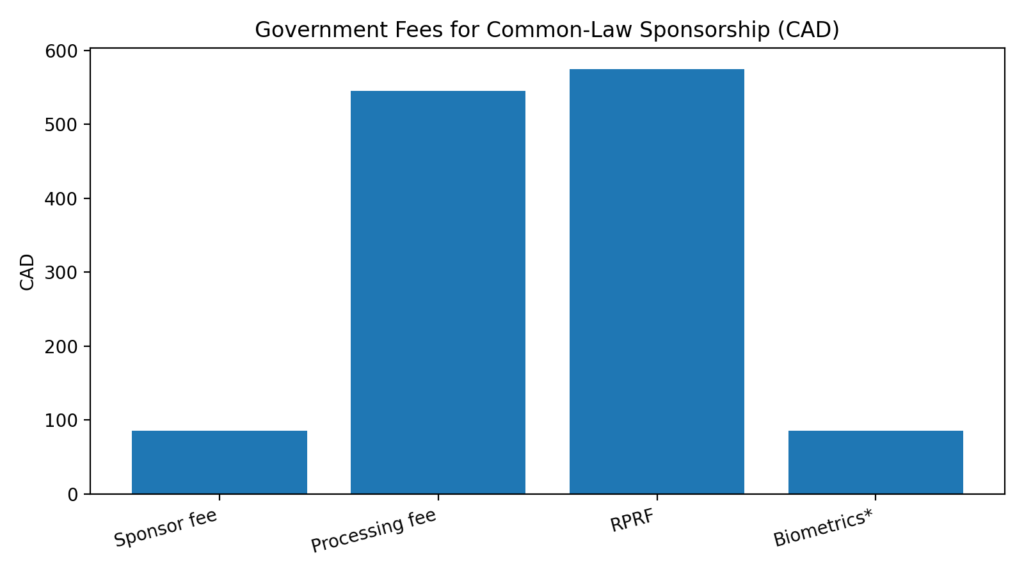
| Sponsorship fee | Processing fee | RPRF | Biometrics |
| $85 | $545 | $575 | $85 |
Current IRCC fees for sponsoring a spouse or partner are CAD 85 for the sponsorship fee, CAD 545 for the principal applicant processing fee, and CAD 575 for the right of permanent residence fee. That creates a common base total of CAD 1,205 when paid together. If dependent children are included, the current fee is CAD 175 per child. Biometrics may also apply depending on the applicant’s situation, and the current biometric fee for one person is CAD 85.
Government fees can change, so every case should be reviewed against the latest IRCC fee list before filing. Legal fees are separate and depend on complexity, missing evidence, prior refusals, admissibility issues, and how much strategic work the case requires.
Strong common-law sponsorship files usually show the relationship from several angles at once. A lease or property record can help prove shared residence. Utility bills, insurance records, and government mail can help confirm the same address. Photos can show the relationship over time. Chat records and travel documents can support the timeline. Letters from family and friends can provide context.
The strongest evidence does not look random. It fits together logically. Dates line up. Addresses match. The story in the forms matches the story in the documents. A well-prepared case does not rely on one perfect document. It uses several pieces of evidence that reinforce each other.
Common-law sponsorship refusals often happen because couples underestimate how closely officers examine cohabitation and genuineness. The relationship may be real, but the evidence may look thin, incomplete, inconsistent, or rushed.
Typical refusal reasons include weak proof of living together, inconsistent addresses across forms and documents, an unclear relationship timeline, little joint documentation, unexplained gaps in communication evidence, previous immigration concerns left unanswered, or contradictions between letters and forms. Officers may also scrutinize cases with prior marriages, long separations, significant age gaps, or a fast-moving relationship if the application does not explain those facts clearly.
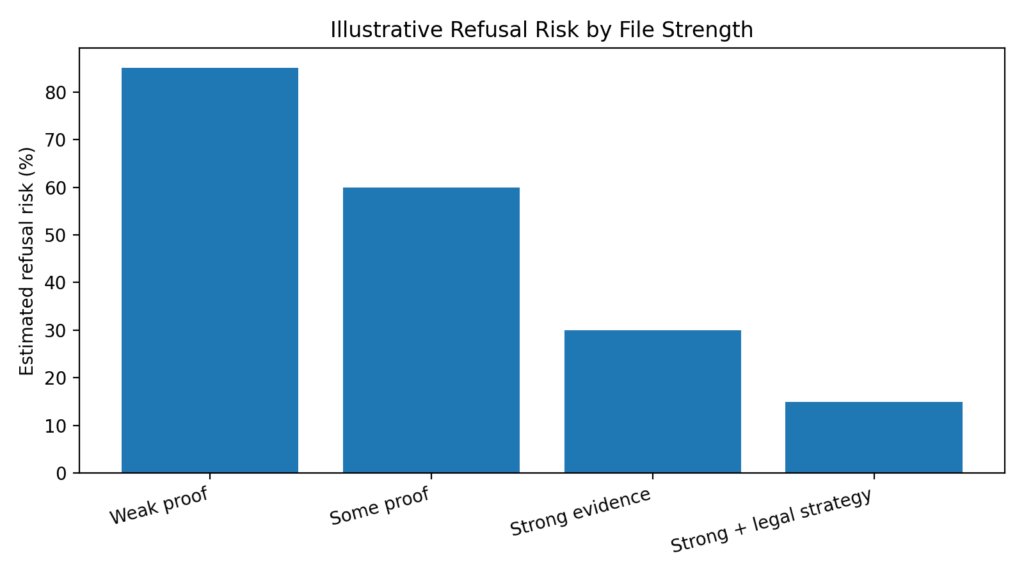
A common-law sponsorship refusal often stems from a credibility problem inside the file rather than a simple legal problem. Many couples submit a package that feels emotionally persuasive to them but appears incomplete from an officer’s perspective. For example, they may provide a few photos, some chat screenshots, and heartfelt letters, yet fail to prove the central issue in a common-law case: real, continuous cohabitation for at least 12 consecutive months. If the lease lists one partner only, the bank statements show different addresses, the IDs were updated late, and the relationship timeline contains unexplained gaps, the officer may conclude that the application does not prove a marriage-like household. Problems grow when the application also includes inconsistent dates about when the couple met, when one partner moved in, or how long the couple lived together. Officers often notice details that applicants assume are minor. Those details can create wider concerns about the reliability of the whole case. Some files also weaken because they never explain unusual facts such as previous marriages, family opposition, periods of long-distance separation, limited joint finances, or earlier visa refusals. None of those facts automatically leads to refusal, but silence on those points often damages the application. Strong files do the opposite. They explain difficult facts directly, support those explanations with objective records, and present a coherent story from start to finish.
A stronger common-law sponsorship application usually includes a clean relationship timeline, proof of at least 12 months of continuous cohabitation, joint lease or rent evidence, shared bills or insurance records, government or bank correspondence sent to the same address, clear explanations for any short separations, detailed statements from both partners, organized photos across multiple dates, communication records that match the timeline, and letters of support from people who know the relationship well.
The strongest applications do not hide difficult facts. They address them. If there was a prior refusal, a period of living apart, a complex divorce history, or limited joint documents because of culture, family, or financial circumstances, the application should explain that issue clearly and support it with evidence wherever possible.
This point matters most when the sponsored partner also wants to enter Canada temporarily while the common-law sponsorship application is pending. In that setting, business travel can sometimes present a stronger temporary purpose than leisure travel because it usually comes with objective documents such as employer letters, conference registrations, client meetings, or contractual obligations. Those records can make the trip look more structured and more credible.
Leisure travel can still succeed, but it often requires stronger proof that the person will respect the terms of entry and leave Canada when required. Business travel does not guarantee approval, and tourism does not guarantee refusal. Purpose, documentation, timing, and travel history all matter. Couples should assess that risk carefully before applying for a visitor visa during sponsorship processing.
Common-law sponsorship cases can look simple until an officer starts testing the evidence. One weak section can create months of delay or a refusal that could have been avoided with better preparation. Our team helps clients identify legal risks early, organize evidence properly, explain unusual facts clearly, and prepare submissions designed to answer the concerns an officer is likely to raise.
That support matters whether you are filing for the first time, responding to concerns, choosing between inland and outland strategies, or rebuilding after a refusal.
How long do we need to live together for common-law sponsorship? IRCC’s current rule requires at least 12 consecutive months of cohabitation in a genuine relationship, with only short and temporary absences.
Do we need joint bank accounts to qualify? No single document is mandatory in every case, but shared financial evidence can help. Officers usually want several forms of proof that show a real shared household and an ongoing partnership.
Can my partner work in Canada while the file is in process? In some inland cases, the sponsored spouse or common-law partner may qualify for an open work permit after the permanent residence application reaches the required stage.
Can we still apply if we have weak documents? Possibly, but the case usually needs more explanation, better organization, and a strategy that fills the evidence gaps with other credible records and detailed statements.


Immigration appeals allow individuals to challenge a refusal or removal decision through the Immigration Appeal Division or Federal Court in Canada.

A refused visa to Canada occurs when an application is denied due to reasons such as insufficient documentation, weak ties to the home country, or failure to meet IRCC requirements.
Misrepresentation in Canadian immigration occurs when false or misleading information is provided, which can lead to refusal and a potential five-year ban from entering Canada.