When your future depends on the details, every decision matters.
With us, your in good hands.

Permanent resident status opens the door to work, health care, family stability, and long-term security in Canada. Yet many permanent residents discover too late that a valid PR card and permanent resident status are not the same thing. A PR card is the travel document that proves status for commercial travel back to Canada, while status itself depends on meeting the residency obligation or convincing Immigration, Refugees and Citizenship Canada that humanitarian and compassionate factors justify an exception.
This landing page explains PR card renewal with humanitarian grounds in practical language. It also covers PR card renewal on humanitarian and compassionate grounds, PR renewal due to residency shortfall, permanent resident card renewal with H&C considerations, and residency obligation relief for permanent residents. Those phrases speak to the same issue from different search angles, which helps readers find the right help faster and helps this page rank for the terms people actually type into Google.
A thoughtful case can preserve status even when the numbers look bad on paper. Officers want a coherent timeline, credible proof, and a clear explanation of why the absence happened, why the hardship was real, and why Canada remains the centre of your life. Our team prepares that story with evidence, structure, and strategy so the file answers the officer’s real concerns before a refusal takes shape.
Most permanent residents must be in Canada for at least 730 days during the previous five years to comply with the residency obligation. Some time abroad can still count, such as qualifying time with a Canadian citizen spouse or while working for a qualifying Canadian business. When those rules do not solve the shortfall, a person may ask the officer to keep permanent resident status because humanitarian and compassionate considerations justify special relief.
In everyday language, people often call this process PR renewal with humanitarian grounds, PR card renewal with H&C, humanitarian PR card renewal, permanent resident renewal based on compassionate grounds, or a residency obligation exception. The exact wording changes from website to website, but the legal issue stays the same: you need to show why strict application of the residency rule would create an unfair result in your circumstances.
These cases are document-heavy and fact-sensitive. Strong files do not rely on emotion alone. They connect medical records, caregiving duties, country conditions, family needs, employment history, tax records, children’s interests, and future settlement plans into one persuasive package. When that package comes together well, the officer can see both the hardship and the seriousness of your connection to Canada.
This route often helps permanent residents who stayed abroad because of a serious illness, a parent in crisis, a child with special needs, unsafe country conditions, court restrictions, closed borders, caregiving duties, or financial barriers that made travel impossible or unreasonable. It also helps people who returned abroad for reasons that began as temporary but became prolonged due to events outside their control.
A person may also need this strategy when a PR card expired outside Canada, when a travel document case raises the same residency concern, or when a permanent resident remained abroad to care for family while still planning to re-establish in Canada. Every case needs its own structure. The same medical fact can be persuasive in one file and weak in another depending on the timeline, the records, and the overall credibility of the explanation.
If you believe your facts are sympathetic but messy, you are exactly the kind of person who should get legal advice early. Messy facts do not always lead to refusal. Poor presentation does.
The current government fee for a permanent resident card application is CAD 50. That fee applies each time you renew or replace a PR card. IRCC’s fee list and help centre continue to show CAD 50 as the PR card fee, and IRCC’s PR status guidance confirms that most permanent residents must meet the 730-day rule over a five-year period.
Legal fees are separate from government fees. A humanitarian case usually requires more work than a basic renewal because the file needs a detailed legal submission, stronger evidence collection, chronology drafting, and careful review for inconsistency. For that reason, many people benefit from a consultation before they submit anything to IRCC.
Submitting a cheap application that lacks proof often costs far more in the long run. Once an officer forms a negative view of the case, the person may face travel complications, status risk, and additional legal steps that could have been avoided with proper preparation from the start.
| Item | Amount | Notes |
| PR card application fee | $50 CAD | Paid to IRCC for each renewal or replacement. |
| Legal fees | Varies | Not a government fee. Humanitarian files often require a full legal submission and document review. |
Officers examine the reason for the absence, the length of time abroad, the quality of supporting documents, the applicant’s degree of establishment in Canada, the hardship that would follow loss of status, and the best interests of any affected child. They also look at whether the explanation remains consistent across the application, the travel history, prior records, and the supporting letters.
Good submissions show the officer not only what happened but why it mattered. They explain why the person could not reasonably return sooner, what they did to maintain ties to Canada, and how they plan to settle in Canada now. They also identify the documentary anchors for each claim so the officer does not have to guess what supports the timeline.
That last point matters more than most applicants realize. Officers review many files quickly. A clear file gets understood. A confusing file gets doubted.
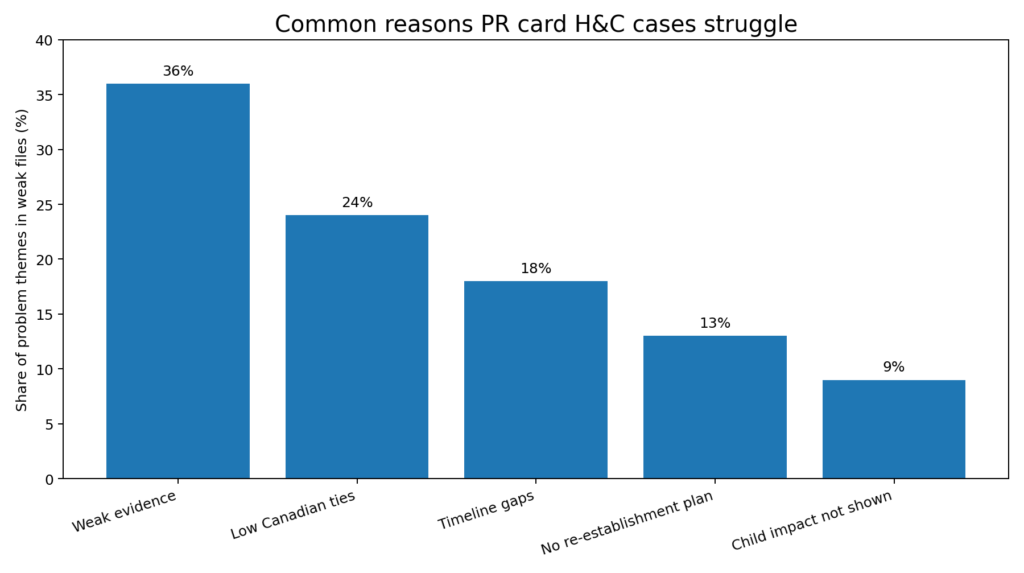
Refusal often starts with preventable weaknesses rather than with truly bad facts. Many applicants send a brief personal statement, a few travel records, and scattered attachments, then hope the officer will fill in the missing logic. That almost never works. Immigration Canada refuses PR card H&C cases when the evidence does not match the story, when the timeline contains gaps, when the hardship remains vague, when the ties to Canada look thin, or when the application does not show a serious plan to re-establish in Canada. Files also struggle when a person stayed abroad for leisure, convenience, or loosely explained personal preference yet tries to frame that choice later as unavoidable. Another recurring problem appears when applicants ignore the best interests of children, fail to explain why a parent or relative required their presence abroad, or omit the records that prove hospitalization, diagnosis, school disruption, custody issues, or unsafe local conditions. Officers also react badly to inconsistent dates, tax non-compliance without explanation, missing passports, unexplained work history abroad, and letters from family members that repeat conclusions but offer no concrete detail. In short, refusal grows where proof is weak, structure is poor, and the case does not guide the officer toward a fair exercise of discretion. A stronger file fixes those problems by presenting a clean chronology, corroborating each major fact, highlighting hardship with specificity, and showing that Canada remains the true destination rather than a backup plan.
A stronger file starts with a master timeline. We map every departure, re-entry, family event, employment period, medical development, and attempted return. That chronology becomes the backbone of the legal submission. Next, we gather documentary proof for each turning point: hospital records, physician letters, death certificates, travel disruption evidence, country condition reports, school records, proof of caregiving, financial documents, tax returns, lease or mortgage records, job offers, business documents, and statements from people with firsthand knowledge.
After the record is complete, we draft a legal explanation that stays disciplined. It does not exaggerate. It does not wander. It addresses the residency shortfall directly, acknowledges difficult facts, and shows why compassion should prevail anyway. We also explain the human impact of losing status, including family separation, interruption of children’s schooling, economic consequences, and the person’s genuine settlement plan in Canada.
Finally, we review the application for consistency against passports, prior visas, previous declarations, and travel records. Small contradictions can destroy trust. Careful review preserves it.
People usually call a lawyer after one of three moments: they realize they do not meet the 730-day test, they receive a refusal or procedural concern, or they need to travel and suddenly understand that an expired PR card creates a real problem. At that stage, speed matters but quality matters more. A rushed weak file can close doors that a careful submission might have kept open.
Our job is to reduce guesswork. We identify the strongest humanitarian themes, test the weak spots in the timeline, assemble evidence that carries weight, and present the case in language an officer can follow. We also tell clients when a fact hurts the case so we can address it honestly instead of pretending it does not exist. That kind of preparation often makes the difference between a sympathetic story and a legally persuasive application.
Most important of all, a consultation gives you a strategy. Once you know the real strengths and the real risks, you can act with purpose instead of panic.
Can I renew my PR card if I do not meet the residency obligation? Yes, but the file becomes a humanitarian and compassionate case rather than a routine renewal, and the result depends on the strength of the evidence and the officer’s assessment.
Does a valid PR card mean I meet the residency obligation? No. A PR card is evidence used for travel. Status remains subject to the residency rules even if the card is still valid.
What is the government fee? The current PR card fee is CAD 50 per person.
Can medical issues or family emergencies help? They can help a great deal when the records are strong and the timeline explains why you could not return sooner.
What if my absence involved both family reasons and business reasons? Mixed cases are common. In fact, combining medical, caregiving, child-related, and business evidence can create a fuller picture of why the absence lasted as long as it did.
If you are worried about losing your status, do not rely on guesswork or generic internet advice. A PR renewal with humanitarian grounds case deserves a plan that reflects your facts, your travel history, your family situation, and your goals in Canada. Call us to book a consultation. We can review the shortfall, identify the strongest humanitarian factors, explain the government process, and build a strategy to make your application stronger before it reaches an officer’s desk.


Immigration appeals allow individuals to challenge a refusal or removal decision through the Immigration Appeal Division or Federal Court in Canada.

A refused visa to Canada occurs when an application is denied due to reasons such as insufficient documentation, weak ties to the home country, or failure to meet IRCC requirements.
Misrepresentation in Canadian immigration occurs when false or misleading information is provided, which can lead to refusal and a potential five-year ban from entering Canada.