When your future depends on the details, every decision matters.
With us, your in good hands.

Canada gives some eligible foreign nationals the chance to work with far more flexibility than an employer-specific permit allows. An open work permit lets the holder work for almost any employer in Canada, which is why so many people search for terms such as open work permit Canada, open work visa Canada, Canada open work authorization, flexible work permit Canada, or work permit without an employer restriction. That flexibility creates real opportunity, but it does not create automatic approval. Immigration officers still review category fit, supporting documents, temporary intent, status history, and credibility with care.
At YS Canada Visa Services, we help clients understand whether they qualify, what documents they need, how officers assess risk, and how to present a stronger application. Some people need help with a spousal open work permit. Others want guidance on a bridging open work permit, a post-graduation work permit strategy, or an open permit linked to a special public policy. Whatever your route, the goal stays the same: build a clear, persuasive file and reduce avoidable refusal risks. Call our office to book a consultation if you want strategic help with your open work permit matter.
An open work permit is a Canadian work permit that is not tied to one named employer. Instead of restricting the worker to a single employer listed on the permit, it allows work for most employers in Canada, subject to standard exclusions. Current IRCC guidance says open work permit holders still cannot work for employers that appear on the non-compliant employer list or for businesses that regularly offer striptease, erotic dance, escort services, or erotic massages.
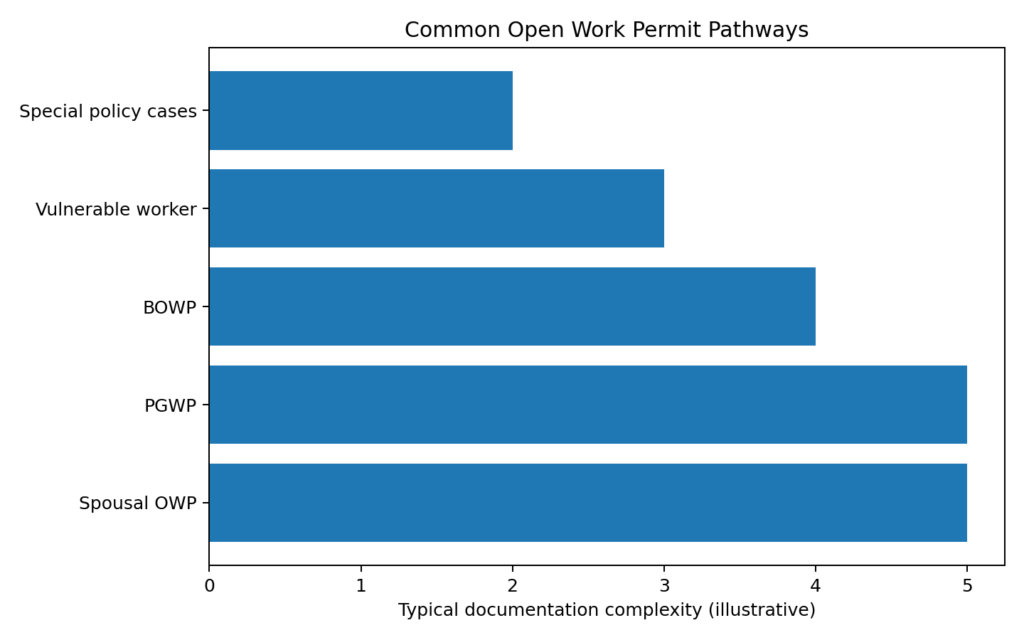
That sounds simple, but open work permits exist only in specific situations. You do not choose an open permit merely because you prefer more flexibility. You must fall into a category that allows it. Common examples include certain spouses or common-law partners, eligible graduates under the post-graduation work permit program, some permanent residence applicants who qualify for a bridging open work permit, vulnerable workers in abusive situations, and a limited number of special public policy cases. Category selection matters because the wrong pathway can lead to delay, return, or refusal.
Spousal open work permits remain one of the most searched topics in Canadian immigration. As of current IRCC guidance, spouses or common-law partners of some international students may qualify, and family-member eligibility for workers changed on January 21, 2025, with narrower rules than before. That means many people who relied on older internet articles are now working with outdated assumptions.
Post-graduation work permits also drive huge interest because they can help graduates gain Canadian work experience after completing eligible studies. Bridging open work permits matter for people waiting on a permanent residence decision who need to keep working lawfully during processing. Special cases can include vulnerable worker open permits, inland spouse or partner sponsorship work permits, and a few targeted public policies. Every one of these categories has its own rules, timing issues, and documentary expectations, so strong legal guidance can make a major difference.
Fees are often straightforward, but applicants still miss them or pay the wrong combination. Current federal fee guidance lists the standard work permit processing fee at 155 Canadian dollars. Open work permit applicants usually also pay the open work permit holder fee of 100 dollars. If biometrics apply, the biometrics fee starts at 85 dollars per person. In many standard cases, that means a typical government-fee total of 340 dollars before legal fees, medicals, translations, or courier costs.
Applicants should also remember that some extensions, restorations, or special program streams can trigger different fee combinations. A file that looks inexpensive at the start can become more expensive if it is filed late, returned for incompleteness, or pushed into restoration territory. Strong preparation protects both timing and cost.
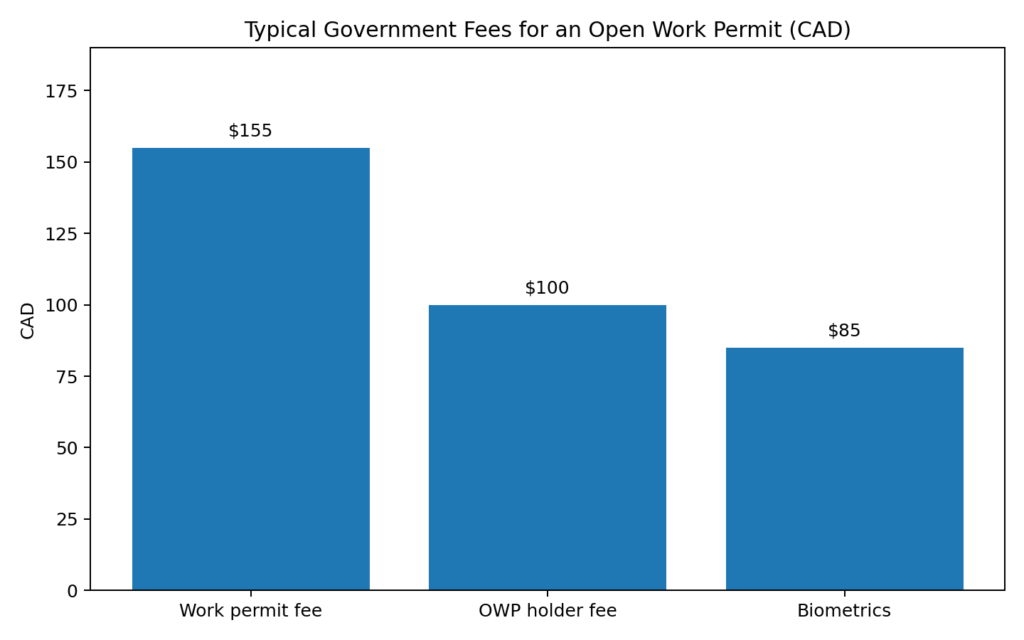
| Fee item | Amount | Comment |
| Work permit processing fee | CAD $155 | Standard work permit fee |
| Open work permit holder fee | CAD $100 | Usually paid with the work permit fee |
| Biometrics fee | CAD $85 | Applies when biometrics are required |
Purpose shapes how officers view temporary residence. A business-focused or work-focused application usually comes with structure: a program basis, a timeline, financial planning, status documents, a relationship to a principal applicant, or a clear next step. Leisure travel can be completely legitimate, but it often does less work in proving why the person is entering Canada and how the person plans to comply with temporary conditions.
That is why business or employment-related purpose often looks stronger than leisure purpose when credibility is being assessed. An open work permit application does not succeed just because someone wants flexibility. It succeeds when the applicant shows a recognized legal route, supporting evidence, and a believable plan. If the officer sees a clear category, a real reason for entry, and documents that support lawful temporary stay, the application becomes easier to approve.
A stronger application starts with the right category. From there, it needs consistent forms, correct fee payment, complete supporting evidence, and a clean explanation of how the applicant qualifies. For a spousal open work permit, relationship proof matters. For a bridging open work permit, permanent residence filing proof and current status matter. For a post-graduation work permit, school completion documents and timing matter. For a vulnerable worker permit, the safety issue and employment facts matter.
Strong applications also address officer questions before they become refusal reasons. We often improve files by reorganizing evidence, rewriting support letters, clarifying status history, tightening relationship documentation, and making sure the timeline actually makes sense. That extra strategy matters because officers do not have time to guess what the applicant meant. The file has to tell the story clearly on its own.
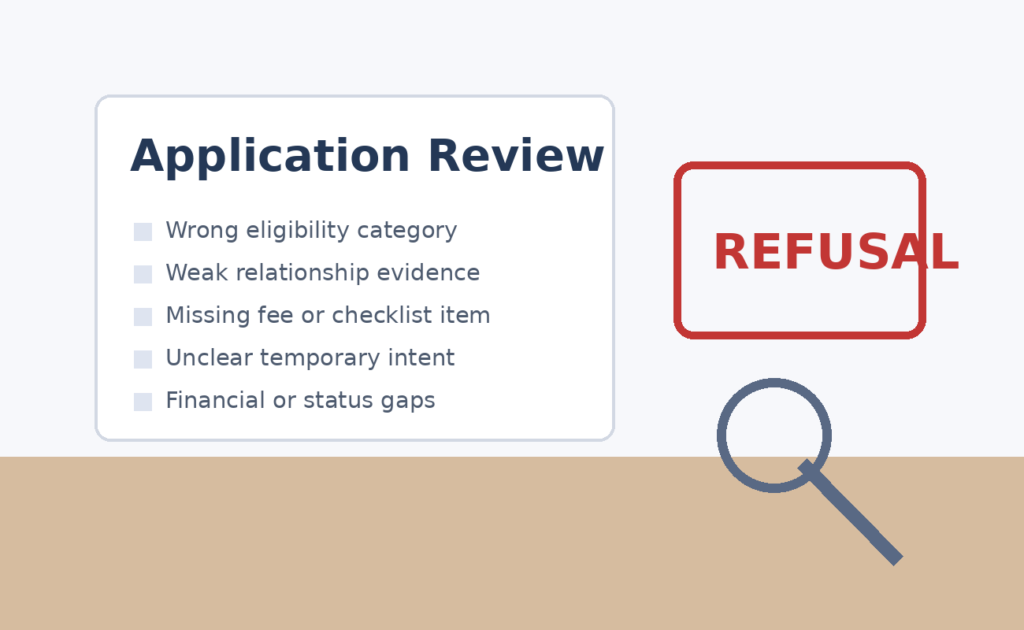
Open work permit refusals happen for reasons that are often avoidable. Some files fail because the applicant chose the wrong category. Others break down because the documents do not actually prove eligibility under the chosen category. Officers may also refuse an application when relationship evidence is weak, fee payment is incomplete, status history is unclear, or temporary intent does not look credible. In spouse-based cases, relationship proof can look too thin or too inconsistent. In bridging cases, the permanent residence connection may be missing or not strong enough. In post-graduation cases, timing mistakes can create problems that no explanation letter can fully fix. Credibility issues also matter. An officer may question whether the applicant understands the temporary nature of the permit, whether the person has complied with previous status conditions, or whether the documents have been assembled in a rushed and unreliable way. Financial gaps, identity inconsistencies, missing translations, unclear cohabitation proof, weak school completion records, or confusion around maintained status can all undermine the file. The strongest way to reduce refusal risk is to prepare a complete, organized, category-specific application that answers obvious concerns before the officer raises them. That is exactly where legal strategy helps most.
Immigration files do not succeed on forms alone. They succeed when the facts, documents, and legal category line up properly. Our office helps clients identify the right open work permit pathway, understand recent rule changes, strengthen relationship evidence, respond to refusals, and present a cleaner, more persuasive case.
Clients call us because they want more than generic internet advice. They want strategy. They want to know what the officer will care about, what can go wrong, and how to position the file for a stronger result. If you need help with an open work permit, a spousal work permit, a post-graduation work permit issue, a bridging open work permit, or a refusal matter, book a consultation with us.


Immigration appeals allow individuals to challenge a refusal or removal decision through the Immigration Appeal Division or Federal Court in Canada.

A refused visa to Canada occurs when an application is denied due to reasons such as insufficient documentation, weak ties to the home country, or failure to meet IRCC requirements.

Misrepresentation in Canadian immigration occurs when false or misleading information is provided, which can lead to refusal and a potential five-year ban from entering Canada.