When your future depends on the details, every decision matters.
With us, your in good hands.

A USMCA work permit can offer one of the most efficient ways for eligible U.S. and Mexican citizens to work in Canada. In Canadian immigration language, officers and official guidance usually use the term CUSMA rather than USMCA, but many applicants still search for USMCA work permit, NAFTA successor work permit, Canada work permit under USMCA, or LMIA-exempt North America work permit. Those search terms point to the same practical question: can you use the trade agreement to enter Canada for professional work, business expansion, investment, or cross-border commercial activity without going through the Labour Market Impact Assessment process?
We helps clients prepare strong trade-based work permit files that line up the legal category, the business purpose, the supporting documents, and the long-term immigration strategy. A well-built application does more than complete forms. It gives the officer a clear reason to approve the case. If you need help with a USMCA work permit, a CUSMA work permit, a treaty-based Canadian work permit, or a cross-border employer-specific work permit, call our office and book a consultation today.
A USMCA work permit is the term many searchers use for the Canadian work authorization available under the Canada–United States–Mexico Agreement. In Canada, government materials typically use CUSMA. That terminology difference matters for legal accuracy, but both phrases are relevant for search engine optimization because potential clients often look for USMCA work permit Canada, CUSMA professional work permit, Canada work permit for U.S. citizens, or Canada work permit for Mexican citizens.
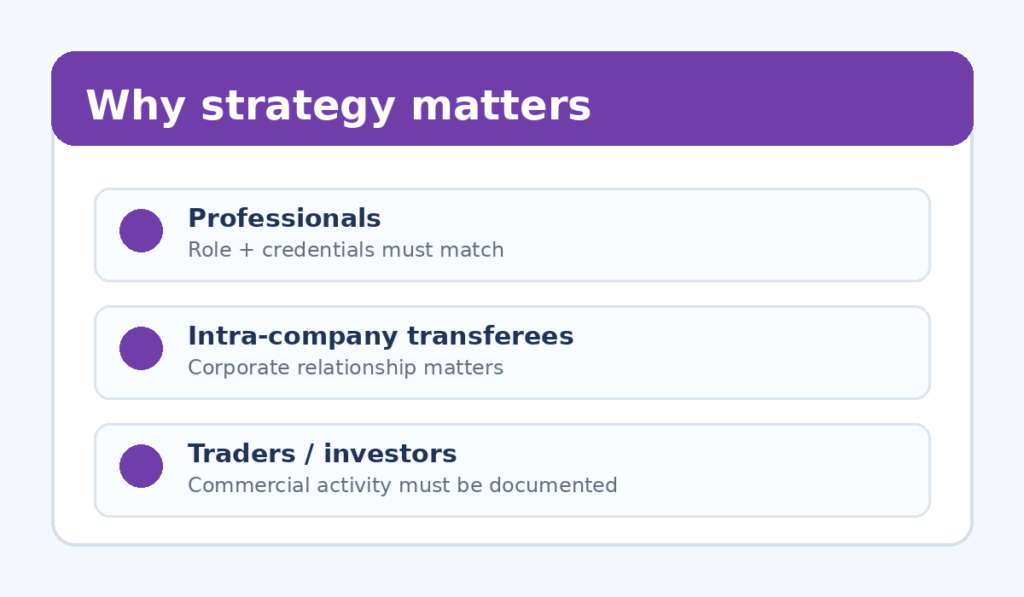
This route matters because many eligible applicants can work in Canada without an LMIA. When the facts fit the agreement, the process can move more smoothly and with less employer burden than some other work permit streams. Professionals, intra-company transferees, traders, investors, and some business visitors may all fall within the broader agreement framework, although each category comes with distinct rules and evidence requirements.
Eligibility depends on the exact category and the quality of the supporting evidence. Professionals must usually show that their role fits a recognized treaty occupation and that their education or credentials support the position. Intra-company transferees must prove a qualifying corporate relationship and a legitimate executive, managerial, or specialized knowledge transfer. Traders and investors need evidence of qualifying trade or investment activity. Business visitors must show that they are entering for permitted business activities rather than taking part directly in the Canadian labour market in a way that requires separate work authorization.
Category fit is where many applications become strong or weak. Officers do not approve cases because a title sounds impressive. They approve cases because the duties, documents, credentials, and business purpose line up clearly. A persuasive application answers the officer’s most important question before that question becomes a refusal reason.
Businesses like the USMCA or CUSMA route because it can reduce friction. The agreement can make it easier to move talent into Canada for commercial objectives, client projects, internal transfers, investment planning, and specialized professional services. Applicants like it because it can create a faster and more structured path to legal work authorization in Canada.
This pathway also works well when clients think beyond the first approval. Some people need quick access to the Canadian market. Others want to build a broader immigration strategy that may later include family planning, extensions, or permanent residence options. Strong legal advice at the start can protect those next steps.
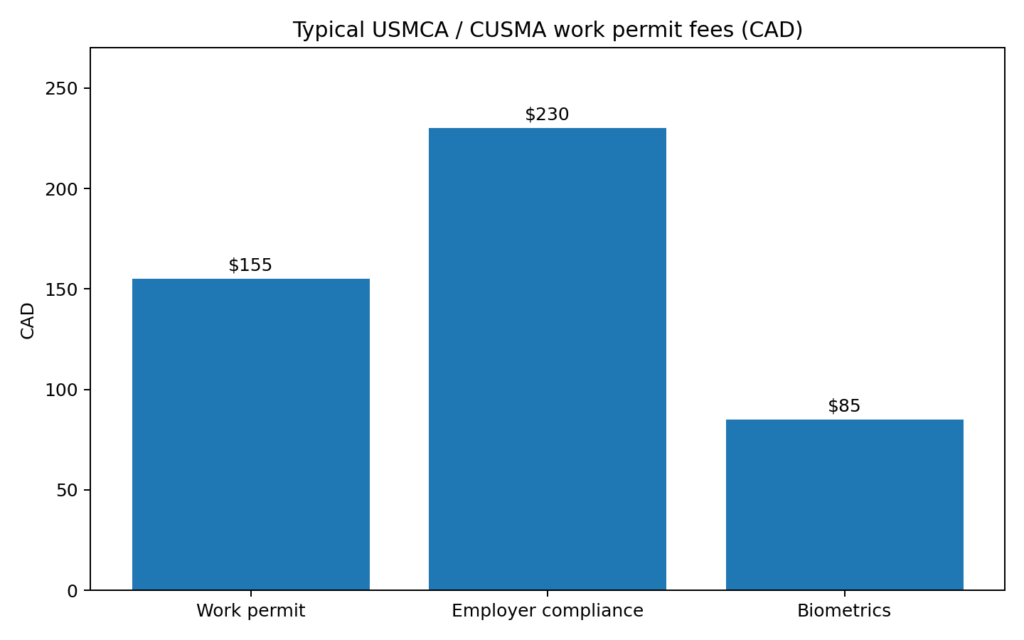
Government fees affect strategy, budgeting, and timing. As of the latest official guidance, the standard work permit processing fee is 155 Canadian dollars. In most employer-specific International Mobility Program cases, the employer must also submit an offer of employment through the Employer Portal and pay the 230-dollar employer compliance fee unless a fee exemption applies. Biometrics start at 85 Canadian dollars per person when required.
Those numbers cover the core government charges, but applicants should also plan for document gathering, credential preparation, translations, legal representation, and travel logistics. We review the full cost picture before filing so clients understand what the case will involve from beginning to end.
Purpose matters in immigration. Business travel often appears stronger because it usually comes with a defined reason for entry, such as a job offer, client service need, training plan, commercial project, corporate transfer, or investment objective. Leisure travel can be completely legitimate, but it rarely answers as many officer questions as a business-based file does.
That matters even more in a treaty-based work permit case. When the application shows a clear commercial purpose, a real business need, and a specific legal category under the agreement, the file often becomes more credible and easier to approve. Officers still assess temporary intent, credibility, and compliance, so the overall presentation must remain consistent and organized.
Strong applications define the category clearly, support the role with real evidence, and keep all documents consistent. The employer support letter should explain what the worker will do, why the role fits the treaty category, how long the assignment will last, and why the Canadian business needs this person in Canada. Educational credentials, licenses, résumés, contracts, and corporate records should all reinforce the same story.
We often strengthen cases by tightening employer letters, clarifying job duties, reorganizing evidence, and drafting legal submissions that explain why the facts match the law. That strategic layer matters. A case can fail even when the applicant looks eligible on paper if the file leaves too much room for doubt.
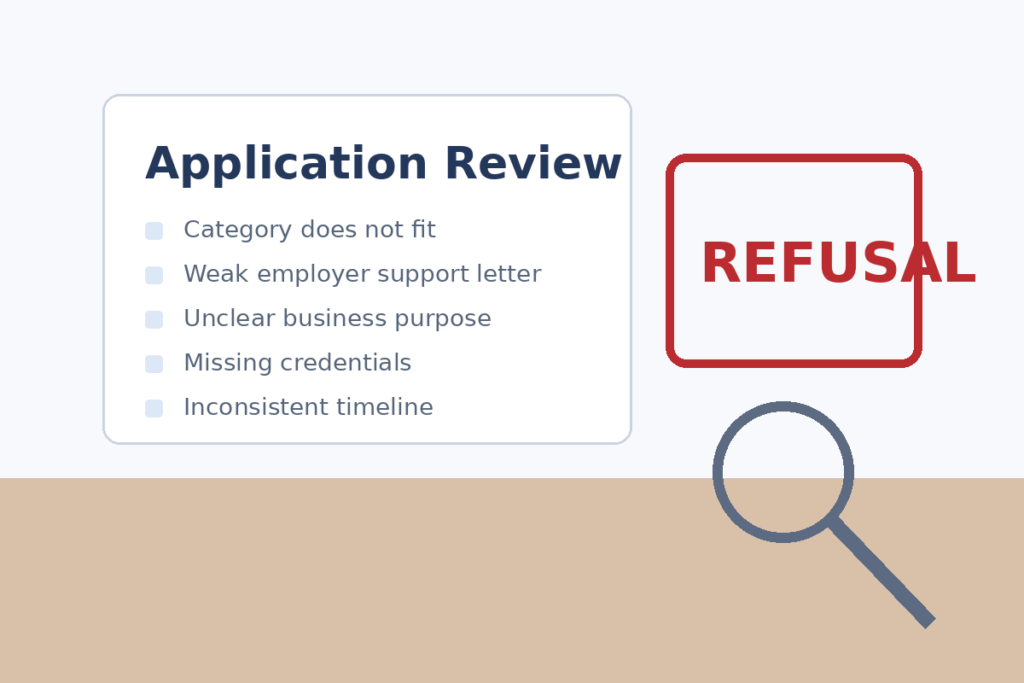
USMCA work permit refusals often happen because the file does not prove category fit with enough clarity. Some cases fail because the proposed job does not truly match the treaty category. Others fail because the applicant’s education or work history does not support the role strongly enough. Officers may also refuse an application when the employer letter is too generic, when the duties drift away from the claimed profession, when the business purpose remains vague, or when the documents create confusion about whether the applicant is a professional, trader, investor, intra-company transferee, or business visitor.
Weak category analysis causes real problems. A title such as consultant, manager, or specialist does not prove eligibility by itself. Officers want specifics. They want to know what the person will do in Canada, why the company needs that person here, how the credentials support the role, and why the legal category applies under the agreement. Refusal risk also rises when the file shows inconsistent dates, prior refusals, unclear temporary intent, or weak proof of business purpose. The strongest way to reduce those risks is to build a detailed, organized, and legally persuasive application from the start. Every letter should explain something useful. Every document should support the same narrative. That is the standard our office applies when preparing cross-border work permit cases.
Cross-border business immigration requires more than form filling. It requires strategy. Our office helps applicants and employers identify risks early, improve support letters, clarify category issues, and align facts with the current legal framework. Whether you are applying as a professional, investor, trader, intra-company transferee, or business visitor under the agreement, the quality of the presentation can shape the outcome.
Clients work with us because we focus on building approval-ready applications. We prepare files that are organized, persuasive, and tailored to the specific category. If you want experienced legal help with a USMCA work permit, CUSMA work permit, or LMIA-exempt cross-border work permit matter, call us today and book a consultation.
| Fee item | Amount | Comment |
| Work permit processing fee | $155 | Standard filing fee |
| Employer compliance fee | $230 | Usually paid by the employer in employer-specific IMP cases |
| Biometrics fee | $85 | Applies if biometrics are required |


Immigration appeals allow individuals to challenge a refusal or removal decision through the Immigration Appeal Division or Federal Court in Canada.

A refused visa to Canada occurs when an application is denied due to reasons such as insufficient documentation, weak ties to the home country, or failure to meet IRCC requirements.
Misrepresentation in Canadian immigration occurs when false or misleading information is provided, which can lead to refusal and a potential five-year ban from entering Canada.