When your future depends on the details, every decision matters.
With us, your in good hands.

If you are an entrepreneur, investor, founder, or self-employed professional looking for a serious business immigration pathway into Canada, the C11 Work Permit may be one of the most strategic options available. This pathway is commonly used by foreign nationals who want to start a new business, buy an existing business, or expand an overseas company into Canada without going through the Labour Market Impact Assessment process.
At YS Canada Visa Services, we help clients build strong, evidence-driven C11 applications from the ground up. We do not treat a C11 file as a simple form submission. We treat it as a business case, an immigration case, and a long-term status strategy at the same time. That difference matters. A C11 application that is weak, generic, or underdeveloped can be refused. A C11 application that is structured properly can create a real pathway to temporary status, business growth, and, in the right case, permanent residence.
| LMIA-exempt route The C11 pathway sits within the International Mobility Program and is built around significant benefit rather than labour market recruitment. | Built for entrepreneurs This route can work for founders, buyers of active businesses, expansion-stage owners, and other applicants who will actively run a Canadian business. | Strategy matters Business plan quality, evidence, financial logic, and the legal submission all shape whether the officer sees the case as credible. |
The C11 Work Permit is an LMIA-exempt employer-specific work permit issued under the International Mobility Program. In practice, it is often used by entrepreneurs and self-employed people who can show that their work in Canada will create a significant benefit for the country. You may also hear it described as a C11 entrepreneur work permit, a Canada entrepreneur work permit, a significant benefit work permit, or an owner-operator work permit alternative.
The legal theory behind the application is not simply that you want to work in Canada. The argument is that your business activity in Canada will produce a meaningful economic, social, or cultural benefit. That means the strength of the application depends on what you will do, how you will do it, how credible your plan is, and why your presence in Canada matters.
This pathway is attractive because it can allow a foreign entrepreneur to enter Canada to run their own business without first obtaining an LMIA. For many applicants, that makes the C11 Work Permit one of the most flexible business immigration options available.
There is no single checklist that guarantees approval, because C11 applications are highly discretionary. That said, strong applicants usually share the same core features. They own or control the proposed Canadian business, they will play an active management role, they have a credible background connected to the business, they have enough funds to launch and operate it, and they can explain why the business will benefit Canada.
Ownership is important, but so is control. A person who only appears on paper without real decision-making power will usually have a weak case. Officers want to see that you are the person who will direct the company and that your presence in Canada is necessary for the business to operate and grow.
Significant benefit is the heart of the C11 analysis. Officers are looking for a practical, evidence-based explanation of why your business activity deserves LMIA-exempt entry. In many successful files, the benefit is primarily economic. That can include job creation, regional investment, export activity, supply-chain development, service expansion, or support for a local labour need.
In some cases, the benefit may also be social or cultural. For example, a business may serve a community need, introduce specialized expertise, fill a service gap, or support a particular region or industry. The important point is this: a C11 application is not approved because the applicant likes Canada or wants a new market. It is approved when the evidence shows that Canada gains something meaningful from the applicant’s work.
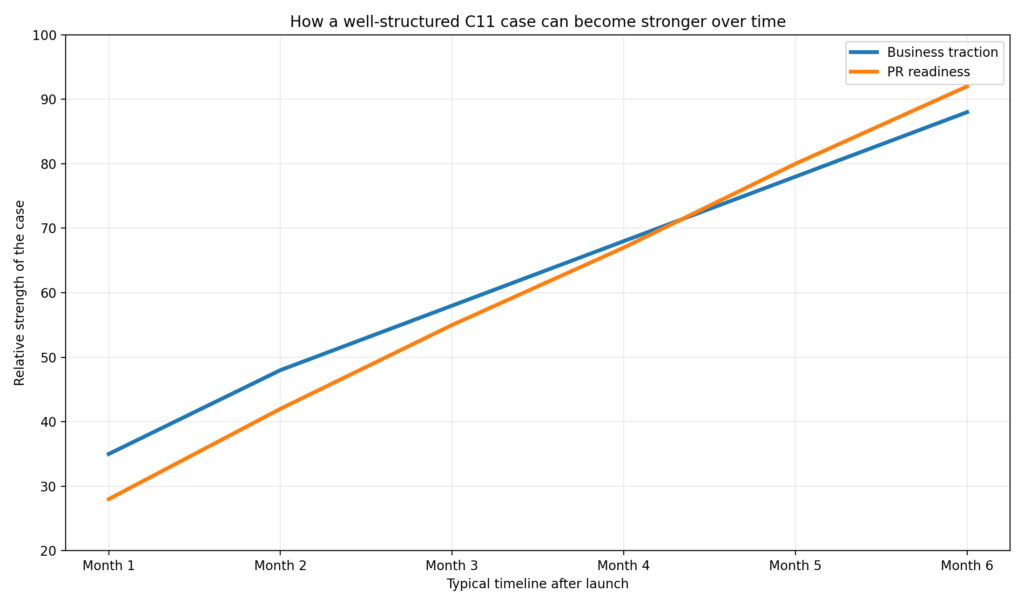
A stronger filing framework can improve both immediate work permit strategy and longer-term permanent residence planning.
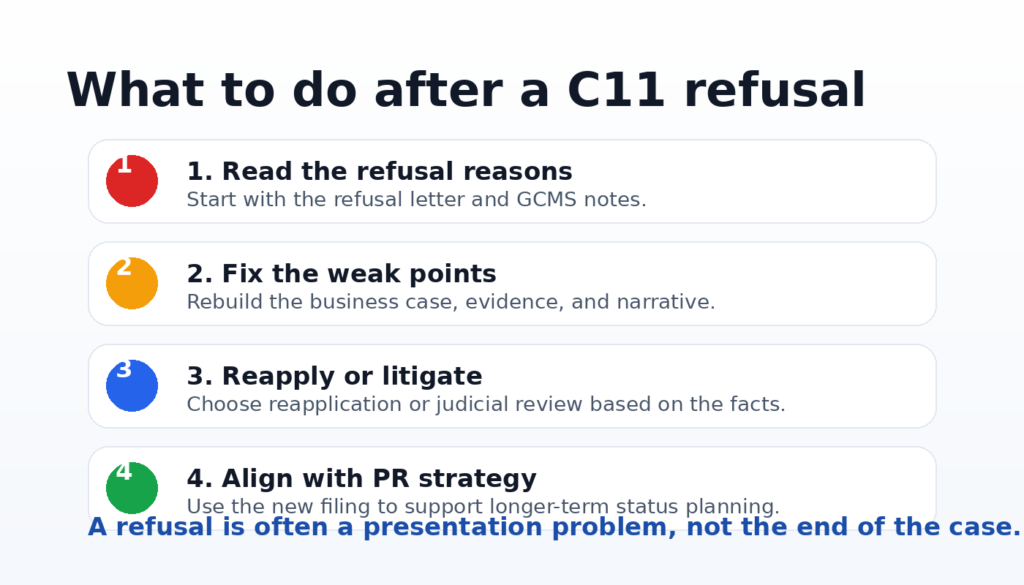
If a C11 work permit is refused, the next move should be evidence-based and strategic.
Many entrepreneurs compare the C11 Work Permit to an LMIA work permit, an owner-operator strategy, or a Start-Up Visa pathway. The C11 is different because it is not built on labour market recruitment. It is built on significant benefit. It is also different from the Start-Up Visa because it does not require a designated organization to support the business, and it is different from a standard employer-sponsored work permit because the applicant is typically connected to ownership and management.
For the right person, the C11 can be faster, more flexible, and more realistic than other business immigration routes. It is especially valuable for applicants who want to control their own business strategy in Canada rather than depending on a third-party employer or a designated incubator, angel investor, or venture capital fund.
A strong C11 application usually begins long before the forms are submitted. The business model must make sense. The market data must support the opportunity. The ownership documents must be clear. The source of funds must be credible. The applicant’s role must be explained carefully. And the supporting evidence must work together as one complete story.
Many refusals happen because applicants underestimate the importance of structure. A C11 file should read like a persuasive business-immigration package, not a generic collection of forms.
Processing time is one of the most searched topics for C11 work permit applicants, and it is also one of the most misunderstood. There is no single fixed C11 processing time. IRCC updates work permit processing times regularly, and the estimate depends on where the applicant applies from, whether biometrics are required, how complete the file is, and whether the case is straightforward or complex.
For that reason, the smartest way to discuss C11 work permit processing time on a landing page is to separate principle from myth. The principle is this: complete, well-organized files usually move more cleanly than disorganized ones. The myth is that there is one universal number for every country and every business case.
As of March 18, 2026, IRCC states that work permit processing times are dynamic and should be checked in the official processing-times tool. The department also explains that temporary residence processing estimates change based on inventory, completeness, verification, and other operational factors. For certain eligible high-skilled employer-specific LMIA-exempt applications filed from outside Canada, the Global Skills Strategy may offer faster processing with a two-week target, but that depends on eligibility and does not apply to every C11 case.
In short, there is no honest lawyer who should promise a universal C11 processing time. The real answer depends on the filing location, the strength of the package, and whether the application is complete from day one.
Government fees matter because many applicants budget only for the work permit form itself and forget the other mandatory or likely costs around a C11 file.
As of March 18, 2026, the core government amounts most applicants should know are the work permit processing fee of 155 CAD, the open work permit holder fee of 100 CAD where an open work permit is sought, the biometrics fee of 85 CAD per person or 170 CAD per family where applicable, and the employer compliance fee of 230 CAD in most employer-specific International Mobility Program cases.
Beyond government charges, applicants should plan for corporate setup or acquisition costs, accounting and tax setup, business-plan preparation, legal fees, translations, courier costs, and working capital for launch. There is no official minimum investment amount written into the C11 category, but a file with undercapitalization is often a weak file. The investment must make sense for the business model you are presenting.
| Fee type | Current amount | Why it matters |
| Work permit processing fee | 155 CAD | Principal work permit fee for most C11 applicants. |
| Open work permit holder fee | 100 CAD | Generally relevant when a qualifying spouse seeks an open work permit. |
| Biometrics | 85 CAD per person / 170 CAD family max | Applies where biometrics are required. |
| Employer compliance fee | 230 CAD | Paid in most employer-specific IMP filings through the business side of the case. |
Note: there is no fixed statutory minimum investment for a C11 work permit. The real test is whether the capital committed is credible and sufficient for the exact business model you are proposing.
This is where approval is often won or lost. A stronger C11 case does not happen by accident. It is built by anticipating the officer’s questions before the officer asks them.
The strongest C11 applications feel coherent from beginning to end. The business plan, corporate documents, legal submission, and personal background all point in the same direction. When the file is internally consistent, it is much easier for an officer to say yes.
Refusals usually do not happen because the applicant used the wrong buzzword. They happen because the officer was not persuaded by the evidence. In most refused files, the weakness is one or more of the following:
A refusal can be emotionally exhausting, but it is also useful. It tells you where the case broke down. That allows counsel to rebuild the case with much more precision.
A C11 refusal is not automatically the end of the road. In many cases, it is the start of a stronger second strategy. The first step is to read the refusal properly. The second step is to avoid panic filing. Reapplying immediately with the same weak package is one of the biggest mistakes people make.
In a reapplication, the goal is not simply to argue harder. The goal is to present a better case. That can mean a stronger business plan, clearer ownership structure, additional contracts, a better financial explanation, new proof of market demand, stronger ties between the applicant’s background and the venture, and a much more strategic legal submission.
Some refusals may also justify a judicial review in Federal Court, especially where the reasoning is unreasonable, important evidence was overlooked, or the officer misread the case. That is a legal analysis that should be done quickly because litigation deadlines are short.
Many applicants want to know whether a spouse and children can accompany them. The answer depends on the family member’s own eligibility and the current rules at the time of filing. As of the rule changes that took effect on January 21, 2025, family open work permit eligibility became more restricted. In general, spouses of certain foreign workers may still qualify, but the rules now focus on the principal worker’s occupation level, whether the worker is on a permanent residence pathway, and in some cases whether the principal worker has at least 16 months remaining on the work permit when the spouse applies.
That is why family strategy should not be treated as an afterthought in a C11 case. If your spouse may want to apply for an open work permit, the structure of the principal applicant’s file may affect the family’s options. Children may study in Canada if eligible, but dependent children are no longer broadly eligible for family open work permits under the post-January 2025 rules.
One of the biggest advantages of a well-planned C11 file is that it can fit into a larger status strategy. The work permit itself is temporary, but the business activity, Canadian management experience, hiring record, and economic footprint developed under the permit may later support other immigration options depending on the facts.
There is no single guaranteed PR route from a C11, but strong entrepreneurs often look at provincial nominee options, Express Entry planning where relevant, or other business and economic pathways that fit their profile. The key is to plan early. A temporary work permit becomes far more valuable when it is part of a larger legal strategy instead of an isolated short-term filing.
A C11 Work Permit is not just about immigration forms. It sits at the intersection of business logic, regulatory structure, evidence, and advocacy. Our office helps clients present a complete case, not just a basic application.
If you are serious about pursuing a C11 work permit, or if your case has already been refused and you need a stronger next step, the quality of the strategy matters.
Call us to book a consultation with YS Canada Visa Services. We can review your business concept, assess whether the C11 pathway fits your profile, identify the weak points before filing, and help you build a stronger strategy from the start.
The right filing is not just a matter of paperwork. It is a matter of positioning your case so that an immigration officer can understand why your presence in Canada makes sense.
How long does a C11 Work Permit take?
There is no universal processing time. IRCC updates work permit estimates regularly and the answer depends on where you apply, whether biometrics are required, and whether the application is complete. Certain eligible high-skilled employer-specific LMIA-exempt cases filed from outside Canada may benefit from faster Global Skills Strategy processing.
How much are the government fees?
Most principal applicants should budget for the 155 CAD work permit fee, biometrics if required, and in many employer-specific IMP cases a 230 CAD employer compliance fee paid through the business side of the filing. A qualifying spouse applying for an open work permit generally pays the additional 100 CAD open work permit holder fee.
Is there a minimum investment amount?
There is no fixed statutory minimum written into the C11 category. The real question is whether the proposed capital is credible and sufficient for the business you are presenting.
What makes a C11 case strong?
A strong case combines a viable business model, a detailed and realistic business plan, credible source of funds, real evidence of market demand, a clear ownership and management structure, and a legal submission that explains the significant benefit to Canada.
Can I reapply after a refusal?
Yes, but it should be strategic. Filing the same package again rarely helps. The refusal reasons should guide how the case is rebuilt.
Call us to book a consultation with YS Canada Visa Services. We can assess whether the C11 route fits your business, explain what the officer will focus on, and help you prepare a stronger application or reapplication.


Immigration appeals allow individuals to challenge a refusal or removal decision through the Immigration Appeal Division or Federal Court in Canada.

A refused visa to Canada occurs when an application is denied due to reasons such as insufficient documentation, weak ties to the home country, or failure to meet IRCC requirements.

Misrepresentation in Canadian immigration occurs when false or misleading information is provided, which can lead to refusal and a potential five-year ban from entering Canada.